Brain & nerves
How nerve cells send and balance signals; epilepsy and Parkinson disease.
For teachers: download this drawing.
Key terms in this drawing
- GABA
- Gamma-aminobutyric acid. The main inhibitory messenger in the central nervous system.
- GABA-A receptor
- Gamma-aminobutyric acid type A receptor. A receptor channel on nerve cells that GABA switches on; benzodiazepines also bind it.
How it works
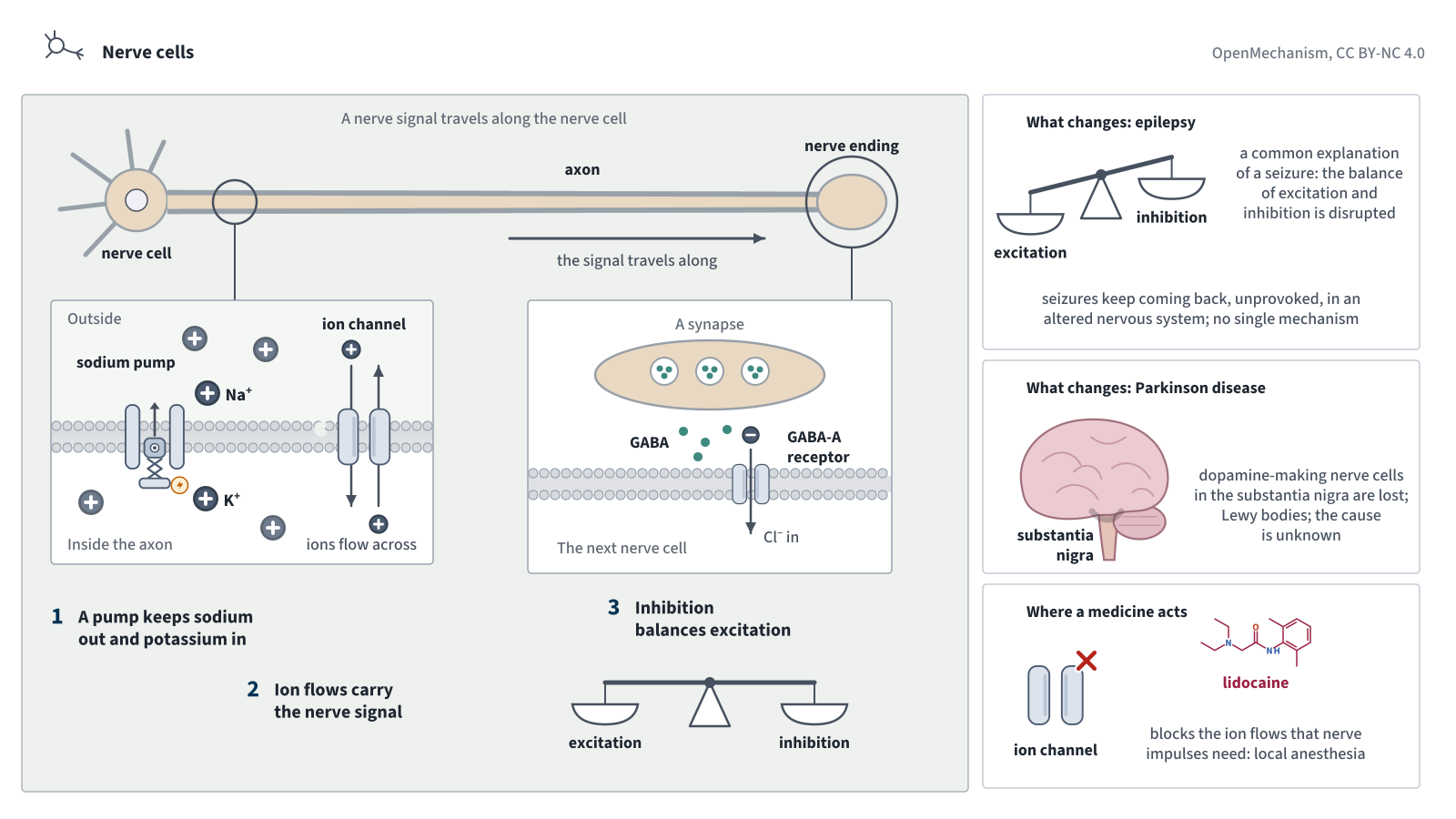
A pump keeps sodium out and potassium in. Throughout the body, the sodium pump keeps the inside of cells as it should be by moving sodium out of them and potassium in.1
What the source says
“This enzyme, the “sodium pump,” is responsible for maintaining the intracellular milieu throughout the body by moving sodium ions out of and potassium ions into cells.”
Source 1Ion flows carry the nerve signal. A nerve signal (an impulse) needs ions to flow across the nerve cell's membrane, both to start and to travel along it.2
What the source says
“Lidocaine stabilizes the neuronal membrane by inhibiting the ionic fluxes required for the initiation and conduction of impulses”
Source 2Inhibition balances excitation. , the main inhibitory messenger in the cerebral cortex, keeps up an inhibitory tone that balances nerve cells' excitation. It is released into the synapse and acts on , which control chloride entry into the cell, and on .3
What the source says
“gamma-Aminobutyric acid (GABA), the principal inhibitory neurotransmitter in the cerebral cortex, maintains the inhibitory tone that counterbalances neuronal excitation.”
Source 3“GABA is formed within GABAergic axon terminals and released into the synapse, where it acts at one of two types of receptor: GABAA, which controls chloride entry into the cell, and GABAB”
Source 3
What changes in disease
Epilepsy. Epilepsy is the state of recurrent unprovoked seizures. A seizure in a person without epilepsy is commonly explained as a disruption of the normal balance of excitation and inhibition; in epilepsy, seizures arise in an altered nervous system, and in temporal lobe epilepsy, for example, genes, development and changes in nerve connections build a lasting state of overexcitability. Epilepsy is complex, with no single mechanism.4
What the source says
“the state of recurrent unprovoked seizures that defines epilepsy itself.”
Source 4“A common way to explain seizures in a normal individual is that a disruption has occurred in the normal balance of excitation and inhibition.”
Source 4“seizures are typically superimposed on an altered nervous system.”
Source 4“Using temporal lobe epilepsy as an example, it is clear that genes, developmental mechanisms, and neuronal plasticity play major roles in creating a state of underlying hyperexcitability.”
Source 4“Epilepsy is a complex disease with diverse clinical characteristics that preclude a singular mechanism.”
Source 4Parkinson disease. Parkinson disease has long been characterized by movement problems (parkinsonism) with Lewy bodies and the loss of dopamine-making nerve cells in the substantia nigra. Its cause remains unknown.5
Where medicines act
- c
Lidocaine
Blocks the ion flows that nerve impulses need: local anesthesia.
From each medicine's label.2
See also
Zoom in: dopamine and movement and fluid and pressure in the eye.
Animations: levodopa in the brain.
Conditions
- Acute pain and period pain
- ADHD
- Alcohol use disorder
- Alzheimer disease
- Anxiety disorders
- Benzodiazepine overdose
- Binge eating disorder
- Bipolar disorder
- Bulimia nervosa
- Cyanide poisoning
- Depression
- Epilepsy
- Excessive sweating (hyperhidrosis)
- Glaucoma
- Heavy metal poisoning
- Hereditary transthyretin amyloidosis
- Herpes infections
- Huntington disease
- Insomnia
- Ischemic stroke
- Migraine
- Multiple sclerosis
- Myasthenia gravis
- Nerve pain after shingles
- Neuroblastoma
- Neuromyelitis optica (NMOSD)
- Nicotine dependence
- Obsessive-compulsive disorder (OCD)
- Opioid overdose
- Opioid use disorder
- Organophosphate poisoning
- Overactive bladder
- Parkinson disease
- Schizophrenia
- Severe and persistent pain
- Sleeping sickness
- Spasticity and dystonia
- Spinal muscular atrophy
- Tapeworm larva infections
- Tardive dyskinesia
- Vertigo
More medicines for this area
- Acetaminophen
- Alprazolam
- Amitriptyline
- Amphetamine
- Aripiprazole
- Atomoxetine
- Brivaracetam
- Buprenorphine
- Bupropion
- Buspirone
- Carbamazepine
- Carbidopa and levodopa
- Citalopram
- Clonazepam
- Clozapine
- Desvenlafaxine
- Deutetrabenazine
- Diazepam
- Disulfiram
- Divalproex sodium
- Donepezil
- Duloxetine
- Entacapone
- Escitalopram
- Ethosuximide
- Fentanyl
- Fluoxetine
- Gabapentin
- Haloperidol
- Hydrocodone
- Hydroxyzine
- Inotersen
- Ketamine
- Lamotrigine
- Lecanemab
- Levetiracetam
- Lisdexamfetamine
- Lithium
- Lorazepam
- Magnesium sulfate
- Meclizine
- Memantine
- Methylphenidate
- Midazolam
- Mirtazapine
- Morphine
- Neostigmine
- Nortriptyline
- Olanzapine
- Oxcarbazepine
- Oxycodone
- Paroxetine
- Patisiran
- Phenytoin
- Pimavanserin
- Pregabalin
- Propofol
- Quetiapine
- Rasagiline
- Rimegepant
- Risperidone
- Ropinirole
- Sertraline
- Sumatriptan
- Tafamidis
- Tetrabenazine
- Topiramate
- Tramadol
- Tranylcypromine
- Trazodone
- Valbenazine
- Varenicline
- Venlafaxine
- Ziprasidone
- Zolpidem
Sources
- 1Lanoxin (digoxin): FDA label12.1 Mechanism of Action. Saved copy
- 2Lidocaine ointment 5%: FDA labelClinical Pharmacology. Saved copy
- 3GABAergic mechanisms in epilepsyTreiman DM. Epilepsia 2001 (abstract). Saved copy
- 4The neurobiology of epilepsyScharfman HE. Curr Neurol Neurosci Rep 2007 (abstract). Saved copy
- 5Parkinson's diseaseKalia LV, Lang AE. Lancet 2015 (abstract). Saved copy
Notes and limits
- Selected qualitative comparison, schematic and not to scale; not a complete physiological or treatment model.
- The medicine example concerns local peripheral nerve conduction; it does not establish a brain-wide drug response or a specific channel isoform.
- What makes chronic seizures emerge and persist in temporal lobe epilepsy is still unresolved.4
- There are no treatments that slow the loss of nerve cells in Parkinson disease.5
- The drawing is schematic and not to scale; it shows only what the statements above say.
Spotted a mistake? Report an error (hello@openmechanism.com). Since launch, every published error we fix is listed on the corrections page.
Cite this page
Tran D. Brain & nerves [Internet]. OpenMechanism; 2026 [updated 2026 Oct 13; cited 2026 Oct 13]. Available from: https://openmechanism.com/body/brain