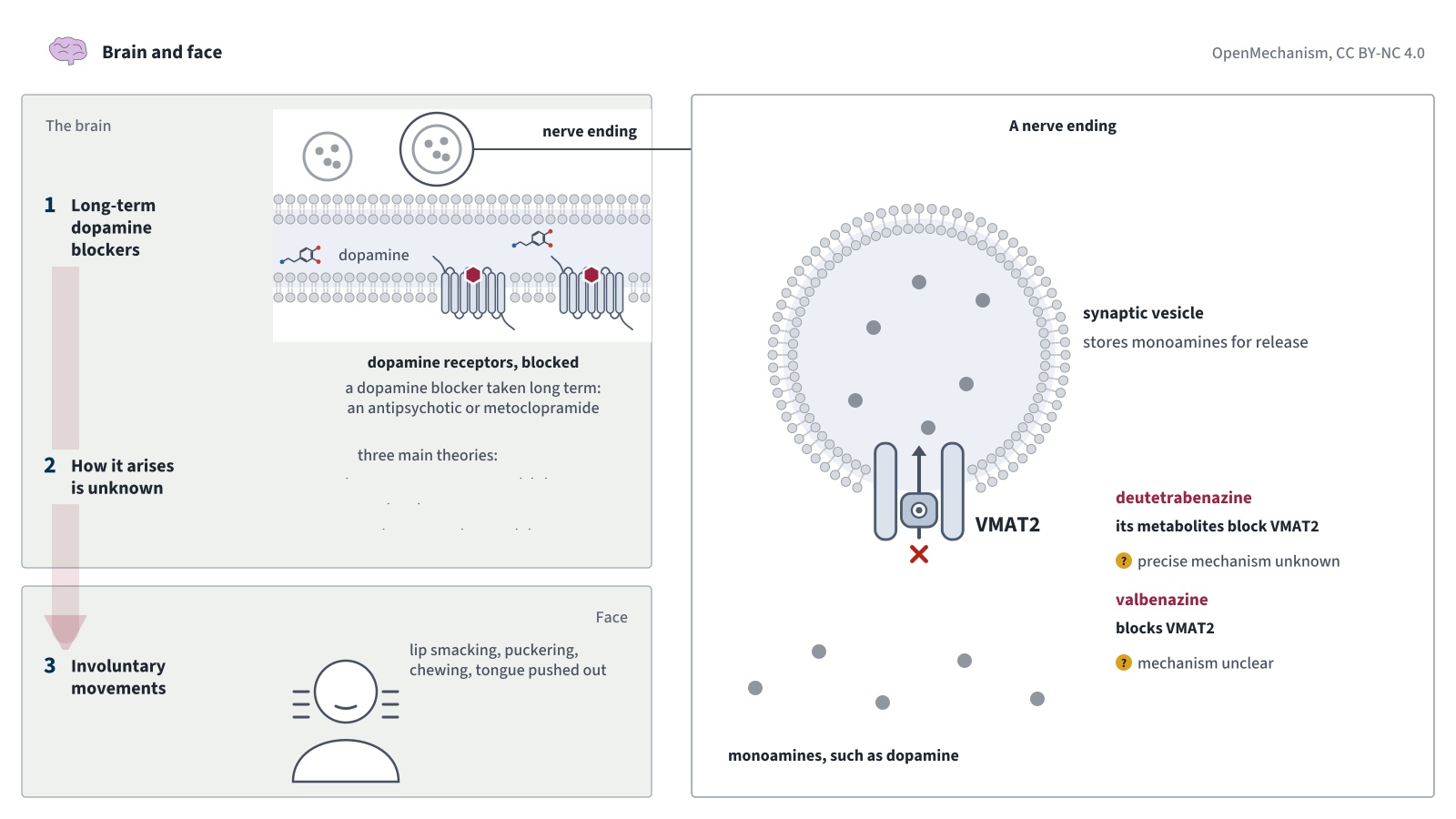
Tardive dyskinesia is a potentially permanent movement disorder caused by long-term use of medicines that block dopamine receptors, such as antipsychotics and metoclopramide. Involuntary movements, most often of the lower face and jaw, begin late. How it arises is unknown. Deutetrabenazine and valbenazine, labeled for it in adults, act on VMAT2, which takes monoamines, such as dopamine, up into synaptic vesicles.
What goes wrong in tardive dyskinesia, and where medicines act. Schematic, not to scale. License CC BY-NC 4.0.
?Precise mechanism unknown
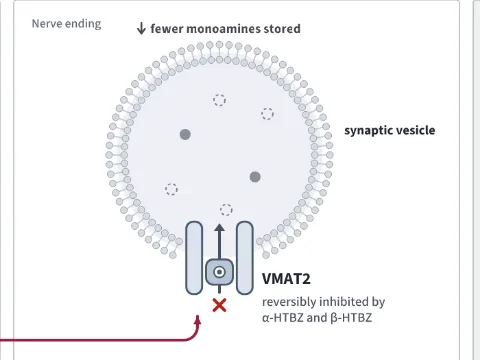
The Austedo label says: The precise mechanism by which deutetrabenazine exerts its effects in the treatment of tardive dyskinesia and chorea in patients with Huntington’s disease is unknown but is believed to be related to its effect as a reversible depletor of monoamines (such as dopamine, serotonin, norepinephrine, and histamine) from nerve terminals.
Clinical study: In Anderson and colleagues' 2017 randomized, double-blind trial (AIM-TD), 298 adults with tardive dyskinesia were assigned to deutetrabenazine (12, 24 or 36 mg a day) or placebo for 12 weeks, and 222 were analyzed for efficacy, those with an abnormal involuntary movement (AIMS) score of 6 or more at the start and at least one later rating; the trial measured AIMS scores, not how deutetrabenazine works: From baseline to week 12, the least-squares mean AIMS score improved by -3·3 points (SE 0·42) in the deutetrabenazine 36 mg/day group, -3·2 points (0·45) in the 24 mg/day group, and -2·1 points (0·42) in the 12 mg/day group, with a treatment difference of -1·9 points (SE 0·58, 95% CI -3·09 to -0·79; p=0·001), -1·8 points (0·60, -3·00 to -0·63; p=0·003), and -0·7 points (0·57, -1·84 to 0·42; p=0·217), respectively, versus -1·4 points (0·41) in the placebo group.Anderson KE et al., Lancet Psychiatry 2017 (PMID 28668671)
?Mechanism unclear
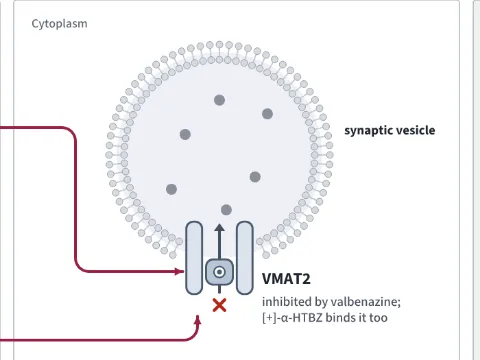
The Ingrezza label says: The mechanism of action of valbenazine for the treatment of tardive dyskinesia and chorea in patients with Huntington’s disease is unclear, but is thought to be mediated through the reversible inhibition of vesicular monoamine transporter 2 (VMAT2), a transporter that regulates monoamine uptake from the cytoplasm to the synaptic vesicle for storage and release.
Clinical study: In Hauser and colleagues' 2017 randomized, double-blind trial (KINECT 3), people with moderate or severe tardive dyskinesia and with schizophrenia, schizoaffective disorder or a mood disorder were assigned to valbenazine (40 or 80 mg once a day) or placebo for 6 weeks, and 225 were analyzed; the trial measured abnormal involuntary movement (AIMS dyskinesia) scores, not how valbenazine works, and its abstract gives no confidence intervals or p values: Least squares mean change from baseline to week 6 in AIMS dyskinesia score was -3.2 for the 80 mg/day group, compared with -0.1 for the placebo group, a significant difference. AIMS dyskinesia score was also reduced in the 40 mg/day group (-1.9 compared with -0.1).Hauser RA et al., Am J Psychiatry 2017 (PMID 28320223)
Dopamine receptors. Receptors that dopamine acts on, among them D1, D2, D3 and D4; olanzapine binds these four strongly.
What goes wrong
Long-term dopamine blockers. Tardive dyskinesia is a potentially permanent movement disorder that results from long-term use of medicines that block . All antipsychotics, including the atypical ones, may cause it. The Reglan label's boxed warning says metoclopramide can cause it too, and that the risk rises with how long metoclopramide is taken and with the total dose. The haloperidol decanoate label adds that tardive dyskinesia can develop, although much less commonly, after relatively brief treatment periods at low doses; the Risperdal label says it may also occur after treatment stops.1,2,3,4,5
What the source says
“Tardive dyskinesia (TD) is a potentially permanent movement disorder resulting from chronic use of dopamine receptor blocking agents (DRBA).”
“All antipsychotics, including the atypical antipsychotics (AAPs), may cause tardive dyskinesia (TD), a potentially irreversible movement disorder, the pathophysiology of which is currently unknown.”
“Metoclopramide, including Reglan, can cause tardive dyskinesia (TD), a potentially irreversible serious movement disorder. In patients treated with metoclopramide, including Reglan, the risk of developing TD increases with duration of treatment and total cumulative dosage”
How it arises is unknown. Three main theories have been proposed: dopamine receptor supersensitivity caused by long-term blockade, oxidative stress, and harmful changes in how synapses adapt (maladaptive synaptic plasticity). Other transmitters and factors are probably involved too.1,2
What the source says
“The pathogenesis of TD is unknown, however there are three main theories proposed: dopamine receptor supersensitivity resulting from chronic dopamine receptor blockade, oxidative stress and maladaptive synaptic plasticity”
“Theories about the etiology of TD include supersensitivity of the dopamine receptors and oxidative stress, but other neurotransmitters and factors are probably involved.”
Involuntary movements. It begins late, typically after at least 3 months of treatment, with involuntary, abnormal movements most often of the lower face and jaw, such as lip smacking, puckering, chewing or pushing out the tongue; it can also affect walking, breathing and the use of the hands and limbs. It may be permanent.6,7
What the source says
“TD onset is delayed, typically appearing after at least 3 months or longer of treatment, and patients will commonly present with involuntary, abnormal facial movements such as lip smacking, puckering, chewing, or tongue protrusion.”
“Tardive dyskinesia (TD), a movement disorder associated with antipsychotics, most frequently affects the lower face and jaw muscles, but can also affect walking, breathing and use of the hands and limbs.”
Its metabolites block VMAT2, so fewer monoamines are stored; the label calls the precise mechanism unknown.8
Used forTardive dyskinesia: in adults
What the label says
“AUSTEDO XR® and AUSTEDO® are indicated in adults for the treatment of: chorea associated with Huntington’s disease [see Clinical Studies (14.1)] tardive dyskinesia”
“The precise mechanism by which deutetrabenazine exerts its effects in the treatment of tardive dyskinesia and chorea in patients with Huntington’s disease is unknown but is believed to be related to its effect as a reversible depletor of monoamines (such as dopamine, serotonin, norepinephrine, and histamine) from nerve terminals.”
“The major circulating metabolites (α-dihydrotetrabenazine [HTBZ] and β-HTBZ) of deutetrabenazine, are reversible inhibitors of VMAT2, resulting in decreased uptake of monoamines into synaptic vesicles and depletion of monoamine stores.”
Blocks VMAT2; the label calls the mechanism unclear.9
Used forTardive dyskinesia: in adults
What the label says
“INGREZZA and INGREZZA SPRINKLE are indicated for the treatment of adults with: - tardive dyskinesia [see Clinical Studies ( 14.1 )]. - chorea associated with Huntington’s disease”
“The mechanism of action of valbenazine for the treatment of tardive dyskinesia and chorea in patients with Huntington’s disease is unclear, but is thought to be mediated through the reversible inhibition of vesicular monoamine transporter 2 (VMAT2), a transporter that regulates monoamine uptake from the cytoplasm to the synaptic vesicle for storage and release.”
Can cause it: haloperidol (“A syndrome consisting of potentially irreversible, involuntary, dyskinetic movements may develop in patients treated with antipsychotic drugs”4); risperidone (“Tardive dyskinesia, a syndrome consisting of potentially irreversible, involuntary, dyskinetic movements, may develop in patients treated with antipsychotic drugs.”5); and metoclopramide (“Metoclopramide, including Reglan, can cause tardive dyskinesia (TD), a potentially irreversible serious movement disorder.”3).
Both labels hedge: the Austedo label calls the precise mechanism unknown, and the Ingrezza label calls the mechanism unclear. A 2022 review says VMAT2 inhibitors oppose the increased dopamine activity linked with long-term antipsychotic use, by interfering with dopamine uptake and storage.7,8,9
Each trial in the notes compared one medicine with placebo, for a different length of time (12 and 6 weeks) and in a different group of patients; neither compared the two medicines with each other.10,11
The Ingrezza label gives a binding figure (Ki) for valbenazine, the Austedo label gives none, and no label compares its figures with another medicine's.8,9
The Risperdal label says who will develop tardive dyskinesia cannot be predicted, and whether antipsychotics differ in how likely they are to cause it is unknown; a 2018 review says the risk is lower with atypical antipsychotics than with typical ones, but remains a problem.2,5
text dc3cd2faa7b0…; drawings 00373ad240af…; notes 18d02fc2deb0…
AI source check
Claude Opus 5.5 (AI source check), 6 November 2026: 40 statements compared with their sources, 6 flagged for the reviewer. An automated check, not a medical review.
Next review due
7 May 2028
Cite this page
Tran D. Tardive dyskinesia [Internet]. OpenMechanism; 2026 [updated 2026 Nov 6; cited 2026 Nov 6]. Available from: https://openmechanism.com/conditions/tardive-dyskinesia