Spasticity and dystonia
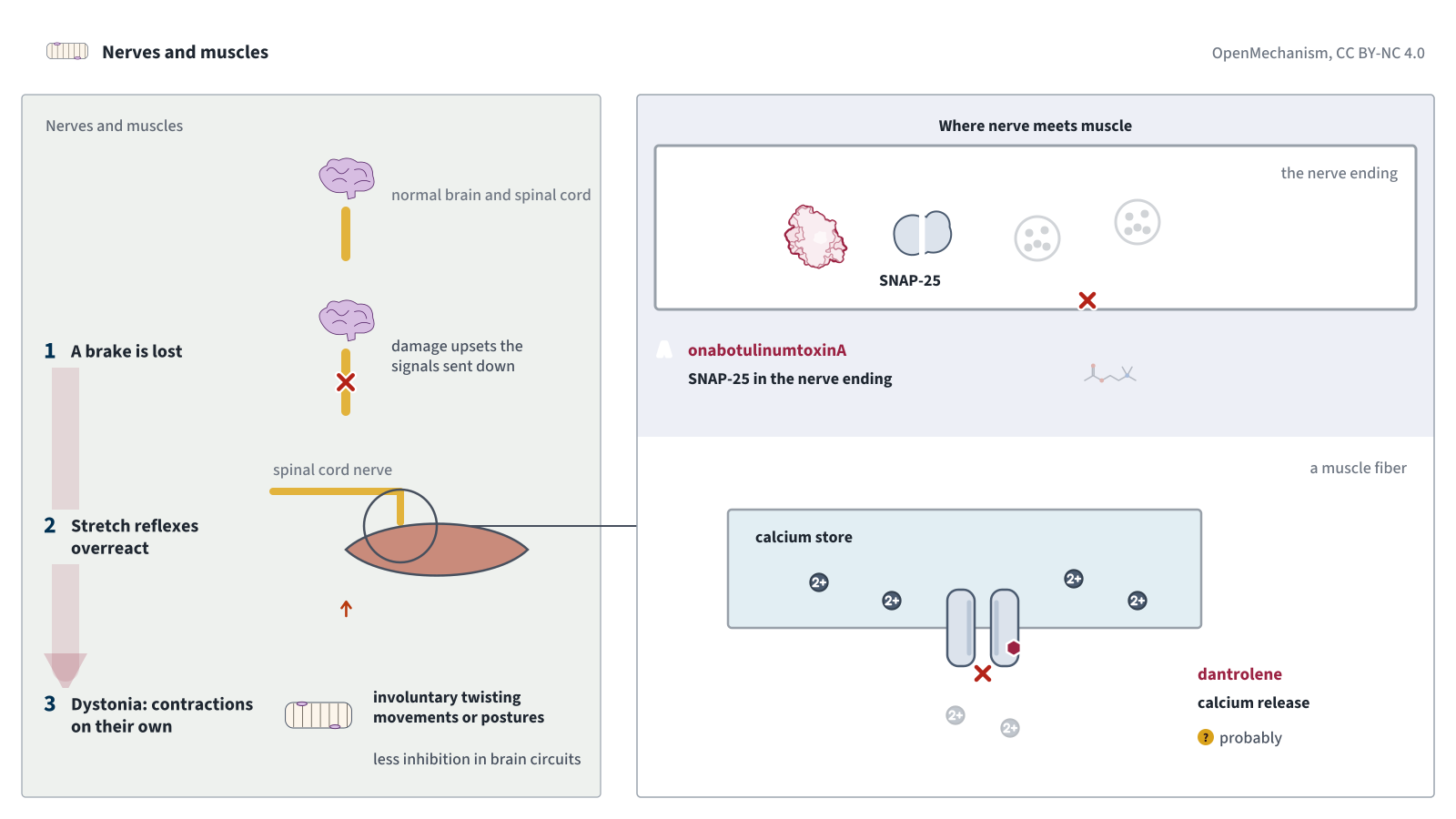
Spasticity follows damage to the brain or spinal cord: stretch reflexes are released and overreact, so muscle tone rises the faster a muscle is stretched. Dystonia is a neurological condition of involuntary movements or postures from sustained or repeated muscle contractions. Botulinum toxin blocks acetylcholine release at the nerve ending; dantrolene acts inside the muscle, probably on calcium release.
- Where
- Nerves and muscles
- Body systems
- Muscles, bones & joints; Brain & nerves
- Medicines
- 2 medicines
Probably
The Dantrium (dantrolene) label says: In skeletal muscle, Dantrium dissociates the excitation-contraction coupling, probably by interfering with the release of Ca ++ from the sarcoplasmic reticulum.
Source 4: Dantrium (dantrolene) capsules: FDA label, Indications and Usage; Clinical Pharmacology
Clinical study: In a double-blind, placebo-controlled trial in 17 people with moderate to severe spasticity from varied causes; the trial measured stiffness, clonus and reflexes, not calcium release in muscle: It is concluded that dantrolene sodium is an effective antispastic drug in about one-third of patients who suffer from spasticity of varying etiology.
Luisto M et al., Acta Neurol Scand 1982 (PMID 7102262)
This study was picked with a literature search and is not yet checked by our reviewer.
For teachers: download this drawing.
Key terms in this drawing
- SNAP25
- Synaptosomal-associated protein 25. A protein nerve endings need to release acetylcholine.
What goes wrong
A brake is lost. Damage to the brain or spinal cord upsets the balance of inhibiting and exciting signals sent down to the spinal cord, releasing the stretch reflex.1
What the source says
“The central lesion causing the UMNS disrupts the balance of supraspinal inhibitory and excitatory inputs directed to the spinal cord, leading to a state of disinhibition of the stretch reflex.”
Source 1Stretch reflexes overreact. Spasticity is muscle tone that rises with the speed of stretching, because the stretch reflex is exaggerated.1
What the source says
“Spasticity is the velocity-dependent increase in muscle tone due to the exaggeration of stretch reflex.”
Source 1Dystonia: contractions on their own. Dystonia is a neurological condition of involuntary movements or postures from sustained or repeated muscle contractions; loss of inhibition in brain circuits is among its mechanisms.2
Where medicines act
- A
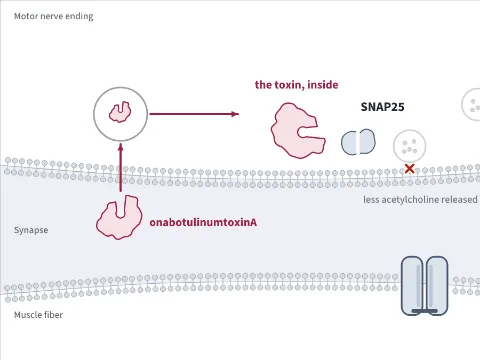
Botulinum toxin: less acetylcholine released
OnabotulinumtoxinA enters motor nerve endings and cuts , a protein needed to release acetylcholine; injected into a muscle, it partly and locally weakens it. It treats spasticity and cervical dystonia.3
What the source says
“BOTOX blocks neuromuscular transmission by binding to acceptor sites on motor or autonomic nerve terminals, entering the nerve terminals, and inhibiting the release of acetylcholine.”
Source 3“This inhibition occurs as the neurotoxin cleaves SNAP-25”
Source 3“When injected intramuscularly at therapeutic doses, BOTOX produces partial chemical denervation of the muscle resulting in a localized reduction in muscle activity.”
Source 3“BOTOX is indicated for the treatment of spasticity in patients 2 years of age and older.”
Source 3“BOTOX is indicated for the treatment of adults with cervical dystonia”
Source 3 - B
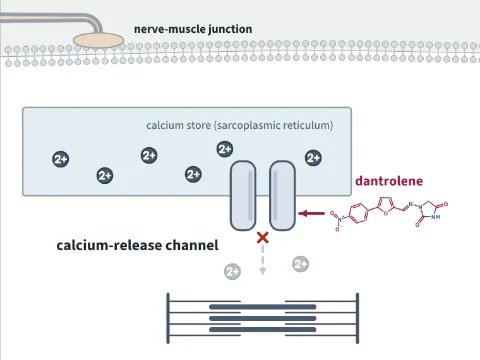
Dantrolene: less calcium released in the muscle
Dantrolene acts in the muscle itself, uncoupling the nerve signal from contraction, probably by reducing calcium release from the sarcoplasmic reticulum. It controls spasticity from brain or spinal cord disorders.4
What the source says
“In skeletal muscle, Dantrium dissociates the excitation-contraction coupling, probably by interfering with the release of Ca ++ from the sarcoplasmic reticulum.”
Source 4“Dantrium is indicated in controlling the manifestations of clinical spasticity resulting from upper motor neuron disorders (e.g., spinal cord injury, stroke, cerebral palsy, or multiple sclerosis).”
Source 4
See also
Body systems: muscles, bones & joints; and brain & nerves.
Related medicines: diazepam, baclofen and tizanidine.
Other conditions: muscle spasm, organophosphate poisoning, anxiety disorders, epilepsy, excessive sweating (hyperhidrosis) and malignant hyperthermia.
Interactions: tizanidine with ciprofloxacin or fluvoxamine.
Sources
- 1Pathophysiology of spasticity: implications for neurorehabilitationTrompetto C et al. Biomed Res Int 2014 (abstract). Saved copy
- 2DystoniaBalint B et al. Nat Rev Dis Primers 2018 (abstract). Saved copy
- 3Botox (onabotulinumtoxinA): FDA label1 Indications and Usage; 12.1 Mechanism of Action. Saved copy
- 4Dantrium (dantrolene) capsules: FDA labelIndications and Usage; Clinical Pharmacology. Saved copy
- 5Dantrolene sodium in chronic spasticity of varying etiology. A double-blind studyLuisto M et al. Acta Neurol Scand 1982 (abstract). Saved copy
- 6Botulinum toxin A light chain with SNAP-25, the protein it cutsPDB 1XTG; Breidenbach, M.A., Brunger, A.T. Nature 2004;432:925-929. The botulinum toxin A outline in the drawing is traced from this structure. Saved copy
Notes and limits
- Stiffness also comes from changes in the soft tissues, not only from reflexes; moving the limbs helps prevent and treat both.1
- Botulinum toxin has not been shown to improve arm function or the range of a joint fixed by contracture.3
Notes that apply to every page are on How to read a page.
Spotted a mistake? Report an error (hello@openmechanism.com). Since launch, every published error we fix is listed on the corrections page.
Cite this page
Tran D. Spasticity and dystonia [Internet]. OpenMechanism; 2026 [updated 2026 Oct 20; cited 2026 Oct 20]. Available from: https://openmechanism.com/conditions/spasticity-and-dystonia