Excessive sweating (hyperhidrosis)
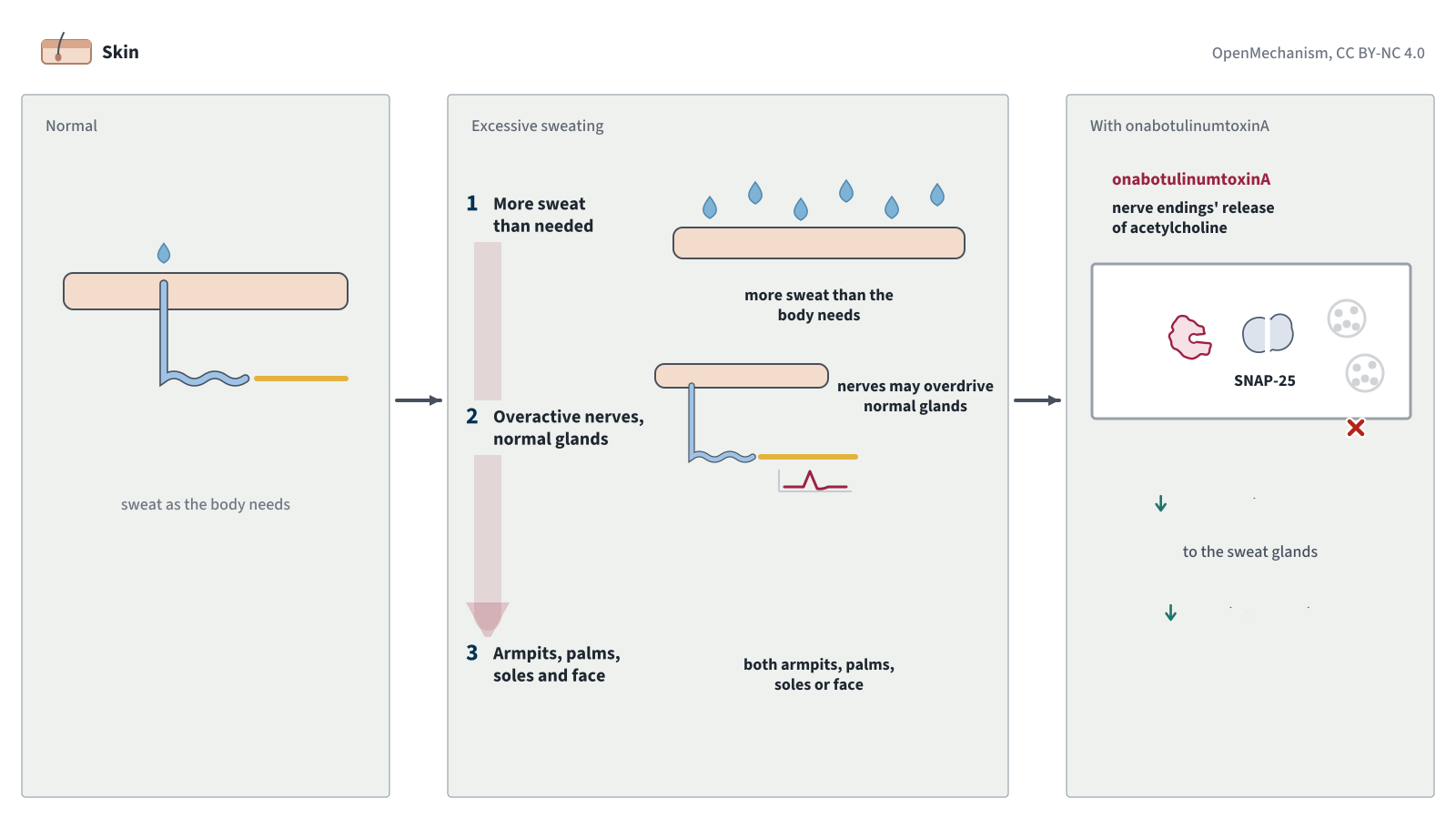
Hyperhidrosis is sweating beyond what the body needs to control temperature; it may affect at least 4.8% of people in the US. It may come from a nervous system problem that overdrives otherwise normal sweat glands, usually in both armpits, palms, soles or face. OnabotulinumtoxinA, injected into the skin, stops nerve endings releasing acetylcholine, temporarily switching off the sweat glands.
- Where
- Skin
- Body systems
- Skin, hair & nails; Brain & nerves
- Medicines
- 1 medicine
For teachers: download this drawing.
Key terms in this drawing
- SNAP25
- Synaptosomal-associated protein 25. A protein nerve endings need to release acetylcholine.
What goes wrong
More sweat than needed. Hyperhidrosis is sweating beyond what the body needs to control its temperature; it may affect at least 4.8% of people in the US.1
Overactive nerves, normal glands. It may come from a problem in the autonomic nervous system that overdrives otherwise normal sweat glands.1
What the source says
“The etiology of HH may stem from a complex autonomic nervous system dysfunction, resulting in neurogenic overactivity of otherwise normal eccrine sweat glands.”
Source 1Armpits, palms, soles and face. Most people have the primary form, which usually affects both armpits, palms, soles or face.1
What the source says
“Approximately 93% of patients with HH have primary HH, of whom >90% have a typical focal and bilateral distribution affecting the axillae, palms, soles, and craniofacial areas.”
Source 1
Where medicines act
- A
OnabotulinumtoxinA: the sweat glands' signal blocked
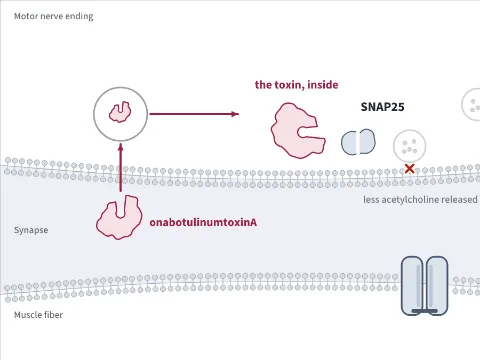
OnabotulinumtoxinA enters nerve endings and stops them releasing acetylcholine; injected into the skin, it temporarily switches off the sweat glands there. It treats severe sweating of the armpits not controlled by treatments on the skin.2
What the source says
“BOTOX blocks neuromuscular transmission by binding to acceptor sites on motor or autonomic nerve terminals, entering the nerve terminals, and inhibiting the release of acetylcholine.”
Source 2“When injected intradermally, BOTOX produces temporary chemical denervation of the sweat gland resulting in local reduction in sweating.”
Source 2“BOTOX is indicated for the treatment of severe primary axillary hyperhidrosis that is inadequately managed with topical agents.”
Source 2
See also
Body systems: skin, hair & nails; and brain & nerves.
Other conditions: migraine; overactive bladder; spasticity and dystonia; and herpes infections.
Sources
- 1The etiology, diagnosis, and management of hyperhidrosis: a comprehensive review: etiology and clinical work-upNawrocki S, Cha J. J Am Acad Dermatol 2019 (abstract). Saved copy
- 2Botox (onabotulinumtoxinA): FDA label1 Indications and Usage; 12.1 Mechanism of Action. Saved copy
- 3Botulinum toxin A light chain with SNAP-25, the protein it cutsPDB 1XTG; Breidenbach, M.A., Brunger, A.T. Nature 2004;432:925-929. The botulinum toxin A outline in the drawing is traced from this structure. Saved copy
Notes and limits
- Sweating can also come from other illnesses or medicines (secondary hyperhidrosis), and the toxin is proven only for the armpits.1,2
Notes that apply to every page are on How to read a page.
Spotted a mistake? Report an error (hello@openmechanism.com). Since launch, every published error we fix is listed on the corrections page.
Cite this page
Tran D. Excessive sweating (hyperhidrosis) [Internet]. OpenMechanism; 2026 [updated 2026 Oct 16; cited 2026 Oct 16]. Available from: https://openmechanism.com/conditions/excessive-sweating