Carbidopa and levodopa
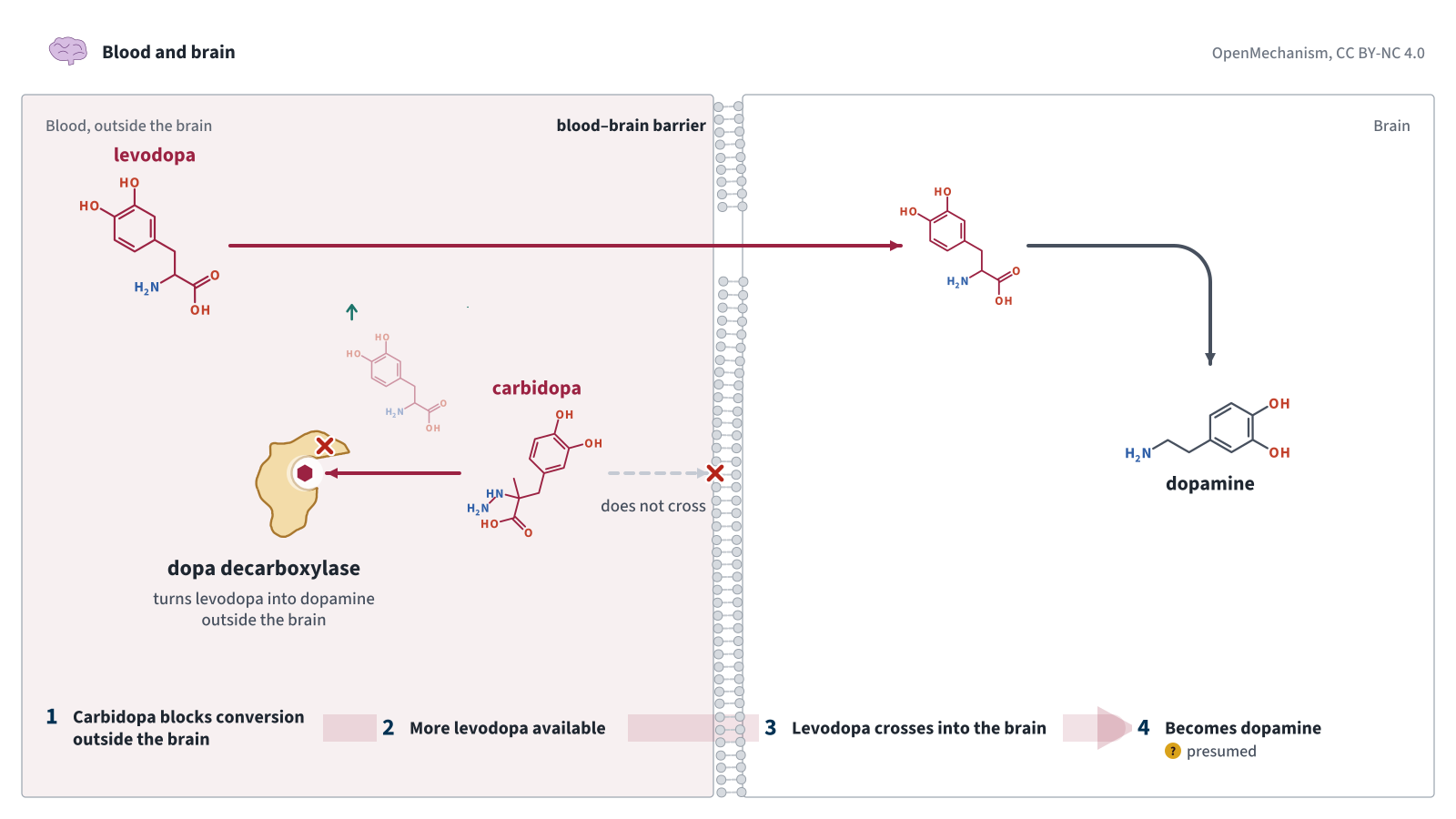
Levodopa is a building block of dopamine. Carbidopa stops levodopa being converted outside the brain, so more of it crosses into the brain, where it is presumed to become dopamine.
- Acts on
- Decarboxylation of peripheral levodopa
- Where
- Body, blood–brain barrier and brain
- Medicine type
- Small molecule
- Used for
- Brain & nerves
Also called Sinemet.
Step 4: presumed
The Sinemet label says: However, levodopa, the metabolic precursor of dopamine, does cross the blood-brain barrier, and presumably is converted to dopamine in the brain.
Source 1: Sinemet (carbidopa and levodopa): FDA label, Mechanism of Action and Pharmacodynamics
Clinical study: In a brain imaging (PET) study in 16 people with advanced Parkinson disease, each scanned off medicine and again after one oral dose of levodopa with carbidopa; it tested the step itself, through the dopamine released in the brain: In advanced Parkinson disease, the improvement of rigidity and bradykinesia and the presence of dyskinesias after a single dose of oral levodopa are governed by the level of dopamine generated at striatal D2 receptors.
Pavese N et al., Neurology 2006 (PMID 17101892)
This study was picked with a literature search and is not yet checked by our reviewer.
How it works
Carbidopa blocks conversion outside the brain. Carbidopa inhibits peripheral decarboxylation of levodopa.1
More levodopa available. Less extracerebral conversion leaves more unchanged levodopa available for transport to the brain.1
Levodopa crosses into the brain. Levodopa reaches the , while carbidopa does not cross this barrier.1
Becomes dopamine. Levodopa is presumed to be converted into dopamine in the brain, providing the label-described symptomatic mechanism.1
For teachers: download this drawing or build a slide deck.
More detail
Carbidopa protects levodopa outside the brain
Levodopa is absorbed, then converted quickly outside the brain. Oral levodopa is transported from the gut and rapidly converted to dopamine in extracerebral tissues.1
Carbidopa blocks that conversion. Carbidopa inhibits peripheral aromatic amino-acid decarboxylation of levodopa.1
Carbidopa stays out of the brain. Carbidopa does not cross the blood–brain barrier or alter CNS levodopa metabolism.1
More levodopa left for the brain. Peripheral decarboxylase inhibition leaves more levodopa available for transport to the brain.1
What the source says
“When levodopa is administered orally, it is rapidly decarboxylated to dopamine in extracerebral tissues so that only a small portion of a given dose is transported unchanged to the central nervous system.”
Source 1
“Carbidopa inhibits decarboxylation of peripheral levodopa. It does not cross the blood-brain barrier and does not affect the metabolism of levodopa within the central nervous system.”
Source 1
“administration of carbidopa with levodopa makes more levodopa available for transport to the brain.”
Source 1
In the brain (presumed)
Levodopa crosses into the brain; dopamine does not. Levodopa crosses the blood–brain barrier; dopamine is described as apparently unable to do so.1
Presumed to become dopamine in the brain. The label presumes brain conversion of levodopa to dopamine and attributes symptomatic relief to this process.1
What the source says
“Administration of dopamine is ineffective in the treatment of Parkinson's disease apparently because it does not cross the blood-brain barrier.”
Source 1
“levodopa, the metabolic precursor of dopamine, does cross the blood-brain barrier, and presumably is converted to dopamine in the brain.”
Source 1
Protein in the diet
Some amino acids compete with its absorption. Certain amino acids compete with levodopa gut-wall transport and may impair absorption.1
What the source says
“Since levodopa competes with certain amino acids for transport across the gut wall, the absorption of levodopa may be impaired in some patients on a high protein diet.”
Source 1
Changes in blood and urine levels
More levodopa in the blood with carbidopa. Carbidopa coadministration raises plasma levodopa and changes urinary levodopa/dopamine proportions in pharmacology studies.1
What the source says
“Carbidopa reduces the amount of levodopa required to produce a given response by about 75% and, when administered with levodopa, increases both plasma levels and the plasma half-life of levodopa, and decreases plasma and urinary dopamine and homovanillic acid.”
Source 1
Side effects outside and inside the brain
Less nausea and vomiting than levodopa alone. Extracerebral dopamine contributes to some levodopa adverse effects; SINEMET shows less nausea/vomiting than levodopa in label experience.1
Linked to involuntary movements (dyskinesias). Levodopa and SINEMET are associated with dyskinesias.1
What the source says
“The incidence of levodopa-induced nausea and vomiting is less with SINEMET than with levodopa.”
Source 1
See also
Condition pages: Parkinson disease.
Explained: levodopa and high-protein meals.
Related drawings: entacapone (blocks COMT, so levodopa lasts longer); and rasagiline (blocks MAO-B, raising dopamine in the striatum).
Animations: levodopa in the brain.
Body system: brain & nerves.
Inside the body: dopamine and movement.
Sources
- 1Sinemet (carbidopa and levodopa): FDA labelMechanism of Action and Pharmacodynamics; Clinical Pharmacology: Mechanism of Action and Pharmacodynamics; Clinical Pharmacology: Pharmacodynamics and Pharmacokinetics; Pharmacodynamics; Precautions: Dyskinesia; Warnings; Precautions; Adverse Reactions
- 2ChEMBL CHEMBL1201236Target and action classification: DOPA decarboxylase inhibitor
- 3Clinical correlates of levodopa-induced dopamine release in Parkinson disease: a PET studyPavese N et al. Neurology 2006 (abstract)
Also used on this page
The decarboxylase outline is traced from the crystal structure below.
- 4Human aromatic L-amino acid decarboxylase (dopa decarboxylase) with carbidopaPDB 9GNS; Baine, J.M. et al. Acs Catalysis 2025; 15:8204-8218
Spotted a mistake? Report an error (hello@openmechanism.com). Since launch, every published error we fix is listed on the corrections page.
Notes and limits
- A schematic teaching drawing: not to scale, not exact structures, binding poses or a complete pathway, and not a guide to dosing, treatment or how a person will respond.
- The steps are in the order that explains them; one step is said to cause the next only where the source says so.
- SINEMET immediate-release oral tablets; no extrapolation to extended-release formulations.
- Central conversion and symptomatic mechanism retain the current label’s presumptive wording; no neuroprotection claim.
- Peripheral and central conversion are separate compartments. The clinical link is expressed as presumed/thought in the label.
All recorded limits are on the evidence page, and notes that apply to every page are on How to read a page. Version 1.1.0, not yet medically reviewed.
Cite this page
Tran D. Carbidopa and levodopa [Internet]. OpenMechanism; 2026 [updated 2026 Oct 14; cited 2026 Oct 14]. Available from: https://openmechanism.com/medicines/carbidopa-plus-levodopa