Bupropion
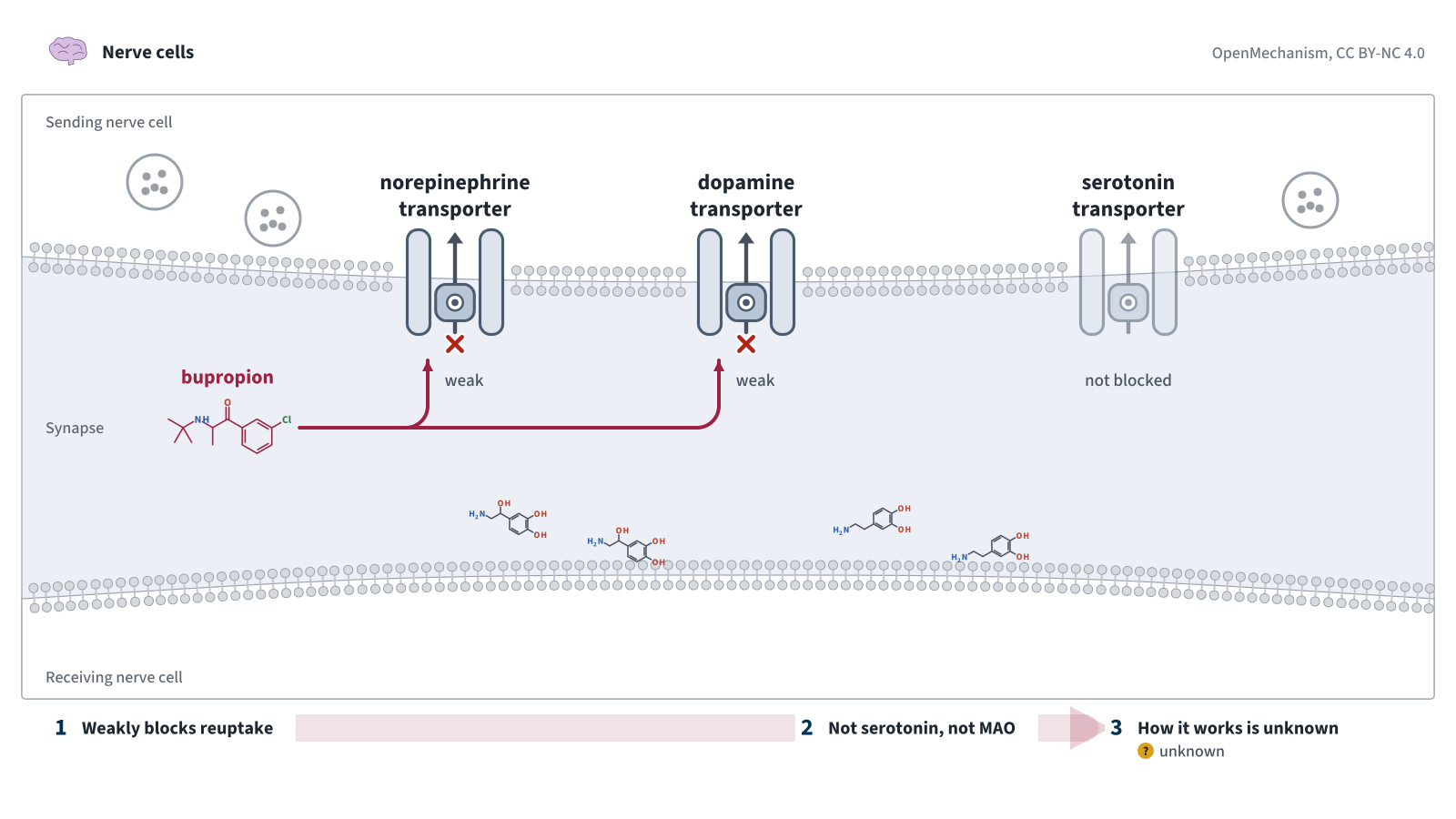
Bupropion is a relatively weak blocker of the of norepinephrine and dopamine by nerve cells. It does not block serotonin reuptake, and it does not inhibit . The Wellbutrin XL label lists it for major depressive disorder and for preventing seasonal episodes of major depression in people with seasonal affective disorder. The label says how bupropion works is unknown, as for other antidepressants, and presumes it works through norepinephrine and/or dopamine.
- Acts on
- Norepinephrine and dopamine reuptake (weak)
- Where
- Nerve cells
- Medicine type
- Small molecule
- Used for
- Brain & nerves
Also called Wellbutrin XL (extended-release bupropion hydrochloride).
Step 3: unknown
The Wellbutrin XL label says: The mechanism of action of bupropion is unknown, as is the case with other antidepressants. However, it is presumed that this action is mediated by noradrenergic and/or dopaminergic mechanisms.
Clinical study: In Meyer and colleagues' 2002 brain imaging (PET) study of the dopamine transporter (DAT) in the striatum of eight people with depression, before and during treatment with bupropion, compared with eight healthy people scanned twice: Bupropion treatment occupies less than 22% of DAT sites. This raises the question as to whether a DAT occupancy of less than 22% is therapeutic or whether there is another mechanism involved during treatment with bupropion.
Meyer JH et al., Psychopharmacology (Berl) 2002 (PMID 12185406)
How it works
Weakly blocks reuptake. Bupropion is a relatively weak inhibitor of the reuptake of norepinephrine and dopamine by nerve cells.1
Not serotonin, not MAO. Bupropion does not block the reuptake of serotonin, and it does not inhibit monoamine oxidase (MAO).1
How it works is unknown. The label says how bupropion works is unknown, as for other antidepressants, and that it is presumed to act through norepinephrine and/or dopamine mechanisms.1
For teachers: download this drawing.
See also
Condition pages: depression and nicotine dependence.
Explained: why bupropion carries a risk of seizures.
Body system: brain & nerves.
Sources
- 1Wellbutrin XL (bupropion hydrochloride): FDA label1 Indications and Usage; 12.1 Mechanism of Action; 12.3 Pharmacokinetics
- 2ChEMBL CHEMBL894Target and action classification: Dopamine transporter inhibitor; Norepinephrine transporter inhibitor
- 3Bupropion occupancy of the dopamine transporter is low during clinical treatmentMeyer JH et al. Psychopharmacology (Berl) 2002 (abstract)
Spotted a mistake? Report an error (hello@openmechanism.com). Since launch, every published error we fix is listed on the corrections page.
Notes and limits
- A schematic teaching drawing: not to scale, not exact structures, binding poses or a complete pathway, and not a guide to dosing, treatment or how a person will respond.
- The label adds that three of bupropion's metabolites are active. It says their potency and toxicity relative to bupropion have not been fully characterized, but in an antidepressant screening test in mice, hydroxybupropion was half as potent as bupropion and the other two a fifth as potent, and this may be of clinical importance because their levels in the blood are as high as bupropion's or higher.
- The label says the mechanism of action of bupropion is unknown, and presumed to be mediated by noradrenergic and/or dopaminergic mechanisms.
All recorded limits are on the evidence page, and notes that apply to every page are on How to read a page. Version 1.0.1, medically reviewed by Daniel Tran, PharmD, on 6 November 2026.
Cite this page
Tran D. Bupropion [Internet]. OpenMechanism; 2026 [updated 2026 Nov 6; cited 2026 Nov 6]. Available from: https://openmechanism.com/medicines/bupropion