Olanzapine
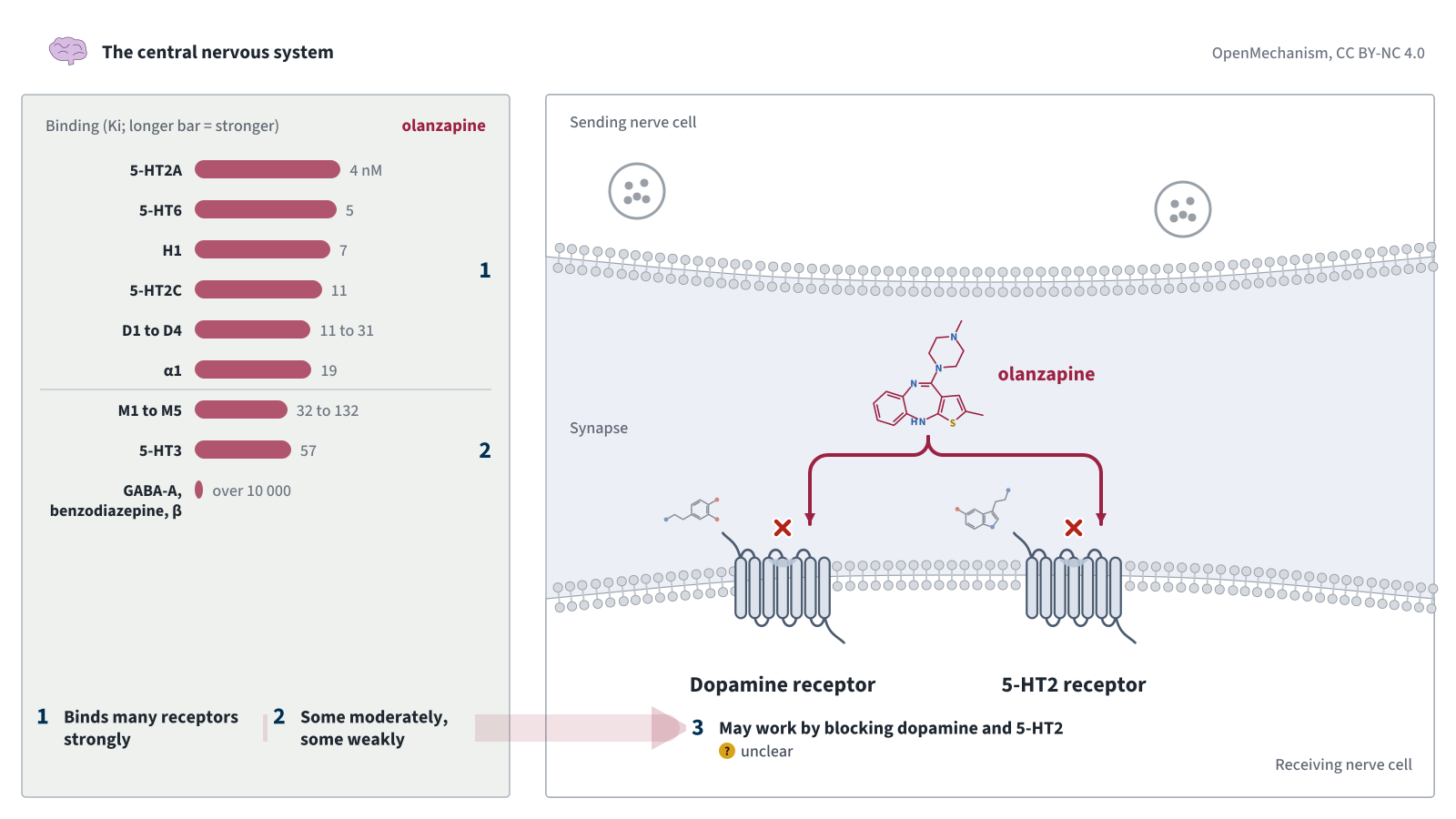
Olanzapine binds many receptors strongly, among them serotonin and , dopamine , and adrenergic α1. Its label lists it for schizophrenia in adults and adolescents aged 13 to 17; for manic or mixed episodes of bipolar I disorder, alone in adults and adolescents aged 13 to 17 or with lithium or valproate in adults, and for maintenance treatment of bipolar I disorder in adults; and, taken with fluoxetine, for depressive episodes of bipolar I disorder and, in adults, for major depressive disorder that has not responded to two adequate trials of different antidepressants in the current episode (treatment-resistant depression), uses for which the label says olanzapine alone is not indicated. The label says how it works in these uses is unclear, and that its effect in schizophrenia could come from blocking dopamine and receptors together.
- Acts on
- Dopamine and serotonin 5-HT2 receptors, among many others
- Where
- The central nervous system
- Medicine type
- Small molecule
- Used for
- Brain & nerves
- Drug class
- Antipsychotics
Step 3: unclear
The olanzapine tablets label says: The mechanism of action of olanzapine, in the listed indications is unclear. However, the efficacy of olanzapine in schizophrenia could be mediated through a combination of dopamine and serotonin type 2 (5HT 2 ) antagonism.
Clinical study: In the double-blind acute phase of Beasley and colleagues' 1996 trial of three dose ranges of olanzapine (5, 10 or 15 mg a day, each ± 2.5 mg: Olz-L, Olz-M and Olz-H), haloperidol (15 ± 5 mg a day: Hal) or placebo in 335 people with schizophrenia; the trial measured symptoms with rating scales such as the Brief Psychiatric Rating Scale (BPRS), not how olanzapine works: In positive symptom improvement (BPRS-positive), Olz-M, Olz-H, and Hal were comparable and significantly superior to placebo.
Beasley CM et al., Neuropsychopharmacology 1996 (PMID 8822534)
Key terms in this drawing (7)
- 5-HT receptors
- Serotonin (5-hydroxytryptamine, 5-HT) receptors. Receptors that serotonin acts on; they come in several subtypes, such as 5-HT1A and 5-HT2A.
- 5-HT2A receptor
- Serotonin 2A receptor. One of the serotonin receptors; olanzapine binds it strongly.
- 5-HT2C receptor
- Serotonin 2C receptor. One of the serotonin receptors; olanzapine binds it strongly.
- 5-HT3 receptor
- Serotonin 3 receptor. A serotonin receptor on vagus nerve endings and in the brain's vomiting trigger zone; ondansetron blocks it.
- dopamine receptors
- Dopamine receptors. Receptors that dopamine acts on, among them D1, D2, D3 and D4; olanzapine binds these four strongly.
- GABA-A receptor
- Gamma-aminobutyric acid type A receptor. A receptor channel on nerve cells that GABA switches on; benzodiazepines also bind it.
- muscarinic receptors
- Muscarinic receptors (M1 to M5). The receptors that antimuscarinic (anticholinergic) medicines block; they come in five subtypes, M1 to M5.
How it works
Binds many receptors strongly. Olanzapine binds serotonin 5-HT2A, 5-HT2C and 5-HT6, dopamine D1 to D4, histamine H1 and adrenergic α1 receptors with high .1
Some moderately, some weakly. It blocks serotonin and receptors with moderate affinity, and binds , benzodiazepine and β-adrenergic receptors only weakly.1
May work by blocking dopamine and 5-HT2. The label says how olanzapine works in the uses it lists is unclear, and that its effect in schizophrenia could come from a combination of blocking dopamine and serotonin 5-HT2 receptors.1
For teachers: download this drawing.
See also
Condition pages: bipolar disorder and schizophrenia.
Other antipsychotics: aripiprazole, clozapine, haloperidol, quetiapine, risperidone and ziprasidone.
Explained: smoking and olanzapine.
Body system: brain & nerves.
Sources
- 1Olanzapine tablets: FDA label1 Indications and Usage; 7 Drug Interactions; 12.1 Mechanism of Action; 12.2 Pharmacodynamics
- 2ChEMBL CHEMBL715Target and action classification: D2-like dopamine receptor antagonist; Serotonin 2a (5-HT2a) receptor antagonist; Serotonin 2c (5-HT2c) receptor antagonist
- 3Olanzapine versus placebo and haloperidol: acute phase results of the North American double-blind olanzapine trialBeasley CM et al. Neuropsychopharmacology 1996 (abstract)
Spotted a mistake? Report an error (hello@openmechanism.com). Since launch, every published error we fix is listed on the corrections page.
Notes and limits
- A schematic teaching drawing: not to scale, not exact structures, binding poses or a complete pathway, and not a guide to dosing, treatment or how a person will respond.
- The label notes a greater potential for weight gain and dyslipidemia in adolescents than in adults.
- The label says the mechanism of action of olanzapine in the listed indications is unclear, and that its efficacy in schizophrenia could be mediated through a combination of dopamine and 5HT2 antagonism.
All recorded limits are on the evidence page, and notes that apply to every page are on How to read a page. Version 1.0.1, medically reviewed by Daniel Tran, PharmD, on 6 November 2026.
Cite this page
Tran D. Olanzapine [Internet]. OpenMechanism; 2026 [updated 2026 Nov 6; cited 2026 Nov 6]. Available from: https://openmechanism.com/medicines/olanzapine