Morphine
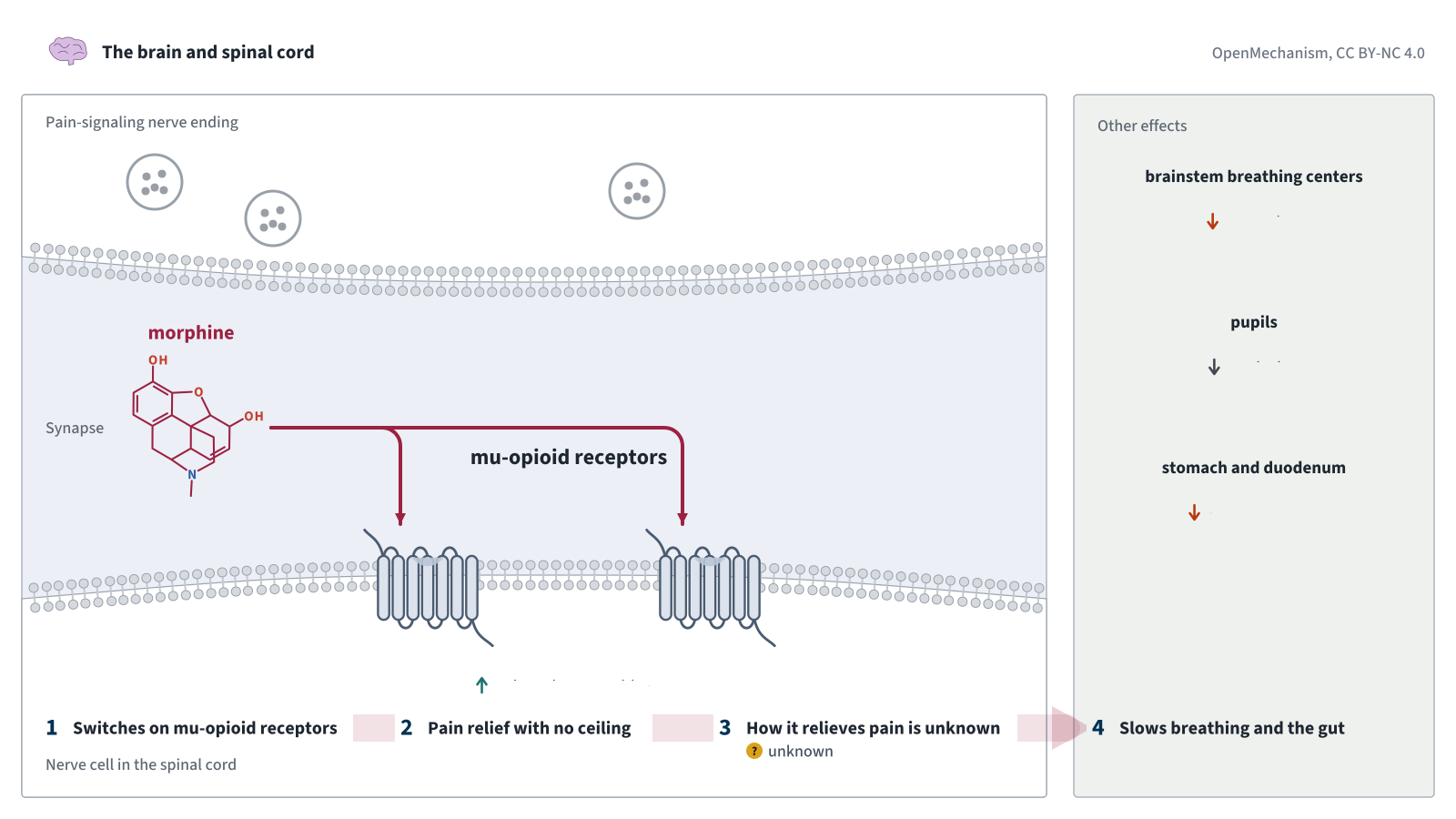
Morphine switches on mu-opioid receptors. It relieves pain with no ceiling to the effect, though how is not precisely known; opioid receptors throughout the brain and spinal cord are thought to play a role. It also slows breathing by acting on the brainstem, narrows the pupils and slows the gut.
- Acts on
- Mu-opioid receptors (and others at higher doses)
- Where
- The brain and spinal cord
- Medicine type
- Small molecule
- Used for
- Brain & nerves
- Drug class
- Opioids
Also called MS Contin (extended-release morphine sulfate).
Step 3: unknown
The MS Contin label says: The precise mechanism of the analgesic action is unknown. … However, specific CNS opioid receptors for endogenous compounds with opioid-like activity have been identified throughout the brain and spinal cord and are thought to play a role in the analgesic effects of this drug.
Clinical study: In a Cochrane review of oral morphine for cancer pain, which measured pain relief, not how morphine works: Only a few reported how many people had good pain relief, but where it was reported, over 90% had no worse than mild pain within a reasonably short time period.
Wiffen PJ et al., Cochrane Database Syst Rev 2016 (PMID 27105021)
This study was picked with a literature search and is not yet checked by our reviewer.
How it works
Switches on mu-opioid receptors. Morphine is a full opioid , relatively selective for the mu-opioid receptor, though it can act at other opioid receptors at higher doses.1
Pain relief with no ceiling. Its main therapeutic action is pain relief (analgesia), and like all full opioid agonists it has no ceiling for pain relief; the dose is limited by side effects such as slowed breathing and depression of the central nervous system.1
How it relieves pain is unknown. The precise mechanism of its pain relief is unknown, but opioid receptors for the body's own opioid-like compounds, found throughout the brain and spinal cord, are thought to play a role.1
Slows breathing and the gut. Morphine slows breathing by acting directly on the brainstem's breathing centers, making them less responsive to carbon dioxide; it narrows the pupils, even in darkness, and it reduces movement (motility) in the stomach and duodenum.1
For teachers: download this drawing.
See also
Condition pages: severe and persistent pain.
Other opioids: buprenorphine, fentanyl, hydrocodone, loperamide, oxycodone and tramadol.
Explained: codeine, tramadol and the CYP2D6 gene; why morphine slows the gut and breathing; and opioids and benzodiazepines.
Body system: brain & nerves.
Sources
- 1MS Contin (morphine sulfate) extended-release tablets: FDA label12.1 Mechanism of Action; 12.2 Pharmacodynamics
- 2ChEMBL CHEMBL70Target and action classification: Mu opioid receptor agonist
- 3Oral morphine for cancer painWiffen PJ et al. Cochrane Database Syst Rev 2016 (abstract)
Spotted a mistake? Report an error (hello@openmechanism.com). Since launch, every published error we fix is listed on the corrections page.
Notes and limits
- A schematic teaching drawing: not to scale, not exact structures, binding poses or a complete pathway, and not a guide to dosing, treatment or how a person will respond.
- The label says the precise mechanism of the analgesic action is unknown, and that CNS opioid receptors for endogenous compounds with opioid-like activity are thought to play a role.
All recorded limits are on the evidence page, and notes that apply to every page are on How to read a page. Version 1.0.0, not yet medically reviewed.
Cite this page
Tran D. Morphine [Internet]. OpenMechanism; 2026 [updated 2026 Oct 21; cited 2026 Oct 21]. Available from: https://openmechanism.com/medicines/morphine