Oxcarbazepine
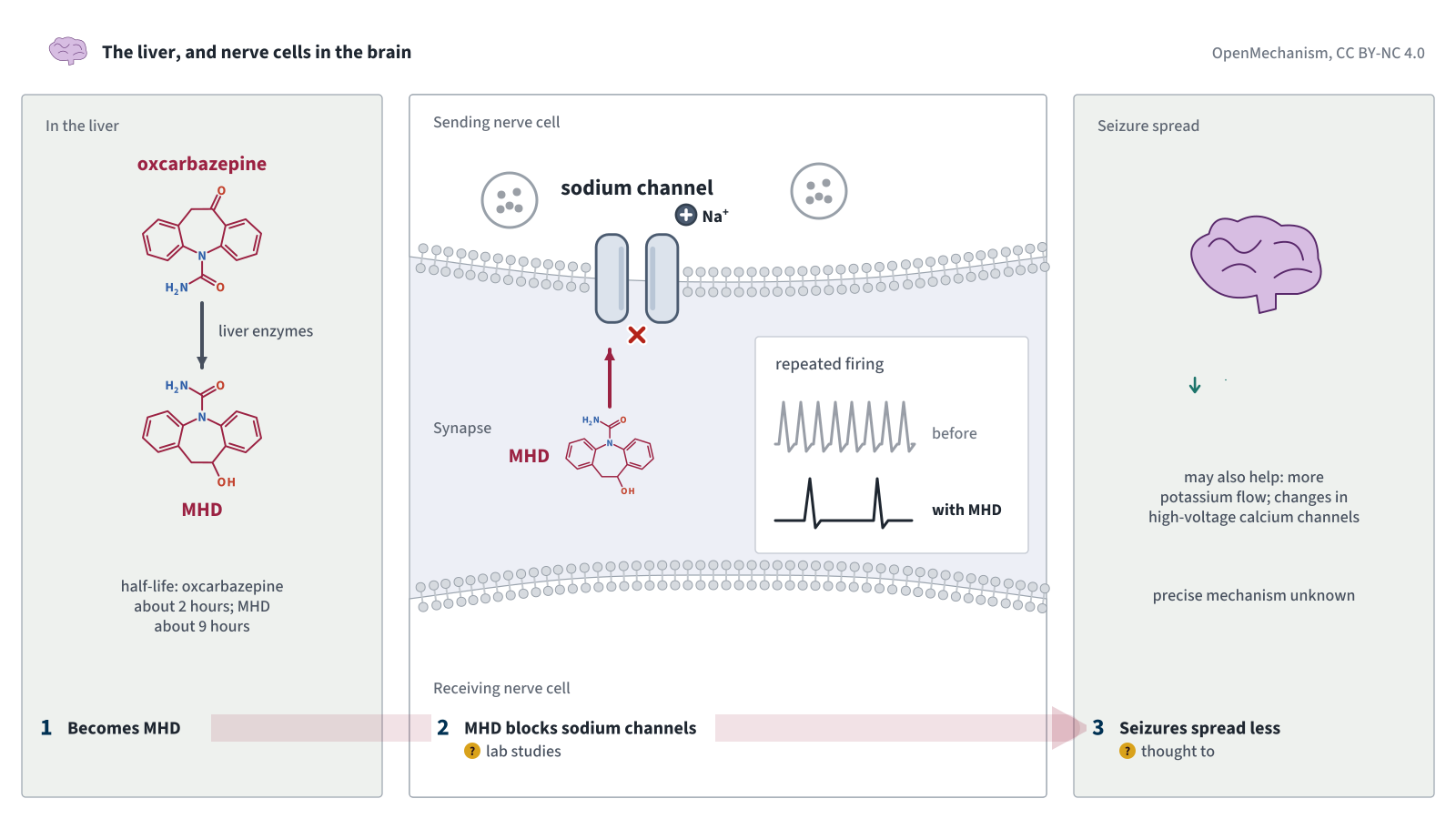
The liver quickly turns oxcarbazepine into MHD, which does most of its work. In laboratory studies, oxcarbazepine and MHD block sodium channels, steadying overexcited nerve cells and holding back repeated firing; this is thought to stop seizures from spreading in the brain. The precise mechanism is unknown.
- Acts on
- Voltage-sensitive sodium channels (in laboratory studies), mostly through its active metabolite MHD
- Where
- Nerve cells in the brain
- Medicine type
- Small molecule
- Used for
- Brain & nerves
- Drug class
- Sodium channel blockers (antiseizure)
Also called Trileptal.
Step 2: lab studies
The Trileptal label says: in vitro electrophysiological studies indicate that they produce blockade of voltage-sensitive sodium channels, resulting in stabilization of hyperexcited neural membranes, inhibition of repetitive neuronal firing, and diminution of propagation of synaptic impulses.
Source 1: Trileptal (oxcarbazepine): FDA label, 12.1 Mechanism of Action; 12.3 Pharmacokinetics
Clinical study: In a double-blind placebo-controlled trial of oxcarbazepine alone in hospitalized people with partial seizures that other medicines had not controlled; the trial measured the time until a set number of seizures, not how oxcarbazepine works: Analysis of the primary efficacy variable--time to meeting one of the exit criteria--showed a statistically significant effect in favor of oxcarbazepine (p = 0.0001).
Schachter SC et al., Neurology 1999 (PMID 10078718)
This study was picked with a literature search and is not yet checked by our reviewer.
Step 3: thought to
The Trileptal label says: The precise mechanism by which oxcarbazepine and MHD exert their anti-seizure effect is unknown … These actions are thought to be important in the prevention of seizure spread in the intact brain.
Source 1: Trileptal (oxcarbazepine): FDA label, 12.1 Mechanism of Action; 12.3 Pharmacokinetics
Clinical study: In a 28-week placebo-controlled trial of three doses of add-on oxcarbazepine in 694 people with partial seizures; the trial measured seizure frequency and blood levels of MHD, not how seizures spread: The median reduction in seizure frequency was 26%, 40%, 50%, or 8% for patients receiving 600, 1200, or 2400 mg/d OXC or placebo, respectively (all p < or = 0.0001). … Higher plasma 10-monohydroxy derivative concentrations were associated with larger decreases in seizure frequency (p = 0.0001).
Barcs G et al., Epilepsia 2000 (PMID 11114219)
This study was picked with a literature search and is not yet checked by our reviewer.
Key terms in this drawing
- half-life
- Half-life. The time it takes for the amount in the blood to fall by half.
How it works
Becomes MHD. Oxcarbazepine is completely absorbed, and enzymes in the cytoplasm of liver cells (cytosolic enzymes) quickly turn it into its 10-monohydroxy metabolite, MHD, which does most of its work. Oxcarbazepine itself has a of about 2 hours; MHD has one of about 9 hours.1
MHD blocks sodium channels. Laboratory (in vitro) studies of nerve cells' electrical activity show that oxcarbazepine and MHD block voltage-sensitive sodium channels. This steadies overexcited nerve cell membranes, holds back repeated firing of nerve cells and reduces the passing on of impulses across synapses. No significant binding to the brain's messenger (neurotransmitter or modulator) receptor sites has been shown.1
Seizures spread less. These actions are thought to be important in preventing seizures from spreading in the brain. More potassium flow (conductance) and changes in high-voltage activated calcium channels may also contribute. The precise mechanism of its antiseizure effect is unknown.1
For teachers: download this drawing.
See also
Condition pages: epilepsy.
Other sodium channel blockers (antiseizure): carbamazepine, lamotrigine, phenytoin and topiramate.
Body system: brain & nerves.
Sources
- 1Trileptal (oxcarbazepine): FDA label12.1 Mechanism of Action; 12.3 Pharmacokinetics
- 2ChEMBL CHEMBL1068Target and action classification: Sodium channel alpha subunit blocker
- 3Oxcarbazepine: double-blind, randomized, placebo-control, monotherapy trial for partial seizuresSchachter SC et al. Neurology 1999 (abstract)
- 4Oxcarbazepine placebo-controlled, dose-ranging trial in refractory partial epilepsyBarcs G et al. Epilepsia 2000 (abstract)
Spotted a mistake? Report an error (hello@openmechanism.com). Since launch, every published error we fix is listed on the corrections page.
Notes and limits
- A schematic teaching drawing: not to scale, not exact structures, binding poses or a complete pathway, and not a guide to dosing, treatment or how a person will respond.
- The label says in vitro electrophysiological studies indicate this sodium-channel blockade.
- The label says these actions are thought to be important in preventing seizure spread, and that the precise mechanism of the anti-seizure effect is unknown.
All recorded limits are on the evidence page, and notes that apply to every page are on How to read a page. Version 1.0.0, not yet medically reviewed.
Cite this page
Tran D. Oxcarbazepine [Internet]. OpenMechanism; 2026 [updated 2026 Oct 16; cited 2026 Oct 16]. Available from: https://openmechanism.com/medicines/oxcarbazepine