Clonazepam
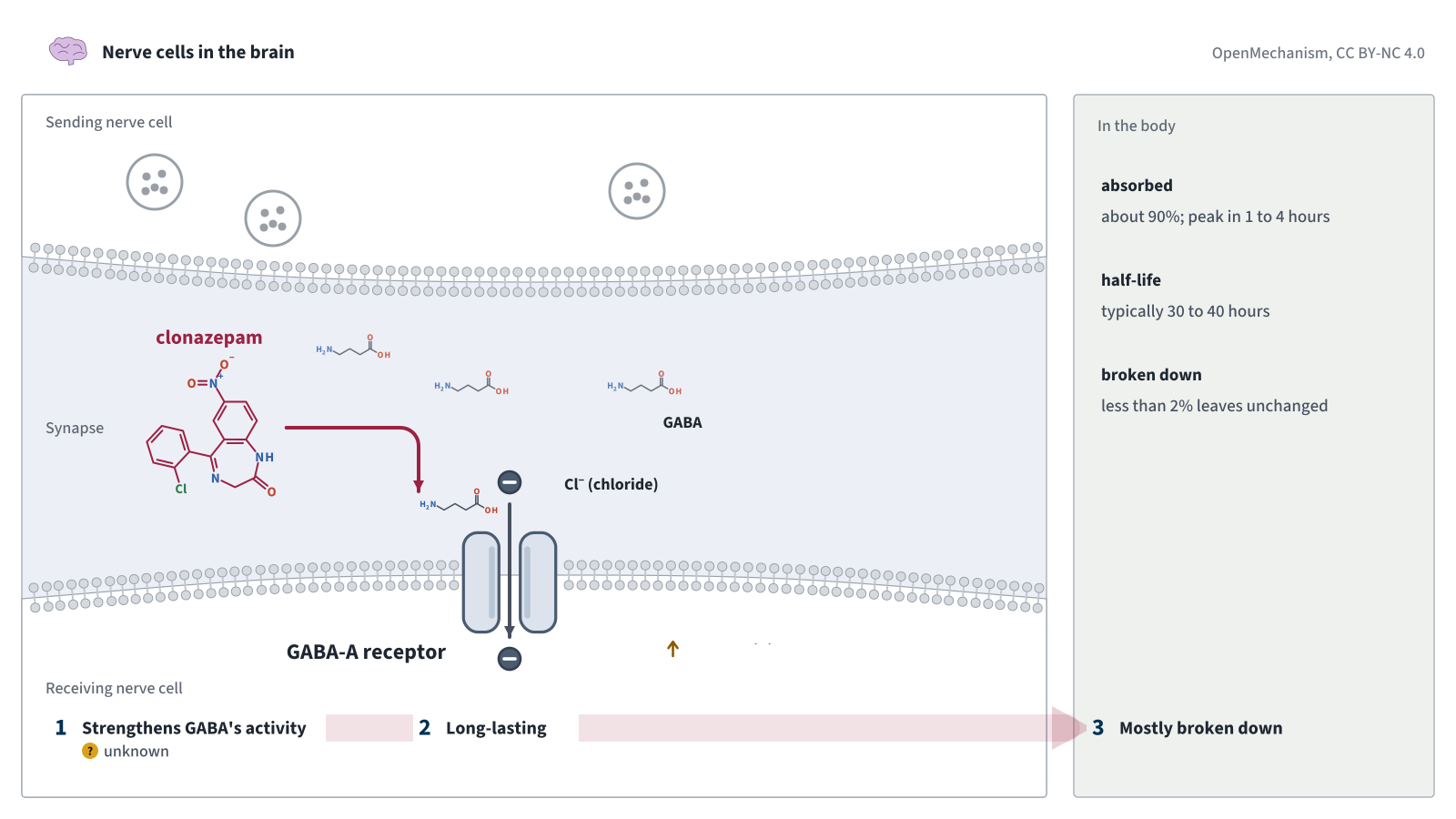
How clonazepam prevents seizures and panic attacks is not known precisely; it is believed to strengthen the activity of , the brain's main braking messenger. It is well absorbed, lasts long (a of 30 to 40 hours) and is almost all broken down before it leaves the body.
- Acts on
- GABA activity in the brain
- Where
- Nerve cells in the brain
- Medicine type
- Small molecule
- Used for
- Brain & nerves
Also called Klonopin.
Step 1: unknown
The Klonopin label says: The precise mechanism by which clonazepam exerts its antiseizure and antipanic effects is unknown, although it is believed to be related to its ability to enhance the activity of gamma aminobutyric acid (GABA), the major inhibitory neurotransmitter in the central nervous system.
Source 1: Klonopin (clonazepam): FDA label, Clinical Pharmacology: Pharmacodynamics; Pharmacokinetics
Clinical study: In a placebo-controlled trial of five fixed daily doses of clonazepam in 413 people with panic disorder; the trial measured clinical improvement and panic attacks, not how clonazepam works: Efficacy measurements at the end of the dose-maintenance phase indicated clinical improvement in all treatment groups but with a clear differentiation of the four higher doses of clonazepam from the 0.5-mg dose and placebo.
Rosenbaum JF et al., J Clin Psychopharmacol 1997 (PMID 9315990)
This study was picked with a literature search and is not yet checked by our reviewer.
Key terms in this drawing
- GABA
- Gamma-aminobutyric acid. The main inhibitory messenger in the central nervous system.
- GABA-A receptor
- Gamma-aminobutyric acid type A receptor. A receptor channel on nerve cells that GABA switches on; benzodiazepines also bind it.
- half-life
- Half-life. The time it takes for the amount in the blood to fall by half.
How it works
Strengthens GABA's activity. The precise mechanism of clonazepam's antiseizure and antipanic effects is unknown, but it is believed to come from strengthening the activity of GABA, the main braking (inhibitory) messenger of the central nervous system.1
Long-lasting. Clonazepam is rapidly and almost completely absorbed (about 90%), reaches peak blood levels within 1 to 4 hours, and has an elimination half-life of typically 30 to 40 hours.1
Mostly broken down. It is highly metabolized, mainly by reduction of its 7-nitro group: less than 2% leaves unchanged in the urine.1
For teachers: download this drawing.
See also
Condition pages: anxiety disorders and epilepsy.
Other GABA-A boosters, including benzodiazepines: alprazolam, diazepam, lorazepam, midazolam, propofol and zolpidem.
Explained: opioids and benzodiazepines.
Body system: brain & nerves.
Sources
- 1Klonopin (clonazepam): FDA labelClinical Pharmacology: Pharmacodynamics; Pharmacokinetics
- 2ChEMBL CHEMBL452Target and action classification: GABA-A receptor; anion channel positive allosteric modulator
- 3Clonazepam in the treatment of panic disorder with or without agoraphobia: a dose-response study of efficacy, safety, and discontinuance. Clonazepam Panic Disorder Dose-Response Study GroupRosenbaum JF et al. J Clin Psychopharmacol 1997 (abstract)
Also used for the drawing
The drawing shares its GABA-A synapse with the other medicines that act there: the receptor is a chloride channel, and chloride usually flows into the receiving nerve cell when GABA opens it. The label does not mention chloride; these two papers back it.
- 4GABA-A receptor signalling mechanisms revealed by structural pharmacologyMasiulis S et al., Nature 2019 (abstract)
- 5Anion transport and GABA signalingHübner CA, Holthoff K, Front Cell Neurosci 2013 (abstract)
Spotted a mistake? Report an error (hello@openmechanism.com). Since launch, every published error we fix is listed on the corrections page.
Notes and limits
- A schematic teaching drawing: not to scale, not exact structures, binding poses or a complete pathway, and not a guide to dosing, treatment or how a person will respond.
- The label says the precise mechanism by which clonazepam exerts its antiseizure and antipanic effects is unknown, although it is believed to be related to its ability to enhance the activity of GABA.
All recorded limits are on the evidence page, and notes that apply to every page are on How to read a page. Version 1.0.0, not yet medically reviewed.
Cite this page
Tran D. Clonazepam [Internet]. OpenMechanism; 2026 [updated 2026 Oct 11; cited 2026 Oct 11]. Available from: https://openmechanism.com/medicines/clonazepam