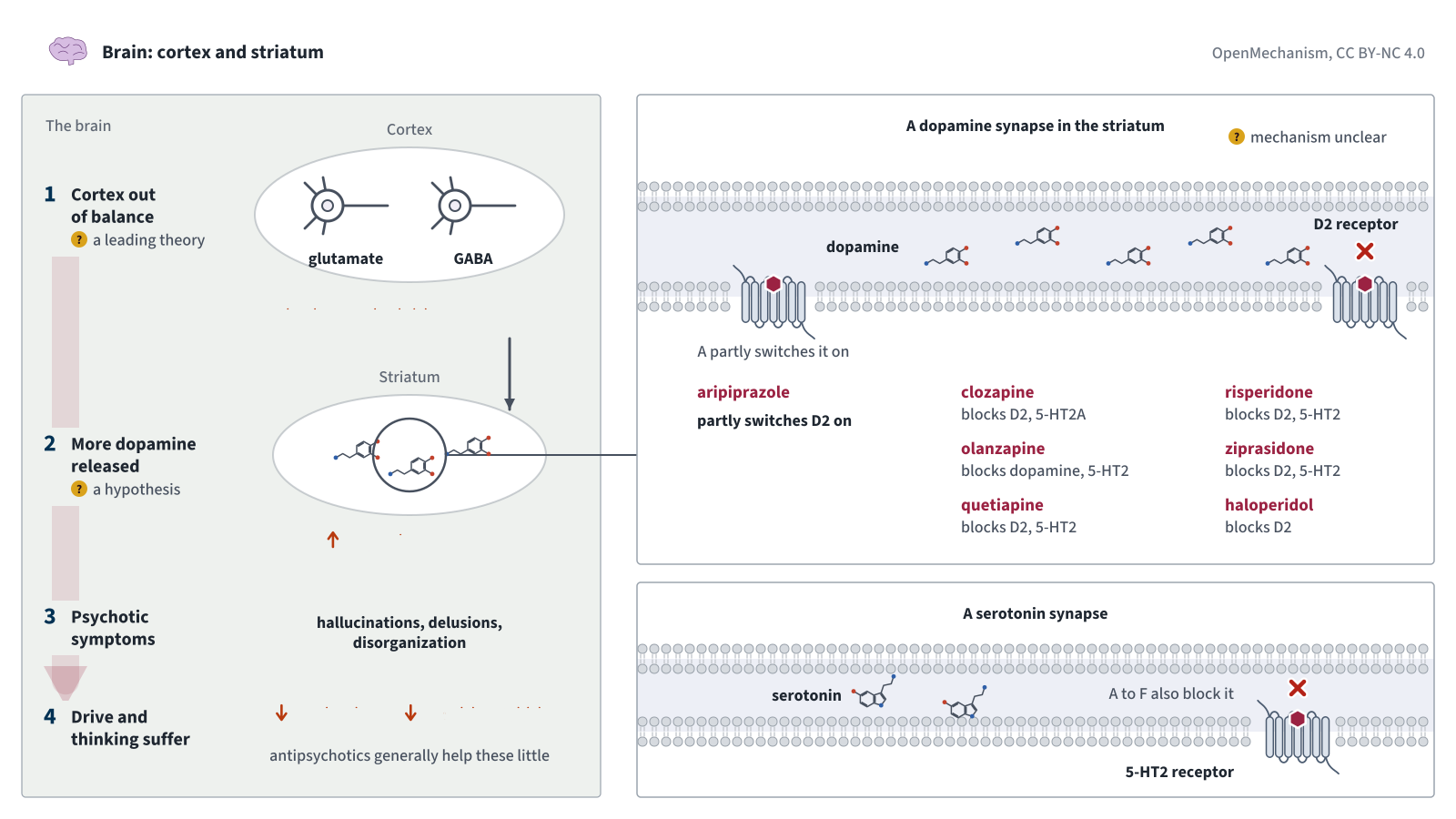
Schizophrenia combines psychotic symptoms, such as hallucinations and delusions, with problems of motivation and thinking; it usually shows itself in late adolescence or early adulthood. A leading theory links an imbalance in the cortex to a faulty dopamine system; the dopamine hypothesis centers on increased dopamine activity in the striatum. The seven antipsychotics on this page act on dopamine D2 receptors, and the labels of all but haloperidol name serotonin receptors too.
What goes wrong in schizophrenia, and where medicines act. Schematic, not to scale. License CC BY-NC 4.0.
?Step 1: a leading theory
The Leucht 2025 review says: A leading theory postulates that excitatory-inhibitory (that is, glutamate-GABA) imbalance in the cortex ultimately leads to dysfunction of the dopaminergic system.
Clinical study: In Smucny and colleagues' 2021 meta-analysis of brain spectroscopy (proton MRS) studies measuring glutamate in people with schizophrenia (36 datasets for the medial prefrontal cortex), which measured one side of the balance, glutamate, and found no significant difference in the dorsolateral prefrontal cortex, hippocampus or thalamus: High-quality measurements reveal consistently reduced medial prefrontal cortex glutamate in schizophrenia.Smucny J et al., Biol Psychiatry 2021 (PMID 34344534)
?Step 2: a hypothesis
The Howes 2009 review, which states the dopamine hypothesis, says: This hypothesis seeks to be comprehensive in providing a framework that links risk factors, including pregnancy and obstetric complications, stress and trauma, drug use, and genes, to increased presynaptic striatal dopaminergic function.
Clinical study: In Howes and colleagues' 2012 meta-analysis of 44 brain imaging (PET and SPECT) studies of striatal dopamine function, comparing 618 people with schizophrenia with 606 controls, which found presynaptic dopamine function raised, with a large effect size: The locus of the largest dopaminergic abnormality in schizophrenia is presynaptic, which affects dopamine synthesis capacity, baseline synaptic dopamine levels, and dopamine release.Howes OD et al., Arch Gen Psychiatry 2012 (PMID 22474070)
?Mechanism unclear
Each label hedges how its medicine works; the Risperdal (risperidone) label says: The mechanism of action of risperidone in schizophrenia is unclear. The drug's therapeutic activity in schizophrenia could be mediated through a combination of dopamine Type 2 (D 2 ) and serotonin Type 2 (5HT 2 ) receptor antagonism.
Clinical study: In Kapur and colleagues' 2000 double-blind brain imaging (PET) study of 22 people with first-episode schizophrenia randomly assigned to haloperidol 1.0 or 2.5 mg a day (raised to 5.0 mg a day if they did not respond), measuring how many of their D2 receptors it occupied after 2 weeks and assessing everyone again at 4 weeks: The degree of receptor occupancy predicted clinical improvement, hyperprolactinemia, and extrapyramidal side effects.Kapur S et al., Am J Psychiatry 2000 (PMID 10739409)
Serotonin (5-hydroxytryptamine, 5-HT) receptors. Receptors that serotonin acts on; they come in several subtypes, such as 5-HT1A and 5-HT2A.
5-HT2A receptor
Serotonin 2A receptor. One of the serotonin receptors; olanzapine binds it strongly.
D2 receptor
Dopamine D2 receptor. A dopamine receptor; in Parkinson disease, ropinirole's effect is thought to be related to its ability to stimulate D2 receptors in the caudate-putamen of the brain.
GABA
Gamma-aminobutyric acid. The main inhibitory messenger in the central nervous system.
What goes wrong
Cortex out of balance. A leading theory holds that an imbalance between excitation and inhibition in the cortex, between glutamate and , ultimately leads to a faulty dopamine system.1
What the source says
“A leading theory postulates that excitatory-inhibitory (that is, glutamate-GABA) imbalance in the cortex ultimately leads to dysfunction of the dopaminergic system.”
More dopamine released. In the dopamine hypothesis, many risk factors, such as genes, complications in pregnancy and birth, stress and trauma, and drug use, converge on increased dopamine activity at the sending nerve endings in the striatum.2
What the source says
“This hypothesis seeks to be comprehensive in providing a framework that links risk factors, including pregnancy and obstetric complications, stress and trauma, drug use, and genes, to increased presynaptic striatal dopaminergic function.”
Psychotic symptoms. Schizophrenia shows itself in psychotic symptoms, such as hallucinations, delusions and disorganization. Faulty dopamine signaling contributes to them, though evidence also points to a widespread, variable involvement of other brain areas and circuits; a review ties psychosocial stressors, psychological factors and dopamine dysfunction below the cortex to the onset of the positive symptoms.3,4,5
What the source says
“Schizophrenia is a chronic psychiatric disorder with a heterogeneous genetic and neurobiological background that influences early brain development, and is expressed as a combination of psychotic symptoms - such as hallucinations, delusions and disorganization - and motivational and cognitive dysfunctions.”
“Dysfunction of dopaminergic neurotransmission contributes to the genesis of psychotic symptoms, but evidence also points to a widespread and variable involvement of other brain areas and circuits.”
“The third theme considers the role of psychosocial stressors, psychological factors, and subcortical dopamine dysfunction in the onset of the positive symptoms of the disorder.”
Drive and thinking suffer. It also brings negative symptoms, with problems of motivation, and broad problems with thinking (a global cognitive deficit); a review ties these to the imbalance in the cortex. Medicines can relieve the psychotic symptoms but generally do not bring substantial improvements in social, cognitive and working life.1,3,5
What the source says
“Schizophrenia is a chronic psychiatric disorder with a heterogeneous genetic and neurobiological background that influences early brain development, and is expressed as a combination of psychotic symptoms - such as hallucinations, delusions and disorganization - and motivational and cognitive dysfunctions.”
“Schizophrenia is a heterogeneous disease with different manifestations, including psychotic symptoms as well as negative symptoms and global cognitive deficit, that do not respond to antipsychotic drugs, making management very difficult.”
“Although pharmacological treatments for schizophrenia can relieve psychotic symptoms, such drugs generally do not lead to substantial improvements in social, cognitive and occupational functioning.”
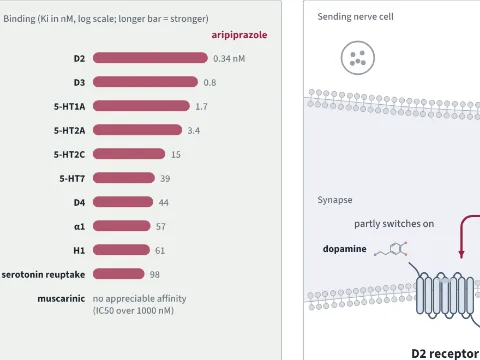
“However, the efficacy of aripiprazole in the listed indications could be mediated through a combination of partial agonist activity at D 2 and 5-HT 1A receptors and antagonist activity at 5-HT 2A receptors.”
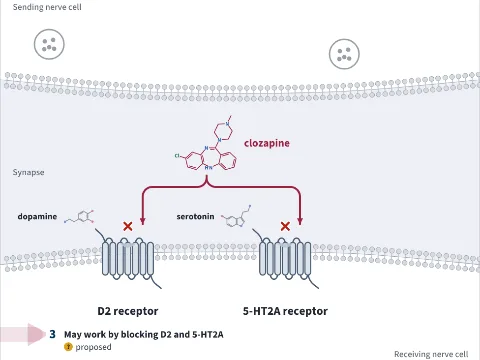
Clozapinetargets D2 and 5-HT2A receptors (proposed)
Proposed to work by blocking D2 and 5-HT2A receptors; the label calls the mechanism unknown.7
Used forSchizophrenia that has not responded adequately to standard antipsychotics: severely ill patients onlyRecurrent suicidal behavior in schizophrenia or schizoaffective disorder: to lower its risk in those judged to be at chronic risk of it
What the label says
“The mechanism of action of clozapine is unknown.”
“However, it has been proposed that the therapeutic efficacy of clozapine in schizophrenia is mediated through antagonism of the dopamine type 2 (D 2 ) and the serotonin type 2A (5-HT 2A ) receptors.”
“CLOZARIL is indicated for the treatment of severely ill patients with schizophrenia who fail to respond adequately to standard antipsychotic treatment. Because of the risks of severe neutropenia and of seizure associated with its use, CLOZARIL should be used only in patients who have failed to respond adequately to standard antipsychotic treatment”
“CLOZARIL is indicated for reducing the risk of recurrent suicidal behavior in patients with schizophrenia or schizoaffective disorder who are judged to be at chronic risk for re-experiencing suicidal behavior, based on history and recent clinical state.”
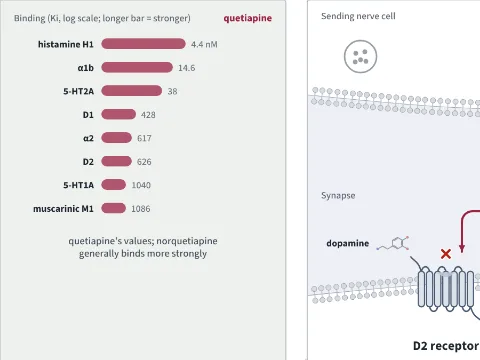
Could work by blocking D2 and serotonin type 2 receptors, with its metabolite norquetiapine; the label calls the mechanism unclear.9
Used forSchizophrenia: adults and adolescents aged 13 to 17
What the label says
“SEROQUEL is indicated for the treatment of schizophrenia. The efficacy of SEROQUEL in schizophrenia was established in three 6-week trials in adults and one 6-week trial in adolescents (13-17 years).”
“However, the efficacy of quetiapine in these indications could be mediated through a combination of dopamine type 2 (D 2 ) and serotonin type 2 (5HT 2 ) antagonism.”
“The active metabolite, N-desalkyl quetiapine (norquetiapine), has similar activity at D 2 , but greater activity at 5HT 2A receptors, than the parent drug (quetiapine).”
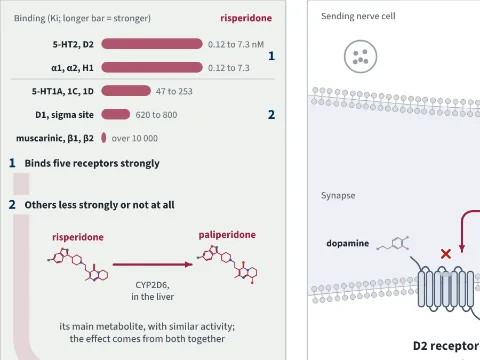
Could work by blocking D2 and serotonin type 2 receptors, with its metabolite paliperidone; the label calls the mechanism unclear.10
Used forSchizophrenia: adults and adolescents aged 13 to 17
What the label says
“RISPERDAL (risperidone) is indicated for the treatment of schizophrenia. Efficacy was established in 4 short-term trials in adults, 2 short-term trials in adolescents (ages 13 to 17 years), and one long-term maintenance trial in adults”
“The drug's therapeutic activity in schizophrenia could be mediated through a combination of dopamine Type 2 (D 2 ) and serotonin Type 2 (5HT 2 ) receptor antagonism.”
“The clinical effect from risperidone results from the combined concentrations of risperidone and its major metabolite, 9-hydroxyrisperidone (paliperidone)”
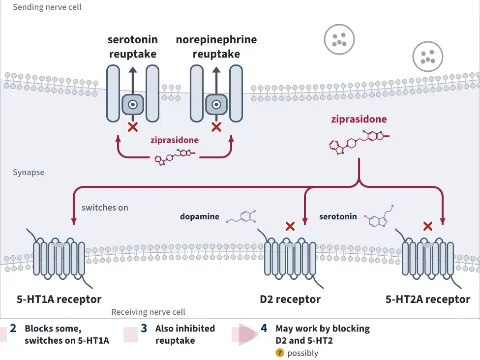
“GEODON intramuscular is indicated for the treatment of acute agitation in schizophrenic adult patients for whom treatment with ziprasidone is appropriate and who need intramuscular antipsychotic medication for rapid control of agitation”
“The mechanism of action of ziprasidone in the treatment of the listed indications could be mediated through a combination of dopamine type 2 (D2) and serotonin type 2 (5HT2) antagonism.”
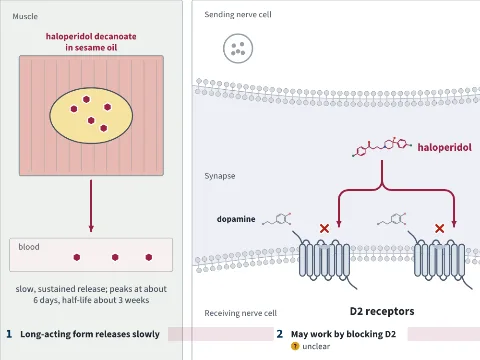
“Haloperidol also binds to alpha-1 adrenergic receptors, but with lower affinity, and displays minimal binding to muscarinic cholinergic and histaminergic (H 1 ) receptors.”
“Haloperidol decanoate 50 and Haloperidol decanoate 100 are indicated for the treatment of patients with schizophrenia who require prolonged parenteral antipsychotic therapy.”
The steps are in the order that explains them; one step is said to cause the next only where a source says so. A review ties the problems with drive and thinking (step 4) to the imbalance in the cortex (step 1).5
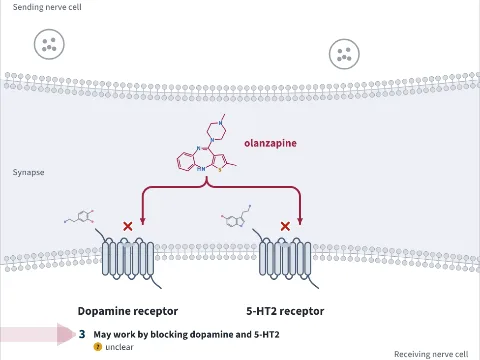
Every label hedges: it calls the mechanism unclear or unknown, or says only what it could be. Each proposal includes dopamine receptors, D2 in all but olanzapine's, and all but haloperidol's include serotonin receptors too.6,7,8,9,10,11,12
The olanzapine label notes a greater potential for weight gain and dyslipidemia in adolescents than in adults.8
The Geodon label says ziprasidone has a greater capacity than several other antipsychotics to prolong the QT/QTc interval, and that in some other medicines a prolonged QTc interval is associated with the ability to cause torsade de pointes, a potentially fatal heart rhythm, and sudden death.11
In the 2009 dopamine hypothesis, the medicines then in use act downstream of the critical change, the extra dopamine activity in the striatum.2
The Leucht 2025 review says: “treatment resistance is frequent. The first medication that targets neurotransmitter systems other than dopamine has been approved for use.”1
Still debated in a 2022 review: whether cannabis and childhood adversity are causes, whether the brain keeps changing after onset, and how well early intervention works in the long run.13
Schizophrenia usually shows itself in late adolescence or early adulthood.1
text ad2176c5527a…; drawings 8c04de39fc4f…; notes d3d21e7b8912…
AI source check
Claude Opus 5.5 (AI source check), 6 November 2026: 69 statements compared with their sources, 9 flagged for the reviewer. An automated check, not a medical review.
Conflict of interest
Ziprasidone: Pfizer, the reviewer's former employer, makes or markets this medicine. Details
text ad9e32abb03c…; drawings 8c04de39fc4f…; notes 0301c24c4b42…
AI source check
The file of this review’s AI source check was later saved over by the check for the review of 9 November 2026, so its own date and counts are not shown. An automated check, not a medical review.
Conflict of interest
Ziprasidone: Pfizer, the reviewer's former employer, makes or markets this medicine. Details
Next review due
7 May 2028
Cite this page
Tran D. Schizophrenia [Internet]. OpenMechanism; 2026 [updated 2026 Nov 9; cited 2026 Nov 9]. Available from: https://openmechanism.com/conditions/schizophrenia