Fluoxetine
Fluoxetine blocks the uptake of serotonin by nerve cells in the brain. The label presumes this is linked to its therapeutic effect but says the exact mechanism is unknown. The Prozac label lists it for the acute and maintenance treatment of major depressive disorder, obsessive-compulsive disorder (OCD) and binge eating and vomiting in moderate to severe bulimia nervosa, and for the acute treatment of panic disorder. Taken with olanzapine, it is also listed for the acute treatment of depressive episodes in bipolar I disorder and for major depressive disorder that has not responded to two separate trials of different antidepressants of adequate dose and duration in the current episode (treatment-resistant depression); the label says fluoxetine alone is not indicated for these two.
- Acts on
- Serotonin transporter
- Where
- Nerve cells in the brain
- Medicine type
- Small molecule
- Used for
- Brain & nerves
Also called Prozac.
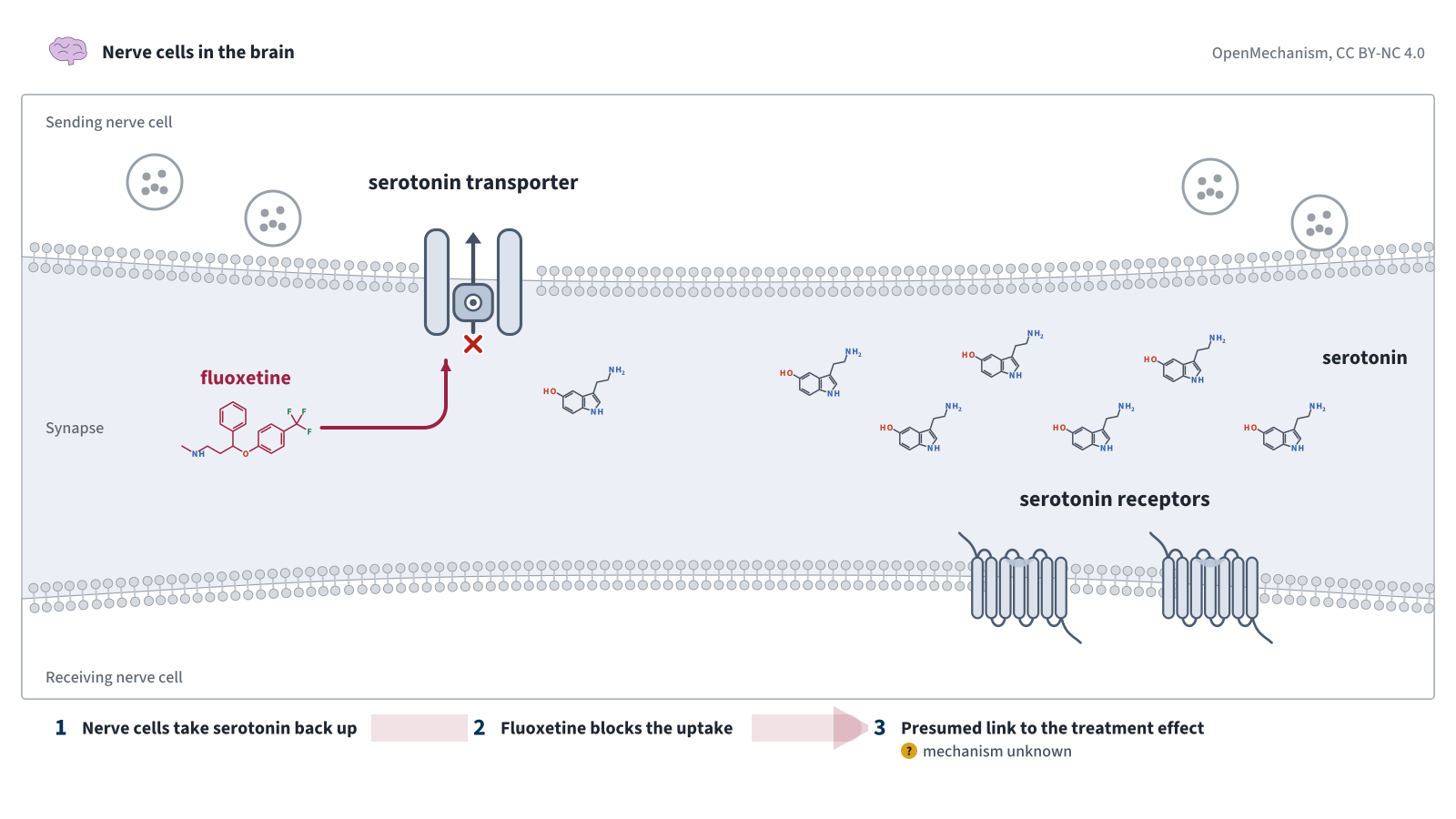
Step 3: mechanism unknown
The Prozac label says: Although the exact mechanism of PROZAC is unknown, it is presumed to be linked to its inhibition of CNS neuronal uptake of serotonin.
Clinical study: In Meyer and colleagues' 2004 brain imaging (PET) study, 77 people took one of five medicines, fluoxetine among them, for 4 weeks: healthy people at doses below those used in treatment, and people with mood and anxiety disorders at treatment doses. It measured how much of the serotonin transporter (5-HTT) was blocked, not the treatment effect: Occupancy of 80% across five SSRIs occurs at minimum therapeutic doses. This suggests that 80% 5-HTT blockade is important for therapeutic effect.
Meyer JH et al., Am J Psychiatry 2004 (PMID 15121647)
Key terms in this drawing
- 5-HT receptors
- Serotonin (5-hydroxytryptamine, 5-HT) receptors. Receptors that serotonin acts on; they come in several subtypes, such as 5-HT1A and 5-HT2A.
How it works
Nerve cells take serotonin back up. Nerve cells of the central nervous system () participate in uptake of serotonin.1
Fluoxetine blocks the uptake. Fluoxetine inhibits this neuronal uptake process. At doses used in treatment it also blocks the uptake of serotonin into human blood platelets, and studies in animals suggest it is a much more potent uptake inhibitor of serotonin than of norepinephrine.1
Presumed link to the treatment effect. The label presumes that this uptake inhibition is linked to therapeutic activity, while stating that the exact mechanism is unknown.1
For teachers: download this drawing or build a slide deck.
See also
Condition pages: anxiety disorders, bipolar disorder, bulimia nervosa, depression and obsessive-compulsive disorder (OCD).
Other serotonin reuptake inhibitors (SSRIs and related): amitriptyline, citalopram, desvenlafaxine, duloxetine, escitalopram, nortriptyline, paroxetine, sertraline and 2 more.
Explained: linezolid and serotonergic medicines; and tamoxifen and CYP2D6 blockers.
Body system: brain & nerves.
Sources
- 1Prozac (fluoxetine hydrochloride): FDA label1 Indications and Usage; 12.1 Mechanism of Action; 12.2 Pharmacodynamics
- 2ChEMBL CHEMBL41Target and action classification: Serotonin transporter inhibitor
- 3A double-blind, randomized, placebo-controlled trial of fluoxetine in children and adolescents with depressionEmslie GJ et al. Arch Gen Psychiatry 1997 (abstract)
- 4Serotonin transporter occupancy of five selective serotonin reuptake inhibitors at different doses: an [11C]DASB positron emission tomography studyMeyer JH et al. Am J Psychiatry 2004 (abstract)
Also used on this page
The limits on this page give this 2016 review's account of what antidepressants that act on serotonin mainly aim to do; the steps above come from the sources listed above.
- 5The serotonergic system in the neurobiology of depression: relevance for novel antidepressantsKöhler S et al. J Psychopharmacol 2016 (abstract)
Spotted a mistake? Report an error (hello@openmechanism.com). Since launch, every published error we fix is listed on the corrections page.
Notes and limits
- A schematic teaching drawing: not to scale, not exact structures, binding poses or a complete pathway, and not a guide to dosing, treatment or how a person will respond.
- The steps are in the order that explains them; one step is said to cause the next only where the source says so.
- Only the blocking of serotonin uptake is shown as fluoxetine's action on cells; the label presumes its treatment effect is linked to this but says the exact mechanism is unknown.
- A 2016 review says antidepressants that act on serotonin mainly aim to raise serotonin levels, increasing serotonin signaling at the synapse, for example by inhibiting the serotonin transporter.
All recorded limits are on the evidence page, and notes that apply to every page are on How to read a page. Version 1.0.1, medically reviewed by Daniel Tran, PharmD, on 3 November 2026.
Cite this page
Tran D. Fluoxetine [Internet]. OpenMechanism; 2026 [updated 2026 Nov 3; cited 2026 Nov 3]. Available from: https://openmechanism.com/medicines/fluoxetine