Buprenorphine
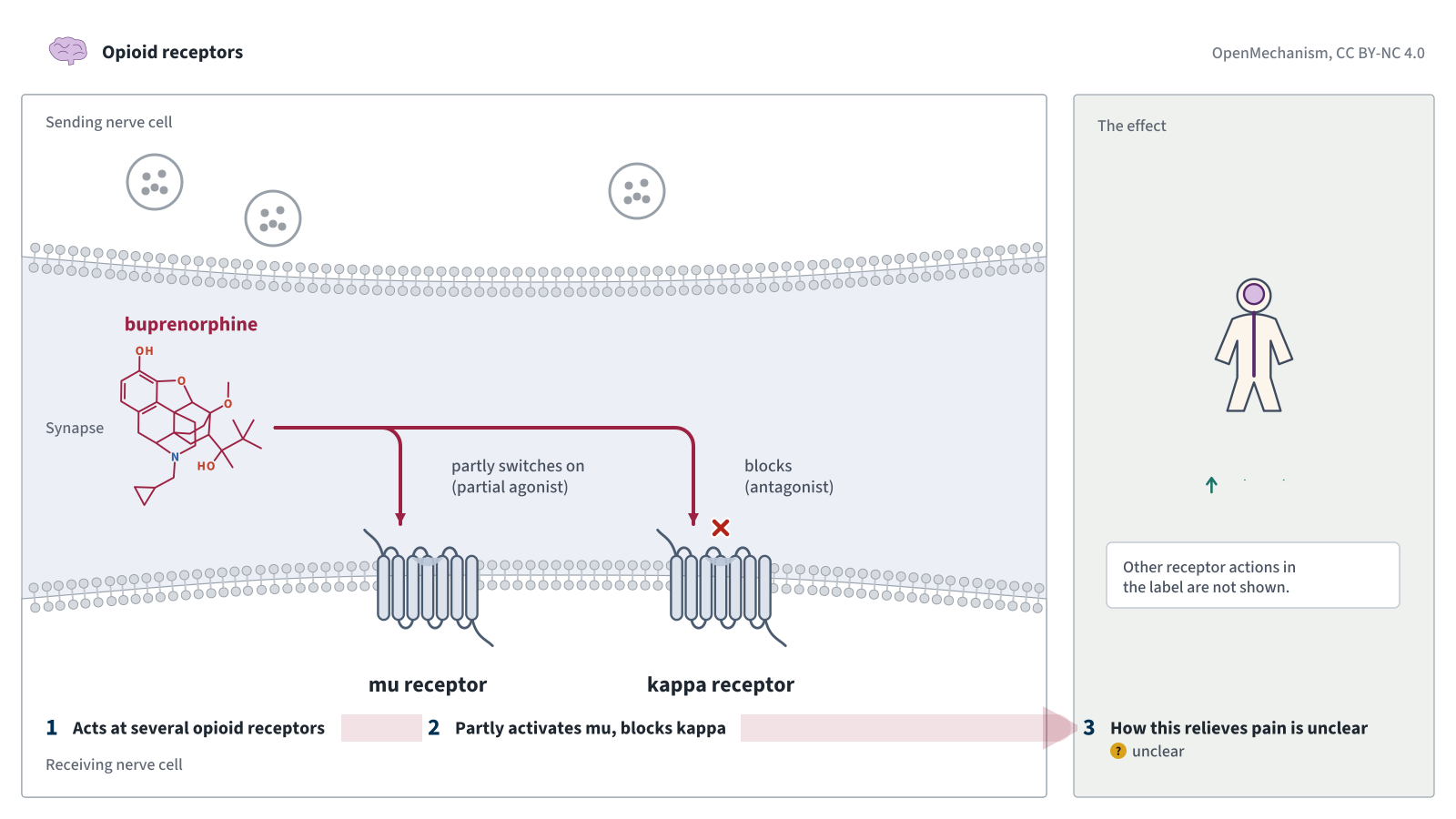
Buprenorphine acts at several types of opioid receptor. It partly activates mu receptors and blocks kappa receptors; the label says how these actions add up to pain relief is unclear.
- Acts on
- Mu opioid receptor, kappa opioid receptor
- Where
- Opioid receptors
- Medicine type
- Small molecule
- Used for
- Brain & nerves
- Drug class
- Opioids
Also called Butrans.
Step 3: unclear
The Butrans label says: Buprenorphine is a partial agonist at the mu-opioid receptor and an antagonist at the kappa-opioid receptors, an agonist at delta-opioid receptors, and a partial agonist at ORL-1 (nociceptin) receptors. The contributions of these actions to its analgesic profile are unclear.
Source 1: Butrans (buprenorphine): FDA label, 12.1 Mechanism of Action
Clinical study: In a randomized, double-blind trial of buprenorphine skin patches (35 to 70 micrograms an hour) or placebo patches in 157 people with chronic, severe pain from cancer or other diseases; the trial measured pain relief and the need for extra pain medicine, not how buprenorphine works: Buprenorphine TDS was shown to be an effective analgesic against chronic, severe pain in this study population.
Sittl R et al., Clin Ther 2003 (PMID 12637117)
This study was picked with a literature search and is not yet checked by our reviewer.
Key terms in this drawing
- agonist
- Agonist. A molecule that binds a receptor and activates it, as the body's own messenger does.
- antagonist
- Antagonist. A molecule that blocks a receptor (or another target). Irbesartan, for example, binds its receptor without activating it.
How it works
Acts at several opioid receptors. The selected label describes activity at several opioid receptor classes.1
Partly activates mu, blocks kappa. At the mu receptor it is a partial , while its kappa action is antagonism.1
How this relieves pain is unclear. The contribution of these and the other labeled receptor actions to the analgesic profile is unclear.1
For teachers: download this drawing or build a slide deck.
See also
Condition pages: opioid use disorder.
Side effects: opioid overdose.
Other opioids: fentanyl, hydrocodone, loperamide, morphine, oxycodone and tramadol.
Body system: brain & nerves.
Sources
- 1Butrans (buprenorphine): FDA label12.1 Mechanism of Action
- 2ChEMBL CHEMBL511142Target and action classification: Kappa opioid receptor agonist; Mu opioid receptor agonist
- 3
Spotted a mistake? Report an error (hello@openmechanism.com). Since launch, every published error we fix is listed on the corrections page.
Notes and limits
- A schematic teaching drawing: not to scale, not exact structures, binding poses or a complete pathway, and not a guide to dosing, treatment or how a person will respond.
- Other medicines in the same family may not follow every step or share the same clinical endpoint.
- The steps are in the order that explains them; one step is said to cause the next only where the source says so.
- Do not infer that all receptors share partial agonism or draw a quantitatively resolved receptor-to-pain circuit.
- The selected current product label includes delta agonism and ORL1 partial agonism as additional actions; these are omitted from the main visual branch.
All recorded limits are on the evidence page, and notes that apply to every page are on How to read a page. Version 1.0.0, not yet medically reviewed.
Cite this page
Tran D. Buprenorphine [Internet]. OpenMechanism; 2026 [updated 2026 Oct 21; cited 2026 Oct 21]. Available from: https://openmechanism.com/medicines/buprenorphine