Trazodone
Trazodone blocks the of serotonin and blocks serotonin's receptors, along with some other receptors. Its label lists it for major depressive disorder in adults. The label says the net result of its two actions on serotonin signaling is unknown, and how it treats depression is not fully understood.
- Acts on
- Serotonin transporter and 5-HT2A receptors
- Where
- Nerve cells in the brain and spinal cord
- Medicine type
- Small molecule
- Used for
- Brain & nerves
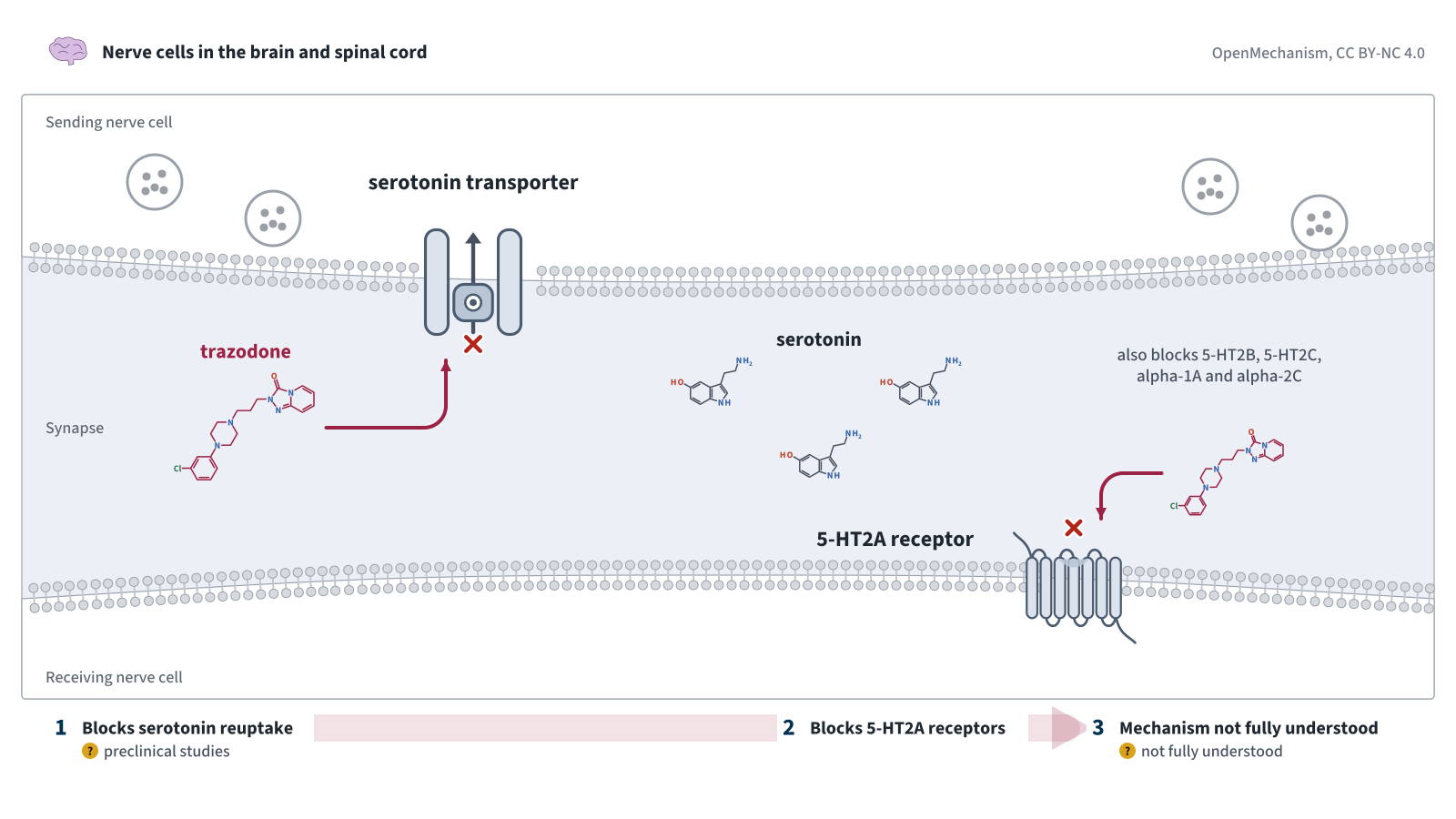
Step 1: preclinical studies
The trazodone label says: Preclinical studies have shown that trazodone selectively inhibits neuronal reuptake of serotonin (Ki = 367 nM) and acts as an antagonist at 5-HT-2A (Ki = 35.6 nM) serotonin receptors.
Clinical study: In Cunningham and colleagues' 1994 double-blind, 6-week trial of venlafaxine, trazodone or placebo in 225 people with major depression (149 completed); the trial measured depression ratings, not serotonin reuptake: Both active treatments were significantly more effective than placebo on some measures during the short-term study, but venlafaxine produced more improvement in the cognitive disturbance and retardation factors on the Hamilton Rating Scale for Depression. Trazodone was more effective against the sleep disturbance factor.
Cunningham LA et al., J Clin Psychopharmacol 1994 (PMID 8195464)
Step 3: not fully understood
The trazodone label says: The mechanism of trazodone's antidepressant action is not fully understood, but is thought to be related to its enhancement of serotonergic activity in the CNS. Trazodone is both a selective serotonin reuptake inhibitor (SSRI) and a 5HT2 receptor antagonist and the net result of this action on serotonergic transmission and its role in trazodone's antidepressant effect is unknown.
Clinical study: In Sheehan and colleagues' 2009 randomized, double-blind trial of a once-daily form of trazodone (150 to 375 mg a day) against placebo in 412 people with major depressive disorder, with the dose adjusted over 2 weeks and then 6 more weeks of treatment; the trial measured depression ratings, not how trazodone works: There was a statistically significant difference between trazodone and placebo on the mean HAMD-17 score (-11.4 vs. -9.3, P=0.012).
Sheehan DV et al., Psychiatry (Edgmont) 2009 (PMID 19724732)
Key terms in this drawing (5)
- 5-HT receptors
- Serotonin (5-hydroxytryptamine, 5-HT) receptors. Receptors that serotonin acts on; they come in several subtypes, such as 5-HT1A and 5-HT2A.
- 5-HT2A receptor
- Serotonin 2A receptor. One of the serotonin receptors; olanzapine binds it strongly.
- 5-HT2C receptor
- Serotonin 2C receptor. One of the serotonin receptors; olanzapine binds it strongly.
- alpha-1 receptor
- Alpha-1 adrenergic receptor. Alpha-1 adrenergic receptors come in at least three subtypes, A, B and D; alpha-1A may have a main role in prostate obstruction, alpha-1B in tightening arteries.
- alpha-2 receptor
- Alpha-2 adrenergic receptor. An adrenergic receptor. Brimonidine switches it on and lowers the pressure inside the eye.
How it works
Blocks serotonin reuptake. In preclinical studies, trazodone selectively inhibits the reuptake of serotonin by nerve cells.1
Blocks 5-HT2A receptors. Trazodone also blocks (antagonizes) serotonin 5-HT2A receptors, binding them more tightly than the transporter in preclinical studies, and blocks other receptors, including , , and ; it partly activates . Blocking alpha-1 receptors may be linked to low blood pressure on standing up.1
Mechanism not fully understood. The label says how trazodone works in depression is not fully understood. It is thought to relate to stronger serotonin activity in the central nervous system, but the net result of its two actions on serotonin signaling, and their role in its effect, is unknown.1
For teachers: download this drawing.
See also
Condition pages: depression.
Other serotonin reuptake inhibitors (SSRIs and related): amitriptyline, citalopram, desvenlafaxine, duloxetine, escitalopram, fluoxetine, nortriptyline, paroxetine and 2 more.
Body system: brain & nerves.
Sources
- 1Trazodone hydrochloride tablets: FDA label1 Indications and Usage; 12.1 Mechanism of Action; 12.2 Pharmacodynamics
- 2ChEMBL CHEMBL621Target and action classification: Serotonin 2a (5-HT2a) receptor antagonist; Serotonin 2c (5-HT2c) receptor antagonist; Serotonin transporter inhibitor
- 3A comparison of venlafaxine, trazodone, and placebo in major depressionCunningham LA et al. J Clin Psychopharmacol 1994 (abstract)
- 4Extended-release Trazodone in Major Depressive Disorder: A Randomized, Double-blind, Placebo-controlled StudySheehan DV et al. Psychiatry (Edgmont) 2009 (abstract)
Spotted a mistake? Report an error (hello@openmechanism.com). Since launch, every published error we fix is listed on the corrections page.
Notes and limits
- A schematic teaching drawing: not to scale, not exact structures, binding poses or a complete pathway, and not a guide to dosing, treatment or how a person will respond.
- The steps are in the order that explains them; one step is said to cause the next only where the source says so.
- The label says the mechanism of trazodone's antidepressant action is not fully understood, and that the net result of its actions on serotonergic transmission and their role are unknown.
All recorded limits are on the evidence page, and notes that apply to every page are on How to read a page. Version 1.0.1, medically reviewed by Daniel Tran, PharmD, on 6 November 2026.
Cite this page
Tran D. Trazodone [Internet]. OpenMechanism; 2026 [updated 2026 Nov 6; cited 2026 Nov 6]. Available from: https://openmechanism.com/medicines/trazodone