Opioid use disorder
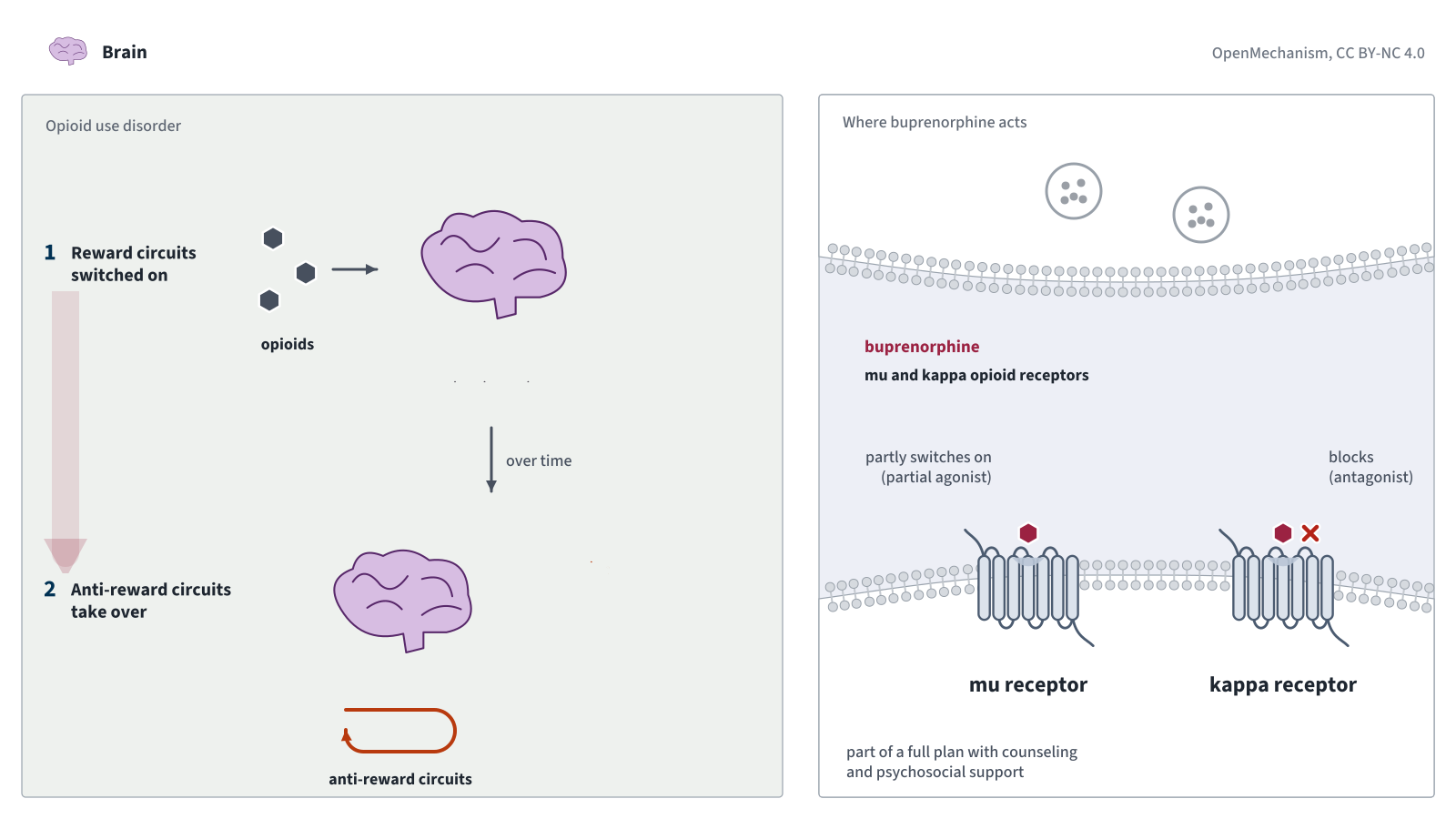
Opioid use disorder is a long-lasting disorder that tends to relapse, with more than 100,000 overdose deaths a year worldwide. Opioids first switch on the brain's reward circuits, but over time 'anti-reward' circuits drive bad feelings and relapse. Buprenorphine, used in a plan with counseling and support, partly switches on the mu opioid receptor and blocks the kappa receptor.
- Where
- Brain
- Body system
- Brain & nerves
- Medicines
- 1 medicine
For teachers: download this drawing.
Key terms in this drawing
- agonist
- Agonist. A molecule that binds a receptor and activates it, as the body's own messenger does.
- antagonist
- Antagonist. A molecule that blocks a receptor (or another target). Irbesartan, for example, binds its receptor without activating it.
What goes wrong
Reward circuits switched on. Opioid use disorder is a long-lasting, relapsing disorder, at first driven by opioids switching on the brain's reward circuits.1
What the source says
“Opioid use disorder (OUD) is a chronic relapsing disorder that, whilst initially driven by activation of brain reward neurocircuits”
Source 1Anti-reward circuits take over. Over time it engages 'anti-reward' circuits that drive bad feelings and relapse.1
What the source says
“increasingly engages anti-reward neurocircuits that drive adverse emotional states and relapse.”
Source 1
Where medicines act
- A
Buprenorphine: a partial switch at the mu receptor
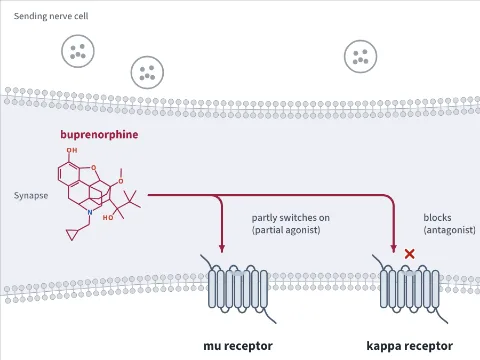
Buprenorphine partly switches on the mu opioid receptor and blocks the kappa opioid receptor. It treats moderate to severe opioid use disorder as part of a full plan with counseling and psychosocial support.2
What the source says
“Buprenorphine is a partial agonist at the mu- opioid receptor and an antagonist at the kappa-opioid receptor.”
Source 2“SUBLOCADE is indicated for the treatment of moderate to severe opioid use disorder”
Source 2“SUBLOCADE should be used as part of a complete treatment plan that includes counseling and psychosocial support.”
Source 2
See also
Body system: brain & nerves.
Can raise or cause it: fentanyl (“Fentanyl Citrate Injection exposes users to risks of addiction, abuse, and misuse, which can lead to overdose and death.”3).
Related medicines: naloxone.
Other conditions: alcohol use disorder; severe and persistent pain; and opioid overdose.
The medicine in the body: codeine, tramadol and the CYP2D6 gene.
Side effects: why naloxone can bring on opioid withdrawal.
Sources
- 1Opioid use disorderStrang J et al. Nat Rev Dis Primers 2020 (abstract). Saved copy
- 2Sublocade (buprenorphine): FDA label1 Indications and Usage; 12.1 Mechanism of Action. Saved copy
- 3Fentanyl citrate injection (Hospira): FDA labelBoxed Warning. Saved copy
Notes and limits
- Recovery is possible with treatment, but the tendency to relapse remains.1
Notes that apply to every page are on How to read a page.
Spotted a mistake? Report an error (hello@openmechanism.com). Since launch, every published error we fix is listed on the corrections page.
Cite this page
Tran D. Opioid use disorder [Internet]. OpenMechanism; 2026 [updated 2026 Oct 21; cited 2026 Oct 21]. Available from: https://openmechanism.com/conditions/opioid-use-disorder