Migraine
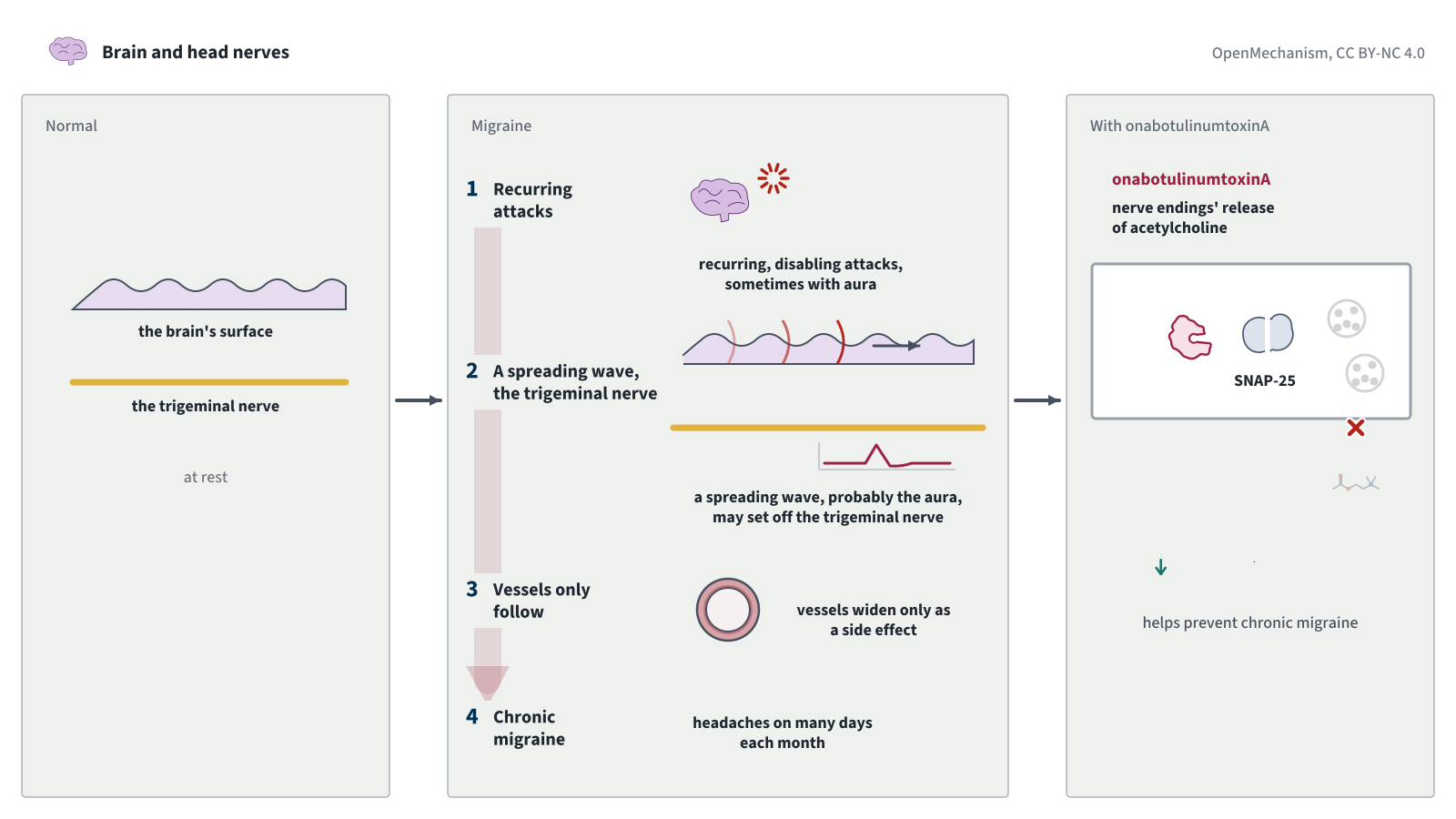
Migraine is a common, long-term disorder of recurring, disabling headache attacks, sometimes with aura. A spreading wave across the brain probably causes the aura and may set off the trigeminal nerve, which drives the pain; vessels widen only as a side effect. In chronic migraine, headaches come on 15 or more days a month. OnabotulinumtoxinA stops nerve endings releasing acetylcholine.
- Where
- Brain and head nerves
- Body system
- Brain & nerves
- Medicines
- 1 medicine
For teachers: download this drawing.
Key terms in this drawing
- SNAP25
- Synaptosomal-associated protein 25. A protein nerve endings need to release acetylcholine.
What goes wrong
Recurring attacks. Migraine is a common, long-term disorder of recurring disabling headache attacks with other symptoms, sometimes an aura.1
What the source says
“Migraine is a common, chronic, disorder that is typically characterized by recurrent disabling attacks of headache and accompanying symptoms, including aura.”
Source 1A spreading wave, the trigeminal nerve. A spreading wave of depolarization across the brain probably causes the aura, and may set off the trigeminal nerve, which drives the headache.1
What the source says
“Spreading depolarization probably causes aura and possibly also triggers trigeminal sensory activation, the underlying mechanism for the headache.”
Source 1Vessels only follow. Widening of blood vessels is only a side effect of the attack, and narrowing them is not needed for treatment to work.1
What the source says
“Despite earlier beliefs, vasodilation is only a secondary phenomenon and vasoconstriction is not essential for antimigraine efficacy.”
Source 1Chronic migraine. In chronic migraine, headaches come on 15 or more days a month.2
What the source says
“chronic migraine (≥15 days per month with headache lasting 4 hours a day or longer)”
Source 2
Where medicines act
- A
OnabotulinumtoxinA: nerve-ending signals blocked
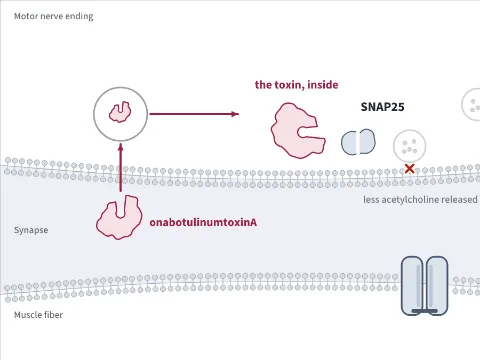
OnabotulinumtoxinA enters nerve endings and stops them releasing acetylcholine. It helps prevent headaches in adults with chronic migraine.1,2
What the source says
“BOTOX blocks neuromuscular transmission by binding to acceptor sites on motor or autonomic nerve terminals, entering the nerve terminals, and inhibiting the release of acetylcholine.”
Source 2“Prophylaxis of headaches in adult patients with chronic migraine”
Source 2“Intramuscular onabotulinumtoxinA may be helpful in chronic migraine”
Source 1
See also
Body system: brain & nerves.
Related medicines: propranolol, topiramate, divalproex sodium, sumatriptan and rimegepant.
Other conditions: vertigo; epilepsy; bipolar disorder; excessive sweating (hyperhidrosis); overactive bladder; and spasticity and dystonia.
Sources
- 1MigraineFerrari MD et al. Nat Rev Dis Primers 2022 (abstract). Saved copy
- 2Botox (onabotulinumtoxinA): FDA label1 Indications and Usage; 12.1 Mechanism of Action. Saved copy
- 3Botulinum toxin A light chain with SNAP-25, the protein it cutsPDB 1XTG; Breidenbach, M.A., Brunger, A.T. Nature 2004;432:925-929. The botulinum toxin A outline in the drawing is traced from this structure. Saved copy
Notes and limits
- It has not been shown to work for episodic migraine (14 or fewer headache days a month).2
Notes that apply to every page are on How to read a page.
Spotted a mistake? Report an error (hello@openmechanism.com). Since launch, every published error we fix is listed on the corrections page.
Cite this page
Tran D. Migraine [Internet]. OpenMechanism; 2026 [updated 2026 Oct 20; cited 2026 Oct 20]. Available from: https://openmechanism.com/conditions/migraine