Overactive bladder
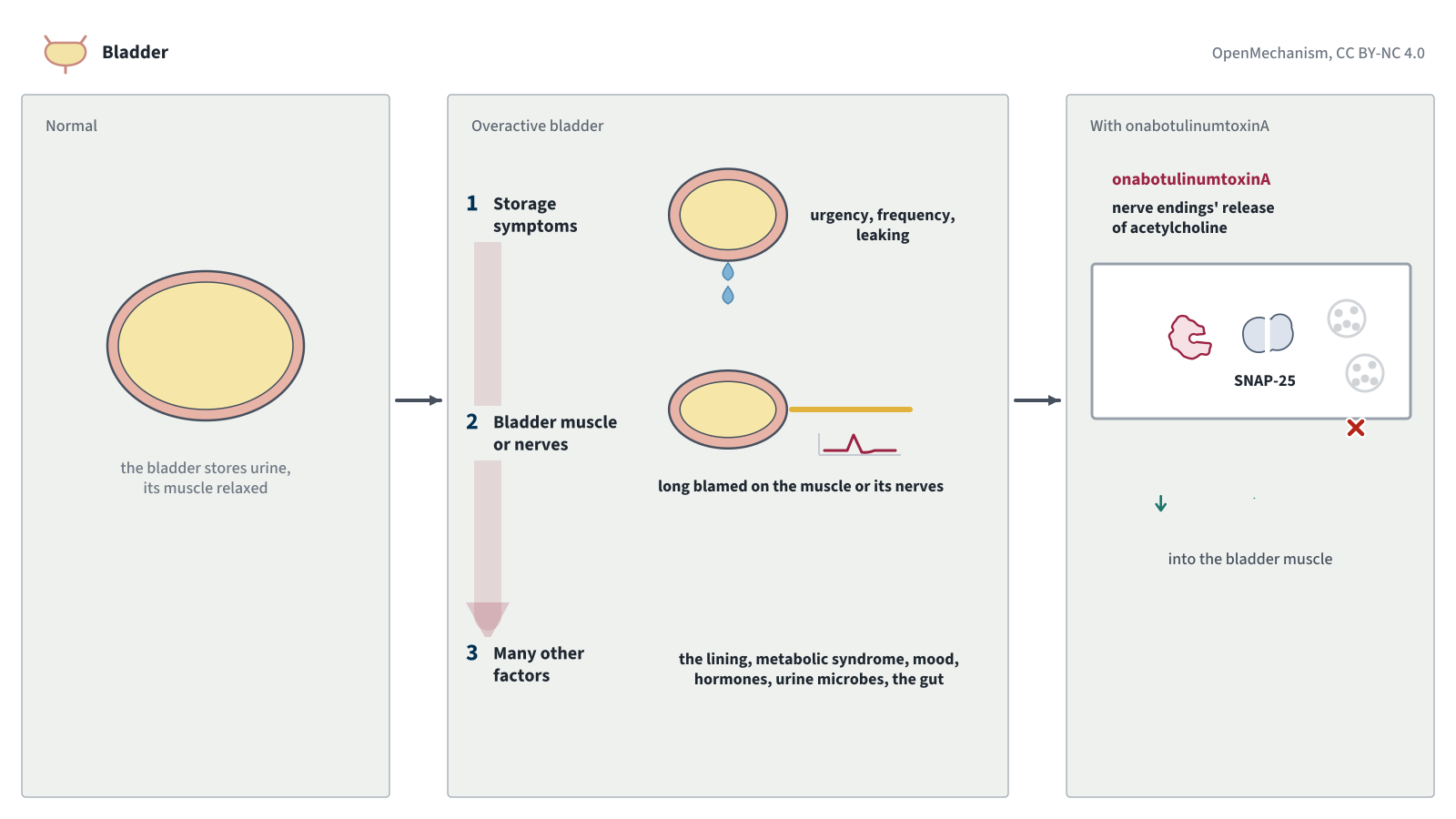
Overactive bladder is a set of storage symptoms (urgency, with frequency and leaking) whose causes are poorly defined. It was long blamed on an overactive bladder muscle, but many people show none; the bladder lining, the urethra, metabolic syndrome, mood, hormones and gut problems may all play a part. OnabotulinumtoxinA stops nerve endings releasing acetylcholine into the bladder muscle.
- Where
- Bladder
- Body systems
- Bladder & reproductive organs, Brain & nerves
- Medicines
- 1 medicine
For teachers: download this drawing.
Key terms in this drawing
- SNAP25
- Synaptosomal-associated protein 25. A protein nerve endings need to release acetylcholine.
What goes wrong
Storage symptoms. Overactive bladder is a set of storage symptoms whose causes are poorly defined.1
What the source says
“OAB is a nonspecific storage symptom complex with poorly defined pathophysiology.”
Source 1Bladder muscle or nerves. It was long blamed on the bladder muscle (detrusor) contracting on its own, or on the nervous system setting off contractions.1
Many other factors. Many people show no overactive muscle on testing. The bladder lining, metabolic syndrome, mood disorders, low sex hormones, urine microbes and gut problems have all been implicated.1
What the source says
“Patients with OAB are often found to not have objective evidence of DO on urodynamic studies”
Source 1“Several other pathophysiological factors have been implicated, including metabolic syndrome, affective disorders, sex hormone deficiency, urinary microbiota, gastrointestinal functional disorders, and subclinical autonomic nervous system dysfunctions.”
Source 1
Where medicines act
- A
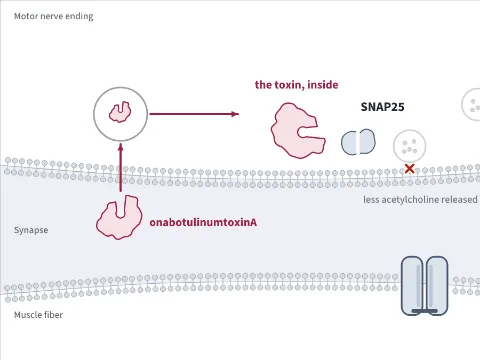
OnabotulinumtoxinA: acetylcholine release blocked
OnabotulinumtoxinA enters nerve endings and stops them releasing acetylcholine. Injected into the bladder, it treats overactive bladder with urgency, leaking and frequency when anticholinergic medicines have not worked or are not tolerated.2
What the source says
“BOTOX blocks neuromuscular transmission by binding to acceptor sites on motor or autonomic nerve terminals, entering the nerve terminals, and inhibiting the release of acetylcholine.”
Source 2“Treatment of overactive bladder (OAB) with symptoms of urge urinary incontinence, urgency, and frequency, in adults who have an inadequate response to or are intolerant of an anticholinergic medication”
Source 2
See also
Body systems: bladder & reproductive organs and brain & nerves.
Related medicines: oxybutynin.
Other conditions: excessive sweating (hyperhidrosis); migraine; spasticity and dystonia; and acute pain and period pain.
Side effects: why anticholinergic medicines cause dry mouth, constipation and confusion.
Sources
- 1A comprehensive review of overactive bladder pathophysiology: on the way to tailored treatmentPeyronnet B et al. Eur Urol 2019 (abstract). Saved copy
- 2Botox (onabotulinumtoxinA): FDA label1 Indications and Usage; 12.1 Mechanism of Action. Saved copy
- 3Botulinum toxin A light chain with SNAP-25, the protein it cutsPDB 1XTG; Breidenbach, M.A., Brunger, A.T. Nature 2004;432:925-929. The botulinum toxin A outline in the drawing is traced from this structure. Saved copy
Notes and limits
- It is a complex syndrome with many possible mechanisms, not one cause.1
Notes that apply to every page are on How to read a page.
Spotted a mistake? Report an error (hello@openmechanism.com). Since launch, every published error we fix is listed on the corrections page.
Cite this page
Tran D. Overactive bladder [Internet]. OpenMechanism; 2026 [updated 2026 Oct 19; cited 2026 Oct 19]. Available from: https://openmechanism.com/conditions/overactive-bladder