Clozapine
Clozapine blocks many receptors. It binds most strongly to and adrenergic α1A, then to several and , and more weakly to , D2 among them. The Clozaril label lists it for severely ill people with schizophrenia who have not responded adequately to standard antipsychotic treatment, a limit it ties to the risks of severe neutropenia and of seizure, and for reducing the risk of recurrent suicidal behavior in people with schizophrenia or schizoaffective disorder judged to be at chronic risk of it. The label says how it works is unknown, and that it has been proposed that its effect in schizophrenia comes from blocking D2 and receptors.
- Acts on
- Many receptors, including dopamine D2 and serotonin 5-HT2A
- Where
- Nerve cells in the brain
- Medicine type
- Small molecule
- Used for
- Brain & nerves
- Drug class
- Antipsychotics
Also called Clozaril.
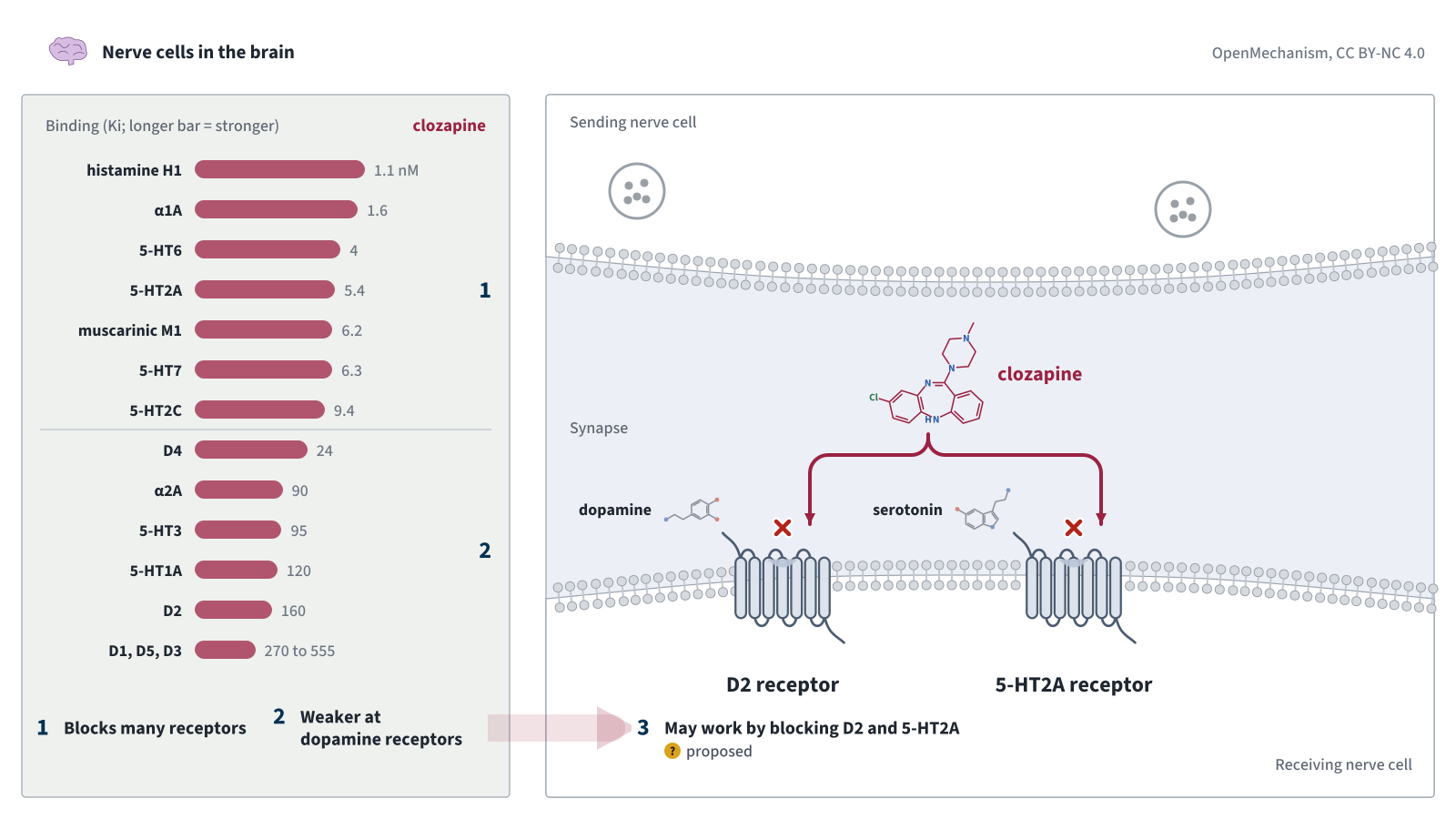
Step 3: proposed
The Clozaril label says: The mechanism of action of clozapine is unknown. However, it has been proposed that the therapeutic efficacy of clozapine in schizophrenia is mediated through antagonism of the dopamine type 2 (D 2 ) and the serotonin type 2A (5-HT 2A ) receptors.
Clinical study: In Kane and colleagues' 1988 trial, 268 people with schizophrenia that had not responded to at least three other antipsychotics, nor then to six weeks of haloperidol, were randomly assigned, double-blind, to clozapine (up to 900 mg a day) or chlorpromazine (up to 1800 mg a day) for six weeks; the trial measured symptoms, not how clozapine works: When a priori criteria were used, 30% of the clozapine-treated patients were categorized as responders compared with 4% of chlorpromazine-treated patients.
Kane J et al., Arch Gen Psychiatry 1988 (PMID 3046553)
Key terms in this drawing (8)
- 5-HT receptors
- Serotonin (5-hydroxytryptamine, 5-HT) receptors. Receptors that serotonin acts on; they come in several subtypes, such as 5-HT1A and 5-HT2A.
- 5-HT1A receptor
- Serotonin 1A receptor. One of the serotonin receptors; in lab studies, buspirone binds it strongly.
- 5-HT2A receptor
- Serotonin 2A receptor. One of the serotonin receptors; olanzapine binds it strongly.
- 5-HT2C receptor
- Serotonin 2C receptor. One of the serotonin receptors; olanzapine binds it strongly.
- 5-HT3 receptor
- Serotonin 3 receptor. A serotonin receptor on vagus nerve endings and in the brain's vomiting trigger zone; ondansetron blocks it.
- D2 receptor
- Dopamine D2 receptor. A dopamine receptor; in Parkinson disease, ropinirole's effect is thought to be related to its ability to stimulate D2 receptors in the caudate-putamen of the brain.
- H1 receptor
- Histamine H1 receptor. A histamine receptor; medicines that block it (antihistamines) treat allergies and often make people sleepy.
- muscarinic receptors
- Muscarinic receptors (M1 to M5). The receptors that antimuscarinic (anticholinergic) medicines block; they come in five subtypes, M1 to M5.
How it works
Blocks many receptors. Clozapine blocks adrenergic, cholinergic, histamine, dopamine and serotonin receptors. It binds most strongly to histamine H1 and adrenergic α1A receptors (Ki 1.1 and 1.6 nM), and then to serotonin 5-HT6, 5-HT2A, 5-HT7 and and muscarinic M1 receptors (Ki 4 to 9.4 nM).1
Weaker at dopamine receptors. Its binding to dopamine receptors is weaker: Ki 24 nM at D4, 160 nM at D2, and 270 to 555 nM at D1, D5 and D3. Its binding to adrenergic α2A and serotonin and falls between D4 and D2 (Ki 90 to 120 nM).1
May work by blocking D2 and 5-HT2A. The label says how clozapine works is unknown, and that it has been proposed that its effect in schizophrenia comes from blocking dopamine D2 and serotonin 5-HT2A receptors.1
For teachers: download this drawing.
See also
Condition pages: schizophrenia.
Other antipsychotics: aripiprazole, haloperidol, olanzapine, quetiapine, risperidone and ziprasidone.
Explained: why clozapine can lower white blood cells.
Body system: brain & nerves.
Sources
- 1Clozaril (clozapine): FDA label1 Indications and Usage; 12.1 Mechanism of Action; 12.2 Pharmacodynamics; Boxed Warning
- 2ChEMBL CHEMBL42Target and action classification: Dopamine D2 receptor antagonist; Serotonin 2a (5-HT2a) receptor antagonist
- 3Clozapine for the treatment-resistant schizophrenic. A double-blind comparison with chlorpromazineKane J et al. Arch Gen Psychiatry 1988 (abstract)
Also used for the drawing
The drawing places clozapine's binding in the brain. The Clozaril label names the receptors it binds but not where they are; this PET study of 17 patients with schizophrenia taking clozapine (125 to 600 mg a day) measured its occupancy of dopamine D1 and D2 and serotonin 5-HT2 receptors in the brain.
- 4D1, D2, and 5-HT2 receptor occupancy in relation to clozapine serum concentration: a PET study of schizophrenic patientsNordström AL et al., Am J Psychiatry 1995 (abstract)
Spotted a mistake? Report an error (hello@openmechanism.com). Since launch, every published error we fix is listed on the corrections page.
Notes and limits
- A schematic teaching drawing: not to scale, not exact structures, binding poses or a complete pathway, and not a guide to dosing, treatment or how a person will respond.
- The steps are in the order that explains them; one step is said to cause the next only where the source says so.
- The Clozaril label has a boxed warning for severe neutropenia; orthostatic hypotension, bradycardia and syncope; seizures; myocarditis, pericarditis and cardiomyopathy; and increased mortality in elderly patients with dementia-related psychosis.
- The label says the mechanism of action of clozapine is unknown, and that it has been proposed that its therapeutic efficacy in schizophrenia is mediated through antagonism of the dopamine type 2 (D2) and the serotonin type 2A (5-HT2A) receptors.
All recorded limits are on the evidence page, and notes that apply to every page are on How to read a page. Version 1.0.1, medically reviewed by Daniel Tran, PharmD, on 7 November 2026.
Cite this page
Tran D. Clozapine [Internet]. OpenMechanism; 2026 [updated 2026 Nov 7; cited 2026 Nov 7]. Available from: https://openmechanism.com/medicines/clozapine