Lisdexamfetamine
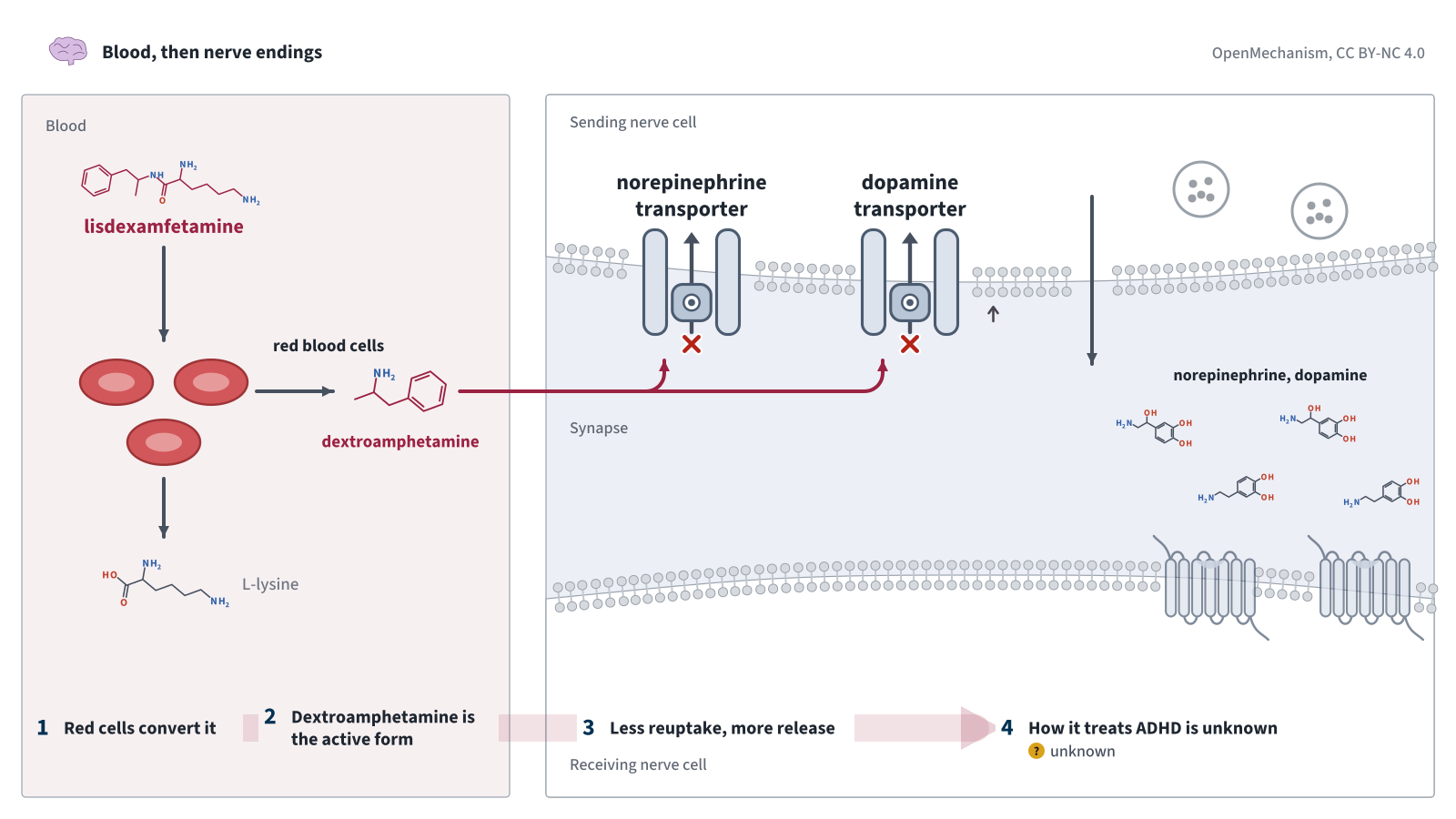
Lisdexamfetamine is converted into dextroamphetamine, the active stimulant, mainly in the blood by red blood cells. Dextroamphetamine blocks the and increases the release of norepinephrine and dopamine. The label lists it for in adults and children 6 and older and for moderate to severe binge eating disorder in adults, and not for weight loss; it says the exact way it works in ADHD and binge eating disorder is not known.
- Acts on
- Norepinephrine and dopamine reuptake (their transporters)
- Where
- Blood, then nerve endings
- Medicine type
- Small molecule
- Used for
- Brain & nerves
- Drug class
- Stimulants
Also called Vyvanse.
Step 4: unknown
The Vyvanse label says: The exact mode of therapeutic action in ADHD and BED is not known.
Clinical study: In Biederman and colleagues' 2007 randomized, double-blind trial, 290 children aged 6 to 12 with ADHD were assigned to lisdexamfetamine (LDX; 30, 50 or 70 mg once a day) or placebo for 4 weeks (230 completed); the trial measured ADHD symptom ratings, not how lisdexamfetamine works: In this population of children with ADHD, treatment once daily with the prodrug LDX at doses of 30 to 70 mg appeared to be effective
Biederman J et al., Clin Ther 2007 (PMID 17577466)
How it works
Red cells convert it. After it is taken by mouth, lisdexamfetamine is converted to dextroamphetamine and L-lysine, mainly in the blood, by the hydrolytic activity of red blood cells.1
Dextroamphetamine is the active form. Lisdexamfetamine is a prodrug of dextroamphetamine, an amphetamine with stimulant activity in the central nervous system. In lab tests (in vitro), lisdexamfetamine itself does not bind to the sites responsible for the reuptake of norepinephrine and dopamine.1
Less reuptake, more release. Amphetamines block the reuptake of norepinephrine and dopamine into the sending nerve cell (the presynaptic neuron) and increase the release of these messengers into the space outside the nerve cell.1,2
How it treats ADHD is unknown. The label states that the exact therapeutic mechanism in ADHD and binge-eating disorder is unknown.1
For teachers: download this drawing or build a slide deck.
See also
Condition pages: ADHD and binge eating disorder.
Other stimulants: amphetamine and methylphenidate.
Body system: brain & nerves.
Sources
- 1Vyvanse (lisdexamfetamine dimesylate): FDA label1 Indications and Usage; 12.1 Mechanism of Action; 12.2 Pharmacodynamics; 12.3 Pharmacokinetics
- 2
- 3ChEMBL CHEMBL1201222Target and action classification: Dopamine transporter releasing agent; Norepinephrine transporter releasing agent; Synaptic vesicular amine transporter inhibitor
- 4
Spotted a mistake? Report an error (hello@openmechanism.com). Since launch, every published error we fix is listed on the corrections page.
Notes and limits
- A schematic teaching drawing: not to scale, not exact structures, binding poses or a complete pathway, and not a guide to dosing, treatment or how a person will respond.
- Other medicines in the same family may not follow every step or share the same clinical endpoint.
- The steps are in the order that explains them; one step is said to cause the next only where the source says so.
- The reuptake and release step comes from section 12.2 of the Vyvanse label, which a mixed amphetamine salts label (source 2) also gives; it is not inferred from the shape of the lisdexamfetamine molecule.
- The page does not show the exact route of the release inside the nerve cell, the brain circuits involved, how fast the release happens or how behavior changes.
All recorded limits are on the evidence page, and notes that apply to every page are on How to read a page. Version 1.0.1, medically reviewed by Daniel Tran, PharmD, on 4 November 2026.
Cite this page
Tran D. Lisdexamfetamine [Internet]. OpenMechanism; 2026 [updated 2026 Nov 4; cited 2026 Nov 4]. Available from: https://openmechanism.com/medicines/lisdexamfetamine