Lithium
The label says how lithium stabilizes mood is unknown. It is not broken down in the body: it leaves mainly in the urine, in proportion to its blood level, with a of about 18 to 36 hours. The label lists lithium, used on its own, for bipolar I disorder in patients 7 years and older: to treat acute manic and mixed episodes, and as maintenance treatment.
- Acts on
- Unknown
- Where
- The brain; the kidneys clear it
- Medicine type
- Small molecule
- Used for
- Brain & nerves
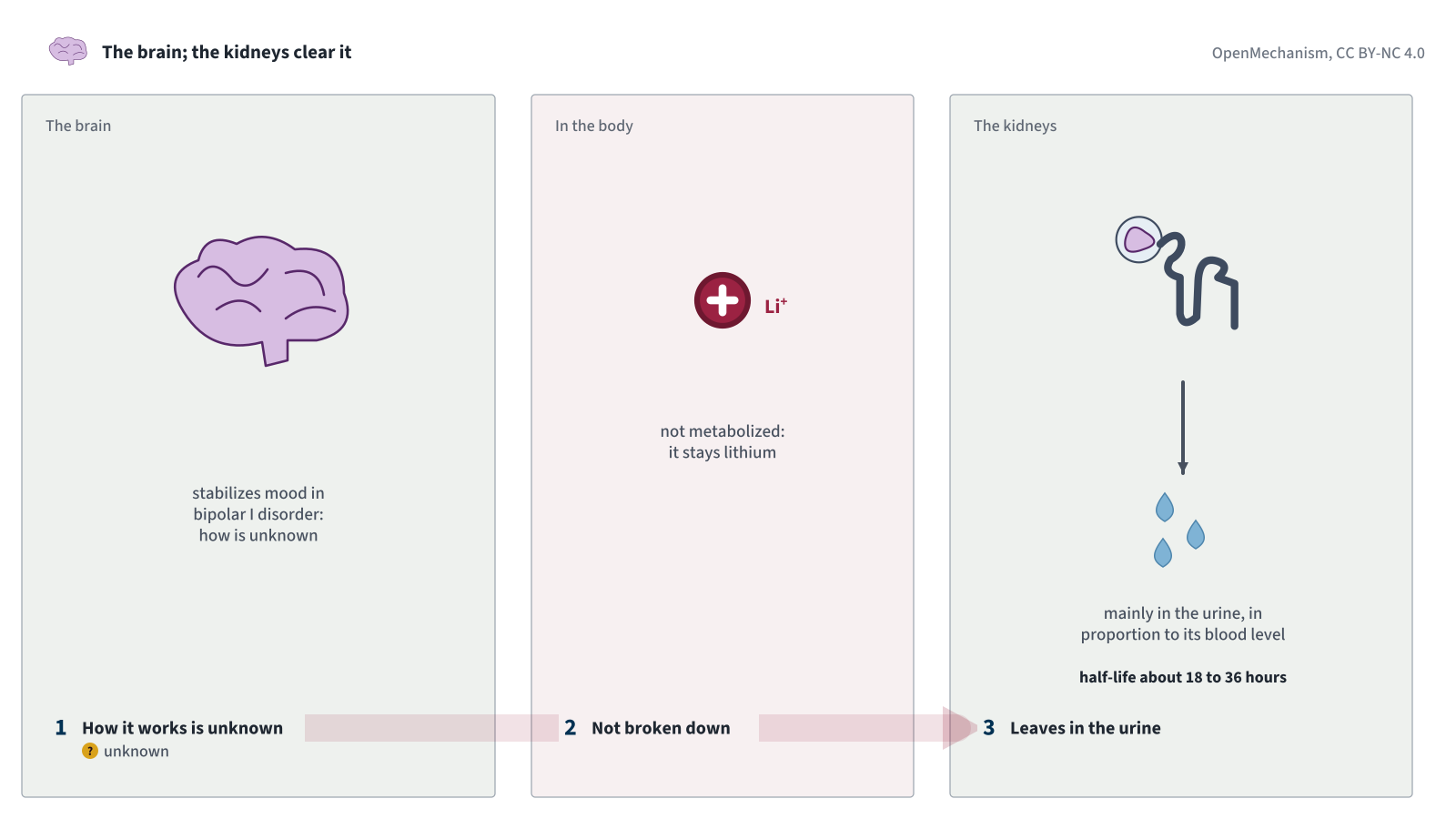
Step 1: unknown
The lithium carbonate label says: The mechanism of action of lithium as a mood stabilizing agent is unknown.
Clinical study: In Geddes and colleagues' 2004 meta-analysis of five randomized trials of long-term lithium against placebo, in 770 people with bipolar disorder, which measured relapse, not how lithium works: Lithium treatment reduces the risk of relapse in bipolar disorder. The preventive effect is clear for manic episodes, although it is equivocal for depressive episodes.
Geddes JR et al., Am J Psychiatry 2004 (PMID 14754766)
Key terms in this drawing
- half-life
- Half-life. The time it takes for the amount in the blood to fall by half.
How it works
How it works is unknown. The label says the mechanism of action of lithium as a mood stabilizing agent is unknown.1
Not broken down. Lithium is not metabolized.1
Leaves in the urine. It leaves the body mainly in the urine, in proportion to its blood level, with an elimination half-life of about 18 to 36 hours; very little leaves in the feces. The kidneys filter it, and 80% is reabsorbed in the proximal tubule.1
For teachers: download this drawing.
See also
Condition pages: bipolar disorder.
Explained: why lithium can cause diabetes insipidus; and lithium and NSAIDs, diuretics or ACE inhibitors.
Body system: brain & nerves.
Sources
- 1Lithium carbonate tablets and capsules: FDA label1 Indications and Usage; 12.1 Mechanism of Action; 12.3 Pharmacokinetics; 5.1 Lithium Toxicity
- 2ChEMBL CHEMBL1200826Target and action classification: Glycogen synthase kinase-3 inhibitor; Inositol-1(or 4)-monophosphatase 1 inhibitor
- 3Long-term lithium therapy for bipolar disorder: systematic review and meta-analysis of randomized controlled trialsGeddes JR et al. Am J Psychiatry 2004 (abstract)
Spotted a mistake? Report an error (hello@openmechanism.com). Since launch, every published error we fix is listed on the corrections page.
Notes and limits
- A schematic teaching drawing: not to scale, not exact structures, binding poses or a complete pathway, and not a guide to dosing, treatment or how a person will respond.
- The steps are in the order that explains them; one step is said to cause the next only where the source says so.
- The label says the mechanism of action of lithium as a mood stabilizing agent is unknown.
All recorded limits are on the evidence page, and notes that apply to every page are on How to read a page. Version 1.0.1, medically reviewed by Daniel Tran, PharmD, on 6 November 2026.
Cite this page
Tran D. Lithium [Internet]. OpenMechanism; 2026 [updated 2026 Nov 6; cited 2026 Nov 6]. Available from: https://openmechanism.com/medicines/lithium