Myasthenia gravis
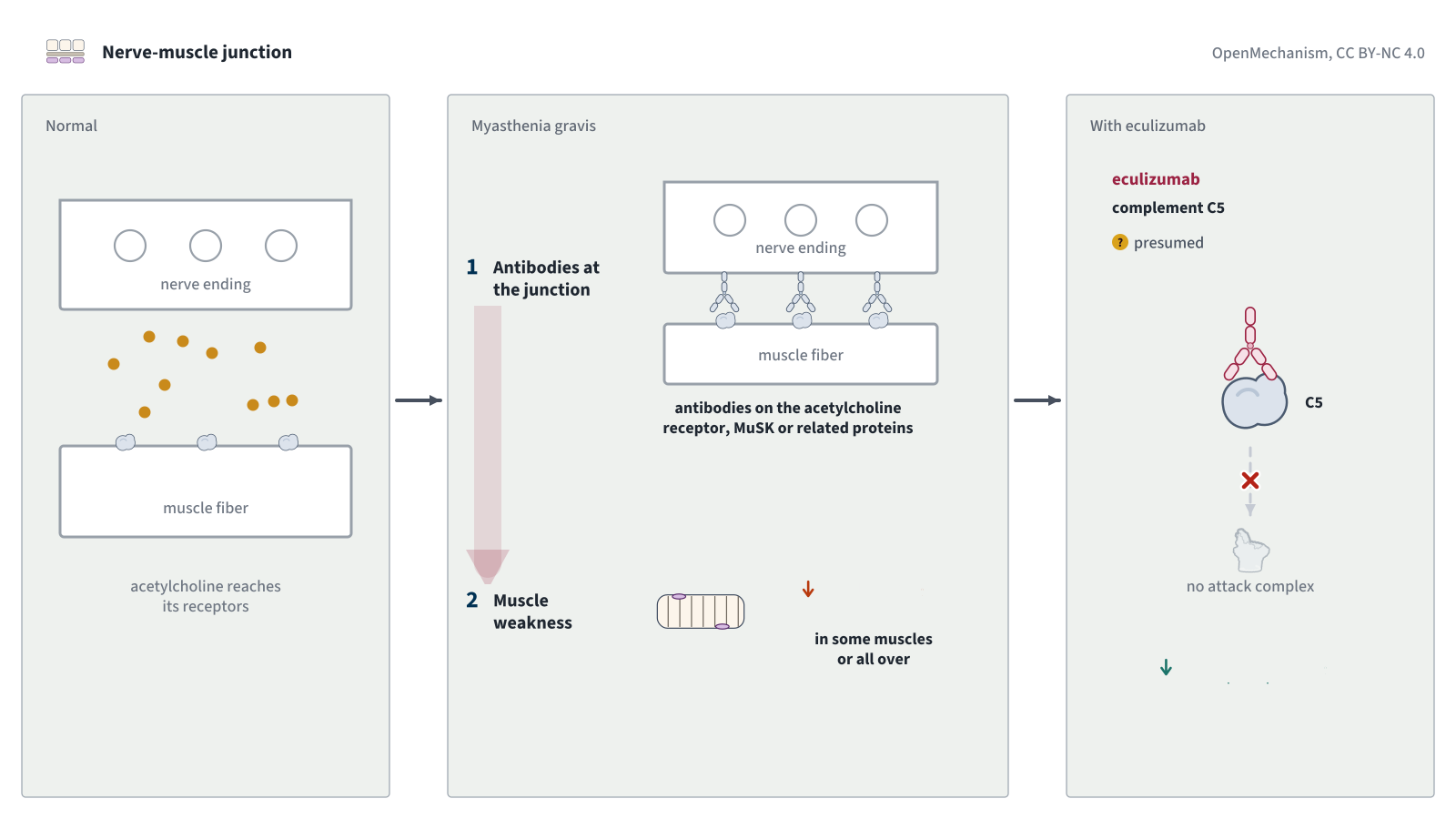
Myasthenia gravis is an autoimmune disease: antibodies attack the acetylcholine receptor or related proteins on the muscle side of the nerve-muscle junction, causing muscle weakness. A 2019 review says flare-ups are treated with fast-acting immunoglobulin or plasma exchange, and need intensive care if breathing fails. Eculizumab blocks complement protein C5, presumed to reduce complement damage at the junction.
- Where
- Nerve-muscle junction
- Body systems
- Brain & nerves; Muscles, bones & joints; Immune system
- Medicines
- 1 medicine
Presumed
The Soliris (eculizumab) label says: The precise mechanism by which eculizumab exerts its therapeutic effect in gMG patients is unknown, but is presumed to involve reduction of terminal complement complex C5b-9 deposition at the neuromuscular junction.
Source 2: Soliris (eculizumab): FDA label, 1 Indications and Usage; 12.1 Mechanism of Action
Clinical study: In a randomized, double-blind trial of eculizumab or placebo for 26 weeks in 125 people with refractory generalized myasthenia gravis; the trial measured daily activities on a myasthenia scale, not complement at the neuromuscular junction, and its main analysis found no significant difference: The change in the MG-ADL score was not statistically significant between eculizumab and placebo, as measured by the worst-rank analysis. … The use of a worst-rank analytical approach proved to be an important limitation of this study since the secondary and sensitivity analyses results were inconsistent with the primary endpoint result; further research into the role of complement is needed.
Howard JF et al., Lancet Neurol 2017 (PMID 29066163)
This study was picked with a literature search and is not yet checked by our reviewer.
For teachers: download this drawing.
Key terms in this drawing
- C5
- Complement component 5. A complement protein; when split, part of it helps build the membrane attack complex.
- complement
- Complement. A set of blood proteins that can kill a cell an antibody has marked.
- MuSK
- Muscle-specific kinase. A protein in the muscle membrane at the nerve junction; in myasthenia gravis, antibodies may attack it rather than the acetylcholine receptor.
What goes wrong
Antibodies at the junction. It is an autoimmune disease: antibodies attack the acetylcholine receptor, or related proteins in the muscle membrane at the nerve-muscle junction.1
What the source says
“Myasthenia gravis (MG) is an autoimmune disease caused by antibodies against the acetylcholine receptor (AChR), muscle-specific kinase (MuSK) or other AChR-related proteins in the postsynaptic muscle membrane.”
Source 1Muscle weakness. The antibodies cause muscle weakness, in some muscles or all over.1
What the source says
“Localized or general muscle weakness is the predominant symptom and is induced by the antibodies.”
Source 1
Where medicines act
- A
Eculizumab: complement C5 blocked
Eculizumab blocks protein . In generalized myasthenia gravis with acetylcholine-receptor antibodies, it is presumed to cut complement damage at the nerve-muscle junction.2
What the source says
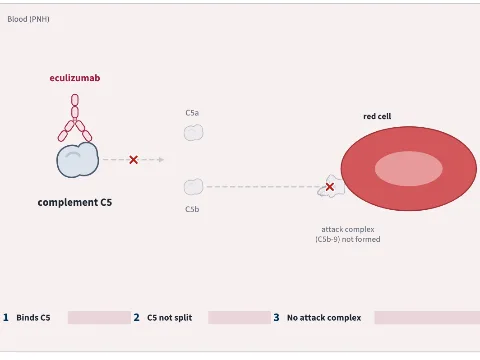
“is a monoclonal antibody that specifically binds to the complement protein C5 with high affinity, thereby inhibiting its cleavage to C5a and C5b and preventing the generation of the terminal complement complex C5b-9.”
Source 2“the treatment of generalized myasthenia gravis (gMG) in adult and pediatric patients six years of age and older who are anti-acetylcholine receptor (AChR) antibody positive.”
Source 2“is presumed to involve reduction of terminal complement complex C5b-9 deposition at the neuromuscular junction.”
Source 2
See also
Body systems: brain & nerves; muscles, bones & joints; and immune system.
Zoom in: the nerve–muscle junction.
Other conditions: neuromyelitis optica (NMOSD), atypical hemolytic uremic syndrome (aHUS) and paroxysmal nocturnal hemoglobinuria.
Side effects: why fluoroquinolones such as ciprofloxacin can damage tendons and why eculizumab raises the risk of meningococcal infections.
Sources
- 1Myasthenia gravisGilhus NE et al. Nat Rev Dis Primers 2019 (abstract). Saved copy
- 2Soliris (eculizumab): FDA label1 Indications and Usage; 12.1 Mechanism of Action. Saved copy
- 3
- 4The complement membrane attack complex (C5b-9) in its open form (cryo-EM)PDB 6H03; Menny, A. et al. Nat Commun 2018;9:5316. The attack complex outline in the drawing is traced from this structure. Saved copy
Notes and limits
- A 2019 review says flare-ups are treated with fast-acting immunoglobulin or plasma exchange, and that intensive care is necessary if breathing fails.1
- Exactly how eculizumab helps in myasthenia gravis is not known.2
Notes that apply to every page are on How to read a page.
Spotted a mistake? Report an error (hello@openmechanism.com). Since launch, every published error we fix is listed on the corrections page.
Cite this page
Tran D. Myasthenia gravis [Internet]. OpenMechanism; 2026 [updated 2026 Nov 18; cited 2026 Nov 18]. Available from: https://openmechanism.com/conditions/myasthenia-gravis