Lidocaine
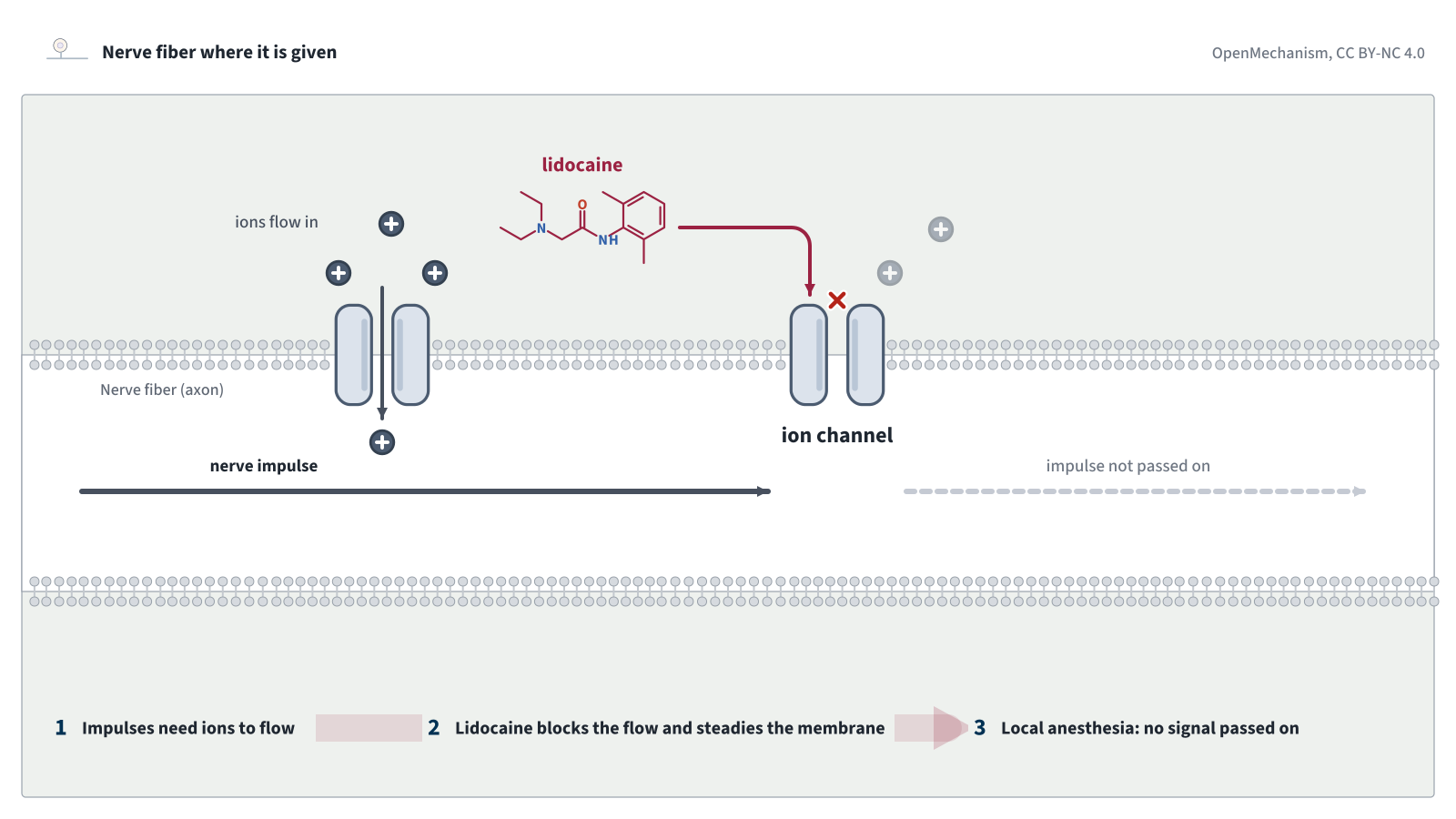
Nerve impulses need ions to flow across the nerve membrane. Lidocaine blocks these ion flows and stabilizes the membrane, so nerves in the area cannot start or pass on signals. This is local anesthesia.
- Acts on
- Neuronal ionic flux required for impulse conduction
- Where
- Nerve membranes where it is given
- Medicine type
- Small molecule
- Used for
- Brain & nerves
- Drug class
- Antiarrhythmics (class I and III)
How it works
Impulses need ions to flow. Neuronal impulses require membrane ionic fluxes for initiation and propagation.1
Lidocaine blocks the flow and steadies the membrane. Lidocaine inhibits these ionic fluxes and stabilizes the neuronal membrane.1
Local anesthesia: no signal passed on. Interference with impulse generation and conduction produces local anesthetic action.1
For teachers: download this drawing or build a slide deck.
See also
Condition pages: nerve pain after shingles and ventricular arrhythmias.
Other antiarrhythmics (class I and III): amiodarone, flecainide and sotalol.
Body system: brain & nerves.
Sources
- 1Lidocaine: FDA labelMechanism of action under clinical pharmacology
- 2ChEMBL CHEMBL79Target and action classification: Sodium channel alpha subunit blocker
Spotted a mistake? Report an error (hello@openmechanism.com). Since launch, every published error we fix is listed on the corrections page.
Notes and limits
- A schematic teaching drawing: not to scale, not exact structures, binding poses or a complete pathway, and not a guide to dosing, treatment or how a person will respond.
- The steps are in the order that explains them; one step is said to cause the next only where the source says so.
- The selected label does not identify a channel isoform or atom-level binding site; a pore drawing is an illustrative flux motif.
All recorded limits are on the evidence page, and notes that apply to every page are on How to read a page. Version 1.0.1, not yet medically reviewed.
Cite this page
Tran D. Lidocaine [Internet]. OpenMechanism; 2026 [updated 2026 Oct 14; cited 2026 Oct 14]. Available from: https://openmechanism.com/medicines/lidocaine