Heavy metal poisoning
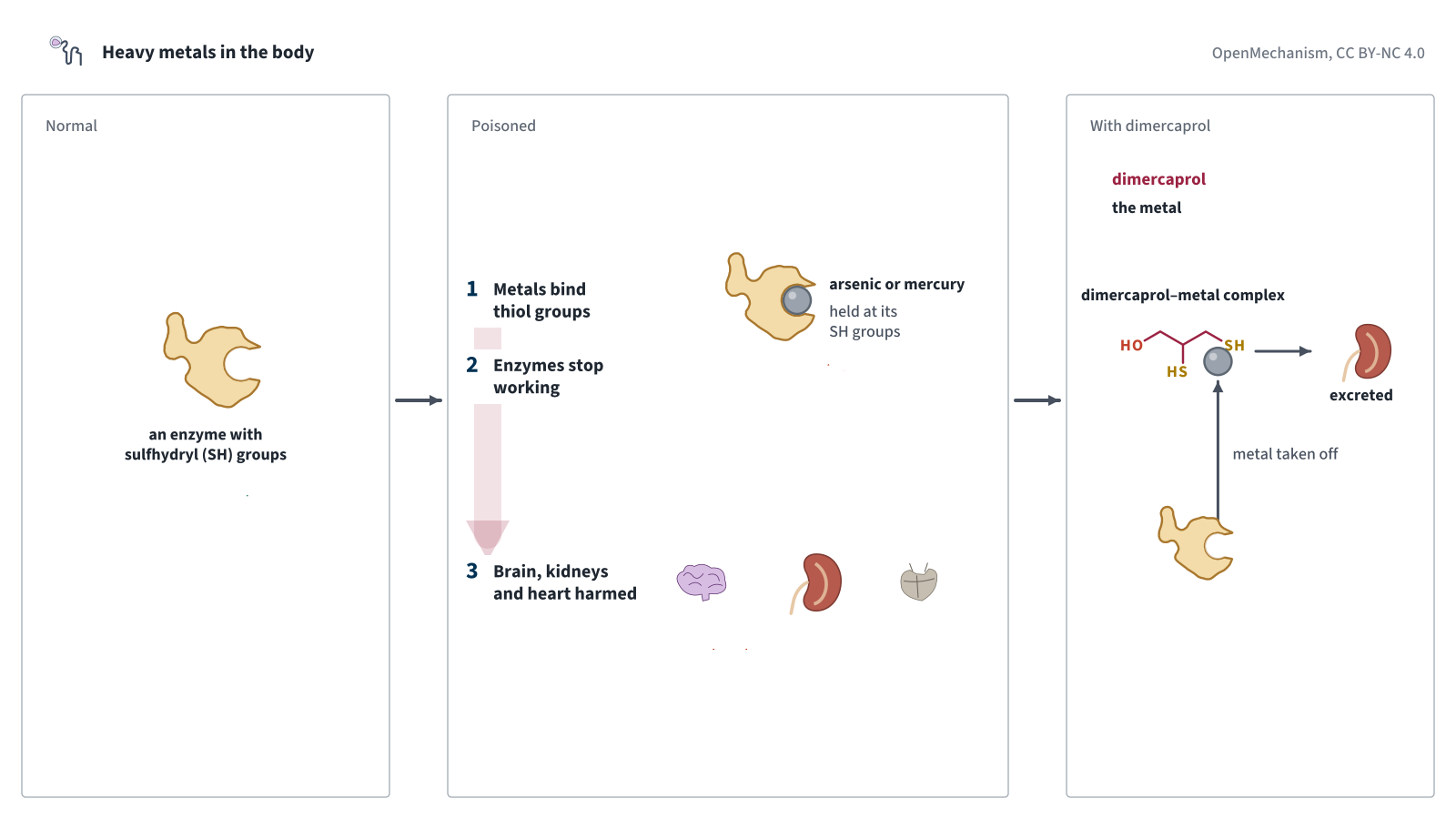
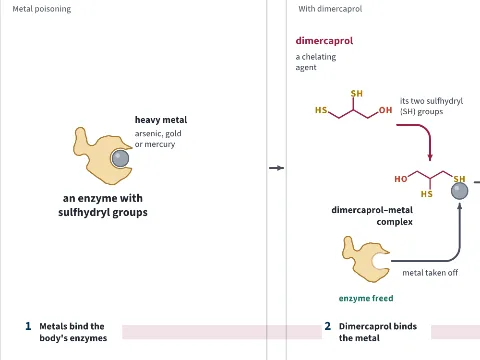
Heavy metals such as arsenic and mercury bind tightly to sulfhydryl (thiol, SH) groups and so stop enzymes working; they harm the brain, kidneys and heart. Dimercaprol, a chelating agent with sulfhydryl groups of its own, takes the metal into a complex that is excreted.
- Where
- Heavy metals in the body
- Body systems
- Kidney, Brain & nerves
- Medicines
- 1 medicine
For teachers: download this drawing.
What goes wrong
Metals bind thiol groups. Arsenic binds tightly to thiol (SH) groups, particularly to pairs of them side by side, as in dihydrolipoic acid. Mercury has a high for the sulfhydryl groups at enzymes' active sites.1,2
What the source says
“are bound tightly to thiol groups, particularly to vicinal dithiols such as dihydrolipoic acid (DHLA), which together with some seleno-enzymes constitute vulnerable targets for the toxic action of As.”
Source 1“took advantage of the fact that As had high affinity towards vicinal dithiols.”
Source 1“Mercury's high affinity for the sulfhydryl moieties of enzyme catalytic sites is a common motif for enzyme inactivation.”
Source 2Enzymes stop working. Bound there, the metals stop enzymes working: mercury's binding inactivates enzymes, harming the body's metabolism, and arsenic's inhibition of enzymes that clear reactive oxygen explains the oxidative stress of arsenic poisoning.1,2,3,4
What the source says
“The sulfhydryl groups of dimercaprol form complexes with certain heavy metals thus preventing or reversing the metallic binding of sulfhydryl-containing enzymes.”
Source 3“These permanent covalent modifications inactivate the enzyme, thereby inducing devastating effects on an organism's metabolic functions.”
Source 2“The binding of Hg to Cys mediates multiple toxic effects of Hg, especially inhibitory effects on enzymes and other proteins that contain free Cys residues.”
Source 4“Inhibition of this and other ROS scavenging seleno-enzymes explain the oxidative stress associated with arsenic poisoning.”
Source 1Brain, kidneys and heart harmed. Even at low doses, heavy metals affect the brain, kidneys and heart. People highly exposed to arsenic may develop acute, subacute or chronic poisoning, with skin lesions, symptoms of the heart and blood vessels and, in some cases, failure of several organs.1,5
Where medicines act
In the body's cells
- A
Dimercaprol targets Heavy metals
Its sulfhydryl groups take the metal into a complex that is excreted, freeing the enzymes.3
Used forArsenic, gold and mercury poisoningAcute lead poisoning: with edetate calcium disodium
What the label says
“BAL in Oil (Dimercaprol Injection USP) is indicated in the treatment of arsenic, gold and mercury poisoning. It is indicated in acute lead poisoning when used concomitantly with Edetate Calcium Disodium Injection USP.”
Source 3“The sulfhydryl groups of dimercaprol form complexes with certain heavy metals thus preventing or reversing the metallic binding of sulfhydryl-containing enzymes. The complex is excreted.”
Source 3
See also
Body systems: kidney and brain & nerves.
Other conditions: acetaminophen overdose; ethylene glycol and methanol poisoning; cyanide poisoning; and methemoglobinemia.
Sources
- 1Arsenic toxicity: molecular targets and therapeutic agentsNurchi VM et al. Biomolecules 2020 (abstract). Saved copy
- 2Mini-review: toxicity of mercury as a consequence of enzyme alterationYnalvez R, Gutierrez J, Gonzalez-Cantu H. Biometals 2016 (abstract). Saved copy
- 3BAL in Oil (dimercaprol): FDA labelIndications; Clinical Pharmacology. Saved copy
- 4Sulfhydryl groups as targets of mercury toxicityAjsuvakova OP et al. Coord Chem Rev 2020 (abstract). Saved copy
- 5Toxicodynamics of lead, cadmium, mercury and arsenic-induced kidney toxicity and treatment strategy: a mini reviewRana MN, Tangpong J, Rahman MM. Toxicol Rep 2018 (abstract). Saved copy
- 6Chelation in metal intoxicationFlora SJ, Pachauri V. Int J Environ Res Public Health 2010 (abstract). Saved copy
- 7Human 5-aminolevulinic acid dehydratase (ALAD) from red cells, with zinc and porphobilinogenPDB 1E51; Mills-Davies, N.L. et al. To be Published. The sulfhydryl enzyme outline in the drawing is traced from this structure. Saved copy
Notes and limits
- Dimercaprol works in acute poisoning by mercury salts if started within one or two hours of swallowing them, and is not very effective in chronic mercury poisoning.3
- The dimercaprol label rules it out in iron, cadmium or selenium poisoning, because the complexes it forms with those metals are more toxic than the metal alone, especially to the kidneys.3
- Dimercaprol's serious side effects led to less toxic chelating agents; water-soluble ones such as meso-2,3-dimercaptosuccinic acid help the kidneys excrete metals but reach metals inside cells poorly.6
- How much mercury's binding to thiol groups explains its toxicity is still poorly defined.4
- For arsenic, a 2020 review says preventing exposure, for the millions of people exposed to unsafe levels, should be the first priority.1
Notes that apply to every page are on How to read a page.
Spotted a mistake? Report an error (hello@openmechanism.com). Since launch, every published error we fix is listed on the corrections page.
Cite this page
Tran D. Heavy metal poisoning [Internet]. OpenMechanism; 2026 [updated 2026 Nov 18; cited 2026 Nov 18]. Available from: https://openmechanism.com/conditions/heavy-metal-poisoning