Insomnia
Chronic insomnia means trouble falling asleep, staying asleep or waking too early, for at least 3 months, with tired, unfocused days. Hyperarousal is thought to be a common pathway: the brain's arousal systems too active, its sleep systems too weak, or both. A 2016 guideline puts cognitive behavioral therapy first; when that alone has not worked, a medicine such as zolpidem may be added for a short time.
- Where
- The brain
- Body system
- Brain & nerves
- Medicines
- 1 medicine
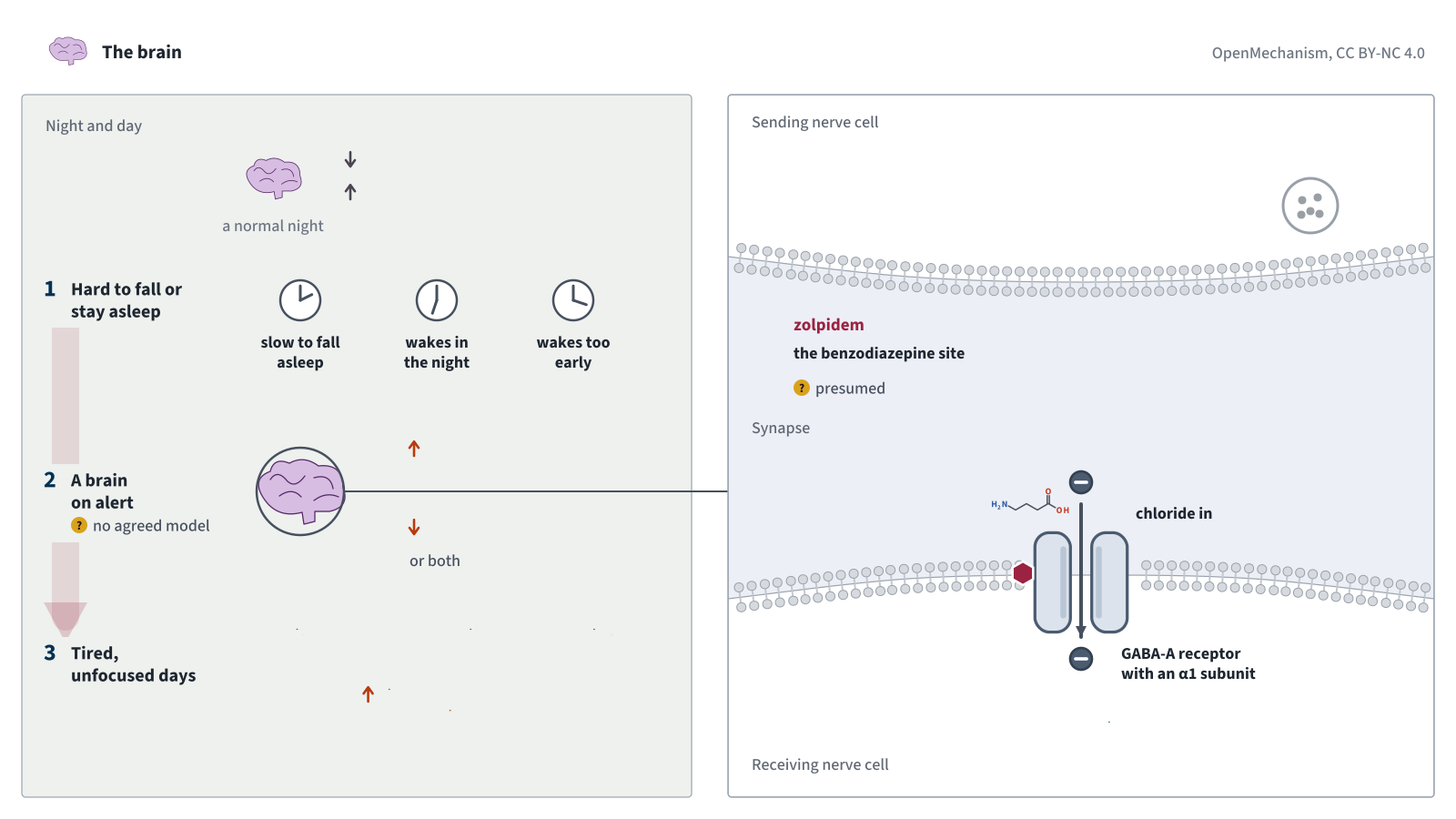
Step 2: no agreed model
The Levenson 2015 review says: Although progress has been made in our understanding of the nature, etiology, and pathophysiology of insomnia, there is still no universally accepted model.
Source 4: The pathophysiology of insomnia, Levenson JC, Kay DB, Buysse DJ. Chest 2015 (abstract)
Clinical study: In a brain imaging (PET) study of 7 people with insomnia and 20 healthy people: Compared with healthy subjects, patients with insomnia showed greater global cerebral glucose metabolism during sleep and while awake, a smaller decline in relative metabolism from waking to sleep states in wake-promoting regions, and reduced relative metabolism in the prefrontal cortex while awake.
Nofzinger EA et al., Am J Psychiatry 2004 (PMID 15514418)
This study was picked with a literature search and is not yet checked by our reviewer.
Presumed
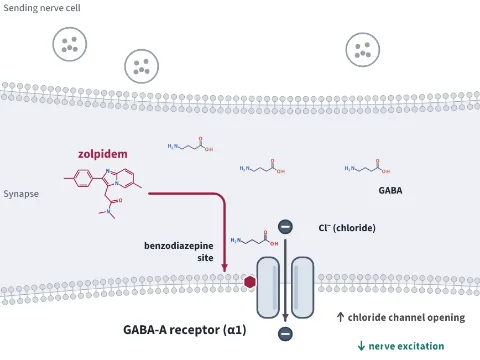
The Ambien label says: Zolpidem is a GABA A receptor positive modulator presumed to exert its therapeutic effects in the short-term treatment of insomnia through binding to the benzodiazepine site of α1 subunit containing GABA A receptors, increasing the frequency of chloride channel opening resulting in the inhibition of neuronal excitation.
Source 2: Ambien (zolpidem): FDA label, 1 Indications and Usage; 12.1 Mechanism of Action
Clinical study: In a placebo-controlled sleep-laboratory trial over 35 nights in 75 people with chronic insomnia; the trial measured how soon and how well people slept, not how zolpidem works: Within the first week of treatment, 10 mg of zolpidem had a significant effect on latency to persistent sleep and sleep efficiency. … Efficacy was maintained throughout the 35 nights of drug administration.
Scharf MB et al., J Clin Psychiatry 1994 (PMID 8071269)
This study was picked with a literature search and is not yet checked by our reviewer.
For teachers: download this drawing.
Key terms in this drawing
- GABA-A receptor
- Gamma-aminobutyric acid type A receptor. A receptor channel on nerve cells that GABA switches on; benzodiazepines also bind it.
What goes wrong
Hard to fall or stay asleep. Chronic insomnia means difficulty falling asleep, staying asleep or waking too early in the morning, for at least 3 months.1
What the source says
“Chronic insomnia is defined by difficulties in falling asleep, maintaining sleep, and early morning awakening, and is coupled with daytime consequences such as fatigue, attention deficits, and mood instability.”
Source 1“These symptoms persist over a period of at least 3 months (Diagnostic and Statistical Manual 5 criteria).”
Source 1A brain on alert. Studies of the body's automatic systems and of the brain point to hyperarousal as a final common pathway: an imbalance in which the arousal systems are overactive, the sleep-inducing systems underactive, or both.1
What the source says
“whereas the investigation of autonomous and central nervous system parameters has identified hyperarousal as a final common pathway of the pathophysiology, implicating an imbalance of sleep-wake regulation consisting of either overactivity of the arousal systems, hypoactivity of the sleep-inducing systems, or both.”
Source 1Tired, unfocused days. The days bring fatigue, attention problems and mood swings, and the disorder raises the risk of heart and mental disorders, including problems with thinking.1
What the source says
“Chronic insomnia is defined by difficulties in falling asleep, maintaining sleep, and early morning awakening, and is coupled with daytime consequences such as fatigue, attention deficits, and mood instability.”
Source 1“As a disorder, it incurs substantial health-care and occupational costs, and poses substantial risks for the development of cardiovascular and mental disorders, including cognitive deficits.”
Source 1
Where medicines act
In the brain
- A
Zolpidem targets α1 GABA-A receptors (the benzodiazepine site)
Presumed to bind the benzodiazepine site of α1 , so nerve cells fire less.2
Used forShort-term treatment of insomnia: difficulty falling asleep
What the label says
“AMBIEN (zolpidem tartrate) is indicated for the short-term treatment of insomnia characterized by difficulties with sleep initiation.”
Source 2“AMBIEN has been shown to decrease sleep latency for up to 35 days in controlled clinical studies”
Source 2“Zolpidem is a GABA A receptor positive modulator presumed to exert its therapeutic effects in the short-term treatment of insomnia through binding to the benzodiazepine site of α1 subunit containing GABA A receptors, increasing the frequency of chloride channel opening resulting in the inhibition of neuronal excitation.”
Source 2
See also
Body system: brain & nerves.
Other conditions: anxiety disorders and depression.
Sources
- 1The neurobiology, investigation, and treatment of chronic insomniaRiemann D et al. Lancet Neurol 2015 (abstract). Saved copy
- 2Ambien (zolpidem): FDA label1 Indications and Usage; 12.1 Mechanism of Action. Saved copy
- 3Management of chronic insomnia disorder in adults: a clinical practice guideline from the American College of PhysiciansQaseem A et al. Ann Intern Med 2016 (abstract). Saved copy
- 4The pathophysiology of insomniaLevenson JC, Kay DB, Buysse DJ. Chest 2015 (abstract). Saved copy
- 5Functional neuroimaging evidence for hyperarousal in insomniaNofzinger EA et al. Am J Psychiatry 2004 (abstract). Saved copy
- 6A multicenter, placebo-controlled study evaluating zolpidem in the treatment of chronic insomniaScharf MB et al. J Clin Psychiatry 1994 (abstract). Saved copy
Notes and limits
- A 2016 guideline from the American College of Physicians strongly recommends cognitive behavioral therapy for insomnia (CBT-I) as the first treatment for chronic insomnia in adults. When CBT-I alone has not worked, it weakly recommends deciding with the patient whether to add a medicine for a short time.3
- Insomnia can also be a symptom of many medical, neurological and mental disorders.1
- There is still no universally accepted model of how insomnia arises.4
- The trials behind zolpidem's use lasted 4 to 5 weeks.2
Notes that apply to every page are on How to read a page.
Spotted a mistake? Report an error (hello@openmechanism.com). Since launch, every published error we fix is listed on the corrections page.
Cite this page
Tran D. Insomnia [Internet]. OpenMechanism; 2026 [updated 2026 Nov 18; cited 2026 Nov 18]. Available from: https://openmechanism.com/conditions/insomnia