Alcohol use disorder
Alcohol use disorder is compulsive heavy drinking with loss of control. Alcohol's reward is important early on; with long-term drinking the brain adapts, and once dependence sets in, drinking to relieve withdrawal likely matters more. Disulfiram, naltrexone and acamprosate are the medicines approved in the United States; disulfiram makes drinking unpleasant.
- Where
- Brain and liver
- Body system
- Brain & nerves
- Medicines
- 1 medicine
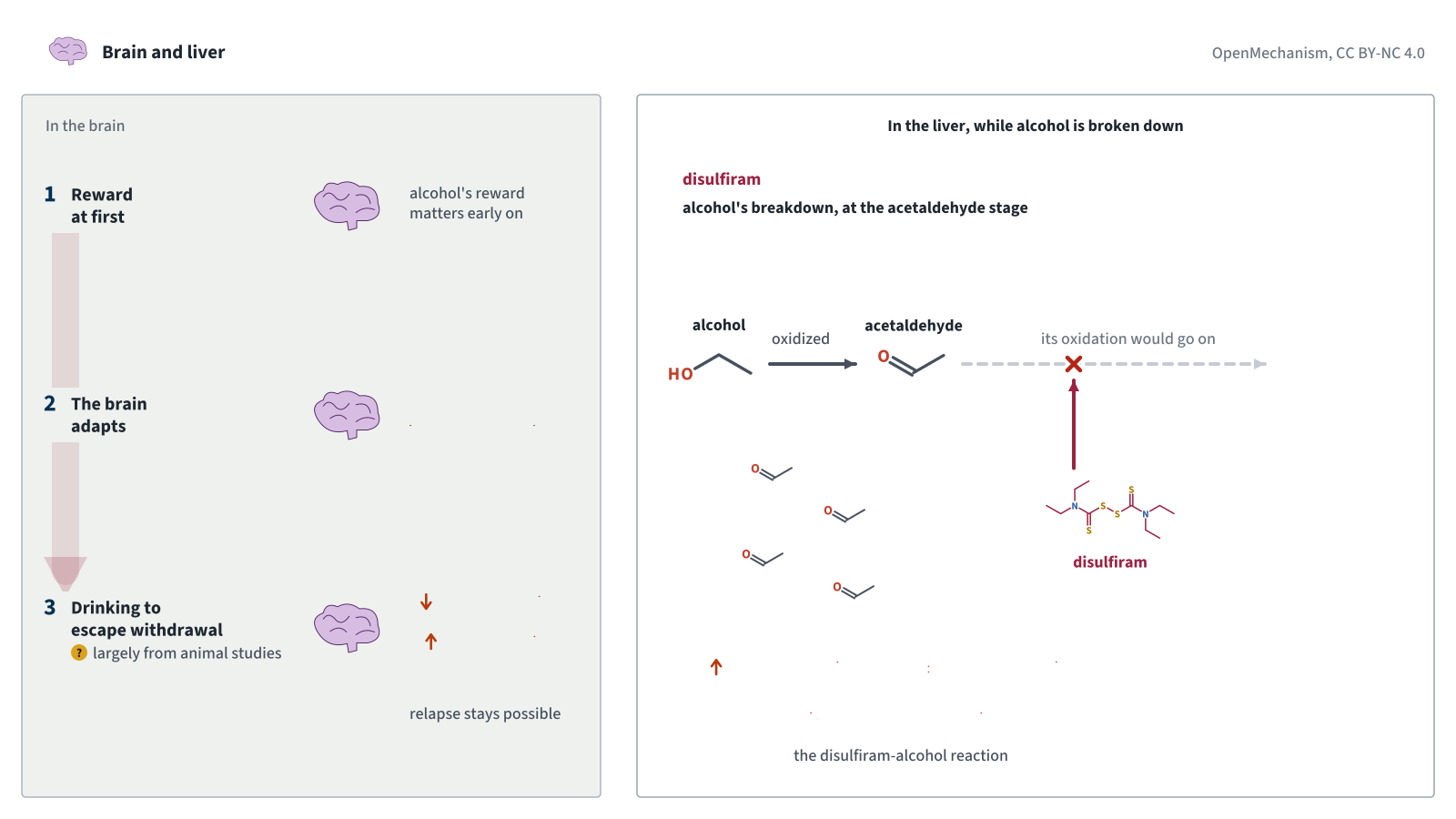
Step 3: largely from animal studies
The Koob 2014 review says: The compulsive drug seeking associated with alcoholism can be derived from multiple neuroadaptations, but the thesis argued here, derived largely from animal models, is that a key component involves decreased brain reward function, increased brain stress function, and compromised executive function, all of which contribute to the construct of negative reinforcement.
Clinical study: In a brain imaging (PET) study of 20 detoxified alcoholics, most of whom smoked, and 20 controls, measuring the dopamine released in the striatum after methylphenidate: In ventral striatum (where the nucleus accumbens is located) and in putamen, dopamine increases were associated with the rewarding effects of methylphenidate (drug liking and high) and were profoundly attenuated in alcoholics (70 and 50% lower than controls, respectively).
Volkow ND et al., J Neurosci 2007 (PMID 18003850)
This study was picked with a literature search and is not yet checked by our reviewer.
For teachers: download this drawing.
What goes wrong
Reward at first. Alcohol use disorders are disorders of compulsive heavy drinking and lost control over it. In the early stages of drinking, alcohol's rewarding effects are important.1,2
The brain adapts. Long-term drinking changes the brain circuits of arousal, reward and stress. These adaptations bring tolerance and sensitization to alcohol, and a withdrawal state when drinking stops.2
What the source says
“Chronic exposure to alcohol induces changes in neural circuits that control motivational processes, including arousal, reward, and stress.”
Source 2“These neuroadaptations produce changes in sensitivity to alcohol's effects following repeated exposure (i.e., sensitization and tolerance) and a withdrawal state following discontinuation of alcohol use.”
Source 2Drinking to escape withdrawal. Drinking to relieve the bad feelings of withdrawal (negative reinforcement) likely matters more after dependence sets in. Work largely in animals points to less reward function and more stress function in the brain. People stay prone to relapse even after long periods without drinking.2,3
What the source says
“Negative reinforcement can be important early in alcohol use by people self-medicating coexisting affective disorders, but its role likely increases following the transition to dependence.”
Source 2“The compulsive drug seeking associated with alcoholism can be derived from multiple neuroadaptations, but the thesis argued here, derived largely from animal models, is that a key component involves decreased brain reward function, increased brain stress function, and compromised executive function, all of which contribute to the construct of negative reinforcement.”
Source 3“However, the organism remains susceptible to relapse, even after long periods of abstinence.”
Source 2
Where medicines act
In the liver, while alcohol is broken down
- A
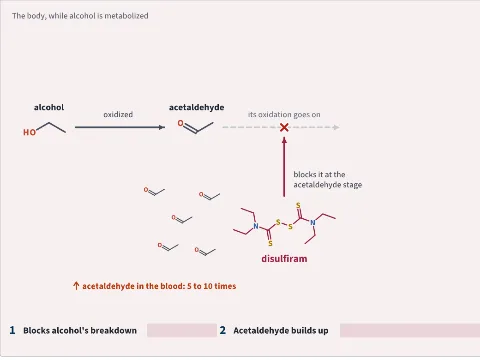
Disulfiram targets Alcohol's breakdown at the acetaldehyde stage
Blocks alcohol's breakdown at the acetaldehyde stage, so acetaldehyde builds up and drinking feels highly unpleasant.4
Used forChronic alcohol problems: selected people who want to stay sober, with support and therapy
What the label says
“Disulfiram is an aid in the management of selected chronic alcohol patients who want to remain in a state of enforced sobriety so that supportive and psychotherapeutic treatment may be applied to best advantage.”
Source 4“Disulfiram is not a cure for alcoholism.”
Source 4“Disulfiram blocks the oxidation of alcohol at the acetaldehyde stage.”
Source 4“During alcohol metabolism following disulfiram intake, the concentration of acetaldehyde occurring in the blood may be 5 to 10 times higher than that found during metabolism of the same amount of alcohol alone.”
Source 4“Accumulation of acetaldehyde in the blood produces a complex of highly unpleasant symptoms referred to hereinafter as the disulfiram-alcohol reaction.”
Source 4
See also
Body system: brain & nerves.
Other conditions: opioid use disorder and nicotine dependence.
Sources
- 1Alcohol use disordersCarvalho AF et al. Lancet 2019 (abstract). Saved copy
- 2Neurobiology of alcohol dependence: focus on motivational mechanismsGilpin NW, Koob GF. Alcohol Res Health 2008 (abstract). Saved copy
- 3Neurocircuitry of alcohol addiction: synthesis from animal modelsKoob GF. Handb Clin Neurol 2014 (abstract). Saved copy
- 4Disulfiram: FDA labelIndications and Usage; Clinical Pharmacology. Saved copy
- 5Diagnosis and pharmacotherapy of alcohol use disorder: a reviewKranzler HR, Soyka M. JAMA 2018 (abstract). Saved copy
- 6Profound decreases in dopamine release in striatum in detoxified alcoholics: possible orbitofrontal involvementVolkow ND et al. J Neurosci 2007 (abstract). Saved copy
Notes and limits
- Four medicines are approved in the United States: disulfiram, naltrexone by mouth, long-acting injectable naltrexone and acamprosate; some approved for other uses, such as topiramate, also work.5
- Used alone, without motivation and support, disulfiram is unlikely to change drinking much.4
Notes that apply to every page are on How to read a page.
Spotted a mistake? Report an error (hello@openmechanism.com). Since launch, every published error we fix is listed on the corrections page.
Cite this page
Tran D. Alcohol use disorder [Internet]. OpenMechanism; 2026 [updated 2026 Oct 20; cited 2026 Oct 20]. Available from: https://openmechanism.com/conditions/alcohol-use-disorder