Hydrocodone
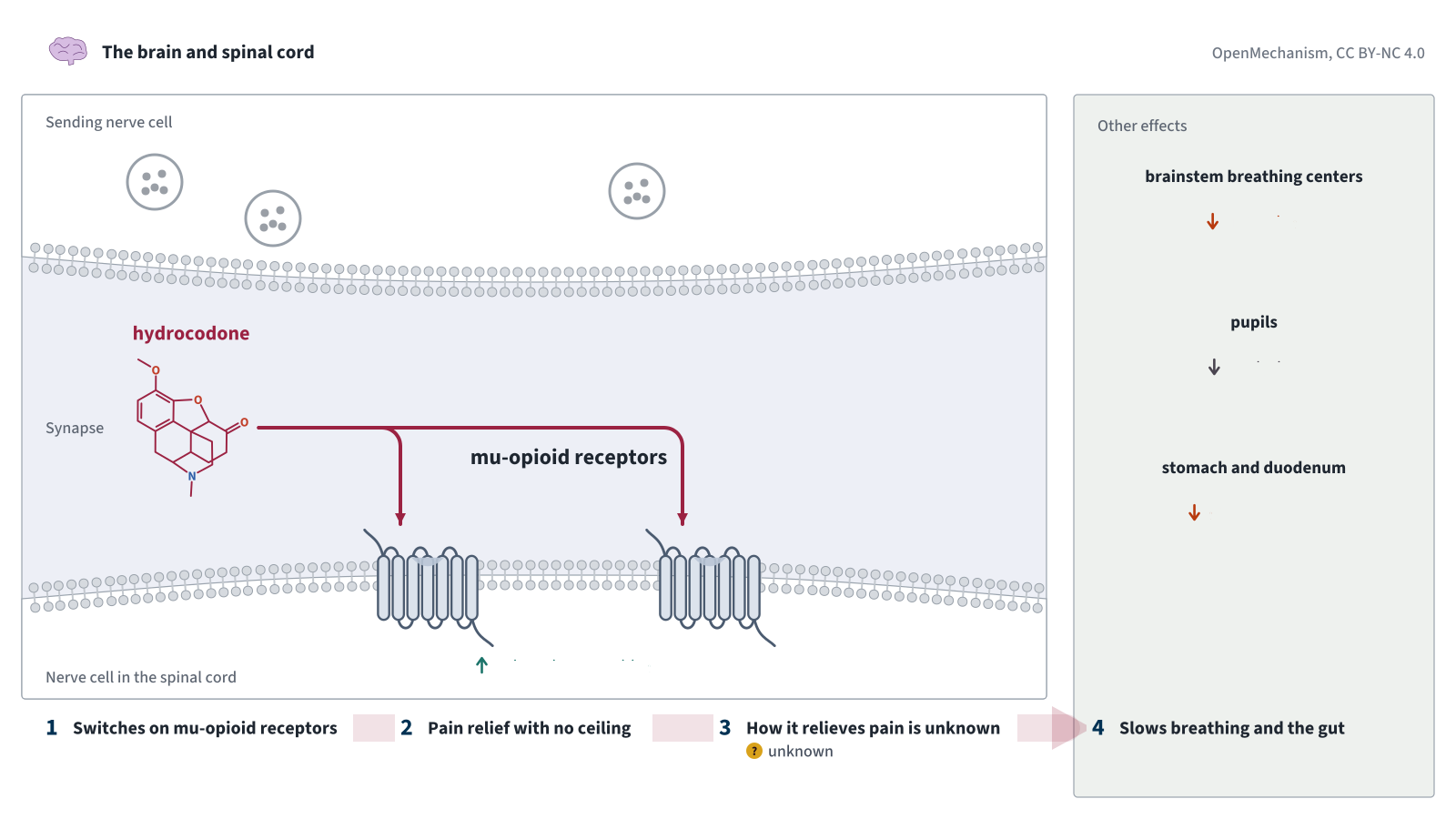
Hydrocodone switches on mu-opioid receptors. Like all full opioid , it has no ceiling to its pain relief, though the label says side effects such as slowed breathing may limit the dose. The label says the precise mechanism of its pain relief is unknown, but that opioid receptors throughout the brain and spinal cord are thought to play a role. It also slows breathing by acting on the brainstem, narrows the pupils and slows the gut. The Hysingla ER label lists its extended-release tablets for severe and persistent pain that needs an opioid and that other options, including immediate-release opioids, cannot adequately treat, and names the risks of addiction, abuse, misuse, overdose and death, which can occur at any dose or duration.
- Acts on
- Mu-opioid receptors (and others at higher doses)
- Where
- The brain and spinal cord
- Medicine type
- Small molecule
- Used for
- Brain & nerves
- Drug class
- Opioids
Also called Hysingla ER (extended-release hydrocodone bitartrate).
Step 3: unknown
The Hysingla ER label says: The precise mechanism of the analgesic action is unknown. However, specific CNS opioid receptors for endogenous compounds with opioid-like activity have been identified throughout the brain and spinal cord and are thought to play a role in the analgesic effects of this drug.
Clinical study: In Wen and colleagues' 2015 double-blind trial in people with uncontrolled moderate to severe chronic low back pain, some new to opioids and some who had taken them before, 588 of the 905 who took once-daily hydrocodone tablets (HYD; 20 to 120 mg) in an open-label period were randomized to keep taking them or to switch to placebo (an enriched enrollment, randomized withdrawal design); the trial measured pain at week 12, not how hydrocodone works: HYD demonstrated superior pain reduction (p = 0.0016); this result was supported by sensitivity analyses using different approaches to handling missing data.
Wen W et al., Expert Opin Pharmacother 2015 (PMID 26111544)
How it works
Switches on mu-opioid receptors. Hydrocodone is a full opioid agonist, relatively selective for the mu-opioid receptor, though it can interact with other opioid receptors at higher doses.1
Pain relief with no ceiling. Its main therapeutic action is pain relief (analgesia), and like all full opioid agonists it has no ceiling for pain relief; the label says that in clinical use the dose may be limited by side effects, including slowed breathing and depression of the central nervous system.1
How it relieves pain is unknown. The precise mechanism of its pain relief is unknown, but opioid receptors for the body's own opioid-like compounds, found throughout the brain and spinal cord, are thought to play a role.1
Slows breathing and the gut. Hydrocodone slows breathing by acting directly on the brainstem's breathing centers, making them less responsive to carbon dioxide; it narrows the pupils, even in darkness, and it reduces movement (motility) in the stomach and duodenum; in the colon, the waves that push contents along weaken and tone rises to the point of spasm, which results in constipation.1
For teachers: download this drawing.
See also
Condition pages: severe and persistent pain.
Other opioids: buprenorphine, fentanyl, loperamide, morphine, oxycodone and tramadol.
Explained: opioids and benzodiazepines.
Body system: brain & nerves.
Sources
- 1Hysingla ER (hydrocodone bitartrate) extended-release tablets: FDA label1 Indications and Usage; 12.1 Mechanism of Action; 12.2 Pharmacodynamics
- 2ChEMBL CHEMBL1457Target and action classification: Opioid receptors; mu/kappa/delta agonist
- 3
Spotted a mistake? Report an error (hello@openmechanism.com). Since launch, every published error we fix is listed on the corrections page.
Notes and limits
- A schematic teaching drawing: not to scale, not exact structures, binding poses or a complete pathway, and not a guide to dosing, treatment or how a person will respond.
- The steps are in the order that explains them; one step is said to cause the next only where the source says so.
- Because addiction, abuse, misuse, overdose and death can occur at any dose or duration and persist over the course of treatment, the Hysingla ER label reserves opioid pain medicines for people whose other options are ineffective, not tolerated or inadequate, and says Hysingla ER is not indicated as an as-needed pain medicine.
- The label says the precise mechanism of the analgesic action is unknown, and that CNS opioid receptors for endogenous compounds with opioid-like activity are thought to play a role.
All recorded limits are on the evidence page, and notes that apply to every page are on How to read a page. Version 1.0.1, medically reviewed by Daniel Tran, PharmD, on 3 November 2026.
Cite this page
Tran D. Hydrocodone [Internet]. OpenMechanism; 2026 [updated 2026 Nov 3; cited 2026 Nov 3]. Available from: https://openmechanism.com/medicines/hydrocodone