Amitriptyline
Amitriptyline, an antidepressant with sedative effects, blocks the membrane pumps that take norepinephrine and serotonin back into nerve cells, which may prolong nerve signaling. It is not a (MAO) inhibitor. The label lists it for the relief of symptoms of depression, saying endogenous depression is more likely to be relieved than other kinds. The label says its mechanism in people is not known; some believe the block underlies its antidepressant effect.
- Acts on
- The membrane pumps that take norepinephrine and serotonin back into nerve cells
- Where
- Nerve cells that release norepinephrine or serotonin
- Medicine type
- Small molecule
- Used for
- Brain & nerves
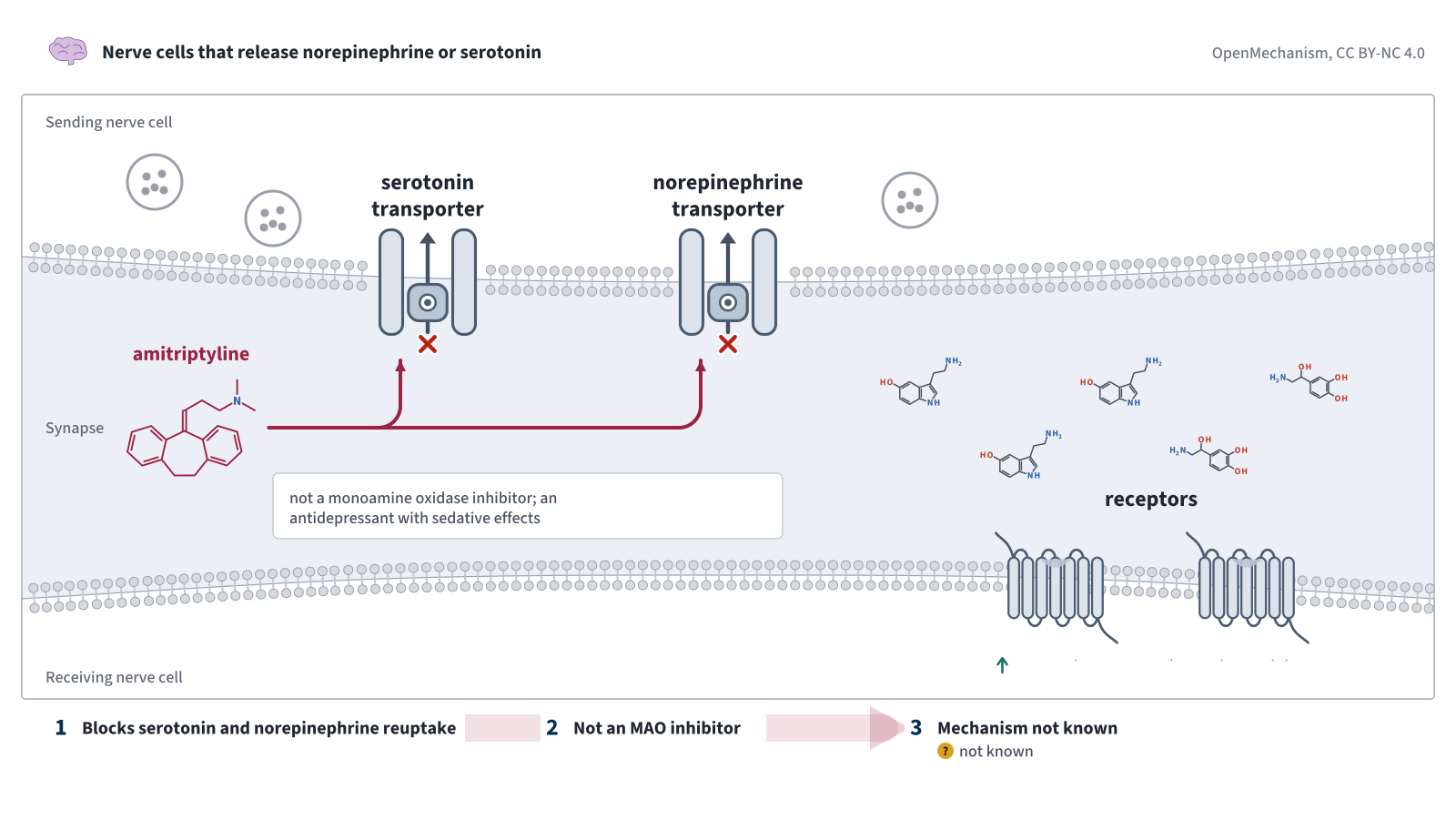
Step 3: not known
The amitriptyline label says: Its mechanism of action in man is not known. … This interference with reuptake of norepinephrine and/or serotonin is believed by some to underlie the antidepressant activity of amitriptyline.
Clinical study: In Cipriani and colleagues' 2018 network meta-analysis of 522 double-blind, randomized trials of 21 antidepressants, amitriptyline among them, for the acute treatment of adults with major depressive disorder; the trials measured response to treatment, not how the medicines work, and the review rated the certainty of its evidence moderate to very low: All antidepressants were more efficacious than placebo in adults with major depressive disorder.
Cipriani A et al., Lancet 2018 (PMID 29477251)
Key terms in this drawing
- MAO
- Monoamine oxidase. Enzymes (MAO-A and MAO-B) that break down amines from food and messengers such as serotonin.
How it works
Blocks serotonin and norepinephrine reuptake. Amitriptyline inhibits the membrane pumps (the norepinephrine and serotonin transporters) that take norepinephrine and serotonin back into nerve cells.1,2
Not an MAO inhibitor. It is an antidepressant with sedative effects; it is not a monoamine oxidase inhibitor and does not act mainly by stimulating the central nervous system.1
Mechanism not known. The label says its mechanism of action in people is not known; since reuptake is important in ending nerve signals, blocking it may potentiate or prolong nerve activity, and some believe this underlies its antidepressant effect.1
For teachers: download this drawing.
See also
Condition pages: depression.
Other serotonin reuptake inhibitors (SSRIs and related): citalopram, desvenlafaxine, duloxetine, escitalopram, fluoxetine, nortriptyline, paroxetine, sertraline and 2 more.
Explained: why anticholinergic medicines cause dry mouth, constipation and confusion.
Body system: brain & nerves.
Sources
- 1Amitriptyline hydrochloride tablets: FDA labelIndications and Usage; Clinical Pharmacology; Warnings
- 2ChEMBL CHEMBL629Target and action classification: Norepinephrine transporter inhibitor; Serotonin transporter inhibitor
- 3
Spotted a mistake? Report an error (hello@openmechanism.com). Since launch, every published error we fix is listed on the corrections page.
Notes and limits
- A schematic teaching drawing: not to scale, not exact structures, binding poses or a complete pathway, and not a guide to dosing, treatment or how a person will respond.
- The label says the mechanism of action in man is not known, and that the reuptake interference is believed by some to underlie the antidepressant activity.
All recorded limits are on the evidence page, and notes that apply to every page are on How to read a page. Version 1.0.1, medically reviewed by Daniel Tran, PharmD, on 6 November 2026.
Cite this page
Tran D. Amitriptyline [Internet]. OpenMechanism; 2026 [updated 2026 Nov 6; cited 2026 Nov 6]. Available from: https://openmechanism.com/medicines/amitriptyline