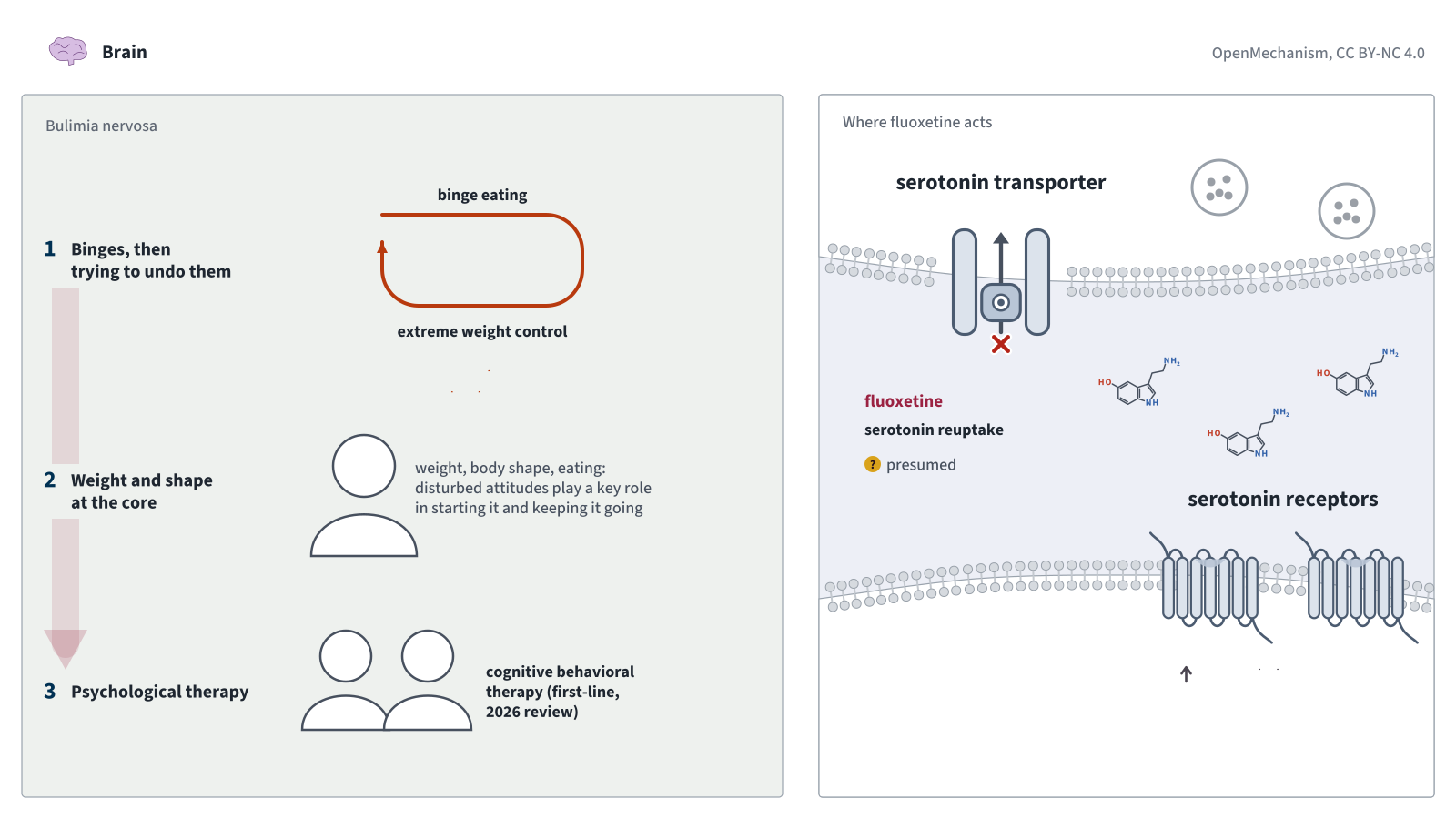
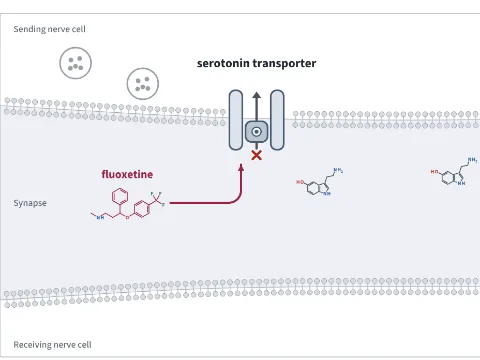
Bulimia nervosa is common worldwide. Its core is repeated binge eating followed by extreme efforts to control weight, with great concern about weight and shape. Eating disorders are disabling and can be deadly. A 2026 review names cognitive behavioral therapy for eating disorders as the first-line treatment. Fluoxetine, thought to work by blocking serotonin reuptake, treats binge eating and vomiting in moderate to severe bulimia.
What goes wrong in bulimia nervosa, and where medicines act. Schematic, not to scale. License CC BY-NC 4.0.
?Presumed
The Prozac (fluoxetine) label says: Although the exact mechanism of PROZAC is unknown, it is presumed to be linked to its inhibition of CNS neuronal uptake of serotonin.
Clinical study: In Goldstein and colleagues' 1995 16-week double-blind trial, 398 people with bulimia nervosa were randomly assigned to fluoxetine 60 mg a day or placebo (3 to 1), and 225 completed it; the trial measured vomiting and binge-eating episodes, not how fluoxetine works: Compared with placebo, fluoxetine treatment resulted in significantly greater reductions in vomiting (F[1,360] = 14.73, P < 0.0001) and binge-eating (F[1,360] = 14.39, P = 0.0002) episodes per week at endpoint and improvement in other outcome measures.Goldstein DJ et al., Br J Psychiatry 1995 (PMID 7620754)
Serotonin (5-hydroxytryptamine, 5-HT) receptors. Receptors that serotonin acts on; they come in several subtypes, such as 5-HT1A and 5-HT2A.
reuptake
Reuptake. Nerve cells taking a messenger such as serotonin back up, which helps end its signal.
What goes wrong
Binges, then trying to undo them. Its core feature is repeated binge eating followed by extreme weight control, with great concern about weight and shape. Eating disorders harm physical health and daily life.1,2
What the source says
“its cardinal feature is recurrent binge eating followed by extreme weight control or compensatory behaviours in association with high levels of weight and shape, and other body image and eating, preoccupations.”
Weight and shape at the core. A 2020 review says disturbed attitudes to weight, body shape and eating play a key role in starting eating disorders and keeping them going.2
What the source says
“Disturbed attitudes towards weight, body shape, and eating play a key role in the origin and maintenance of eating disorders.”
Neurobiology of anorexia and bulimia nervosaKaye W. Physiol Behav 2008 (abstract). Also used for the place the page and its drawing give, the brain: this 2008 review says considerable evidence suggests that altered serotonin function in the brain contributes to poorly regulated appetite, mood and impulse control in anorexia and bulimia nervosa. Saved copy
Notes and limits
Eating disorders are under-researched; much about what goes wrong in them, and about their treatment, is uncertain.2
The Prozac label says the exact mechanism of fluoxetine is unknown, and that it is presumed to be linked to its inhibition of serotonin uptake.3
text 78b718db2462…; drawings dfd24a09888d…; notes ba1e731e4ca8…
AI source check
Claude Opus 5.5 (AI source check), 7 November 2026: 26 statements compared with their sources, 4 flagged for the reviewer. An automated check, not a medical review.
Next review due
8 May 2028
Cite this page
Tran D. Bulimia nervosa [Internet]. OpenMechanism; 2026 [updated 2026 Nov 7; cited 2026 Nov 7]. Available from: https://openmechanism.com/conditions/bulimia-nervosa