Tafamidis
Transthyretin () normally forms a four-part tetramer. Tafamidis binds and stabilizes it, slowing its break-up into single units, the step that limits amyloid formation.
- Acts on
- TTR thyroxine-binding sites
- Where
- TTR protein in the blood
- Medicine type
- Small molecule
- Used for
- Brain & nerves
Also called Vyndaqel.
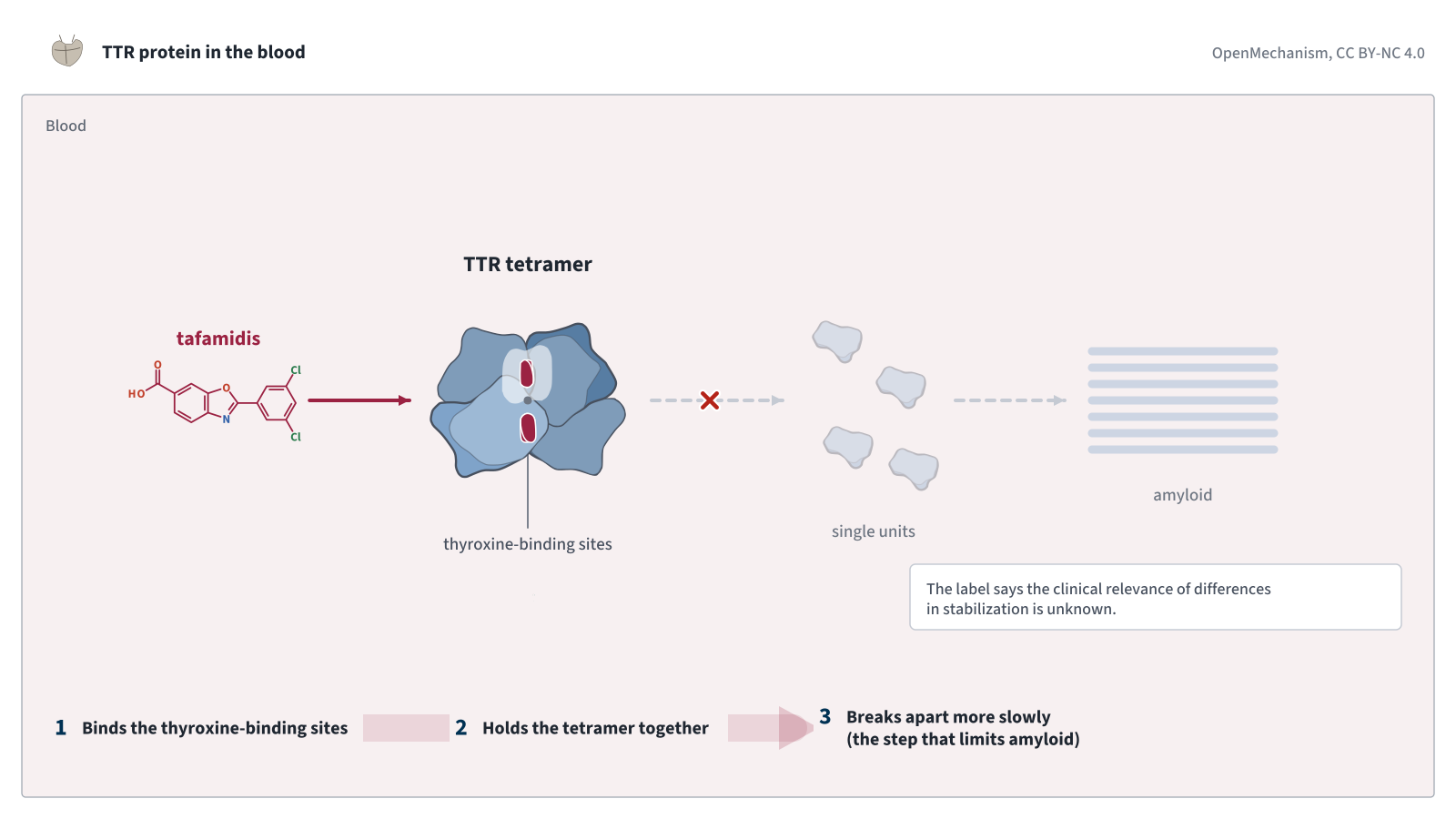
Key terms in this drawing
- TTR
- Transthyretin. A blood protein that can misfold and build up as amyloid.
How it works
Binds the thyroxine-binding sites. Tafamidis binds the thyroxine-binding sites of TTR.1
Holds the tetramer together. Binding stabilizes the TTR tetramer.1
Breaks apart more slowly (the step that limits amyloid). The stabilized assembly dissociates more slowly into monomers, the label-described rate-limiting amyloidogenic step.1
For teachers: download this drawing or build a slide deck.
See also
Condition pages: hereditary transthyretin amyloidosis and transthyretin amyloid heart disease (ATTR-CM).
Body system: brain & nerves.
Sources
- 1Vyndaqel (tafamidis meglumine): FDA label12.1 Mechanism of Action
- 2ChEMBL CHEMBL2103837Target and action classification: Transthyretin stabiliser
Also used for the drawing
The TTR outline is traced from the crystal structure below.
- 3Human transthyretin (TTR) tetramer with tafamidis in its two thyroxine-binding sitesPDB 3TCT; Bulawa, C.E. et al. Proc.Natl.Acad.Sci.USA 2012; 109:9629-9634
Spotted a mistake? Report an error (hello@openmechanism.com). Since launch, every published error we fix is listed on the corrections page.
Notes and limits
- A schematic teaching drawing: not to scale, not exact structures, binding poses or a complete pathway, and not a guide to dosing, treatment or how a person will respond.
- Other medicines in the same family may not follow every step or share the same clinical endpoint.
- The steps are in the order that explains them; one step is said to cause the next only where the source says so.
- The tetramer has four subunits; the glyph is not a resolved pocket or drug occupancy model.
- The label says the clinical relevance of differences in ex-vivo stabilization magnitude to cardiovascular outcomes is unknown.
All recorded limits are on the evidence page, and notes that apply to every page are on How to read a page. Version 1.0.0, not yet medically reviewed.
Cite this page
Tran D. Tafamidis [Internet]. OpenMechanism; 2026 [updated 2026 Oct 16; cited 2026 Oct 16]. Available from: https://openmechanism.com/medicines/tafamidis