Neostigmine
Neostigmine blocks , the enzyme that breaks acetylcholine down. More acetylcholine builds up in the gap between nerve and muscle and competes for the same binding site as non-depolarizing muscle relaxants, which reverses the neuromuscular block; it is used for this after surgery. The extra acetylcholine strengthens muscarinic as well as nicotinic activity. Neostigmine does not readily cross into the brain.
- Acts on
- Cholinesterase at the nerve-muscle junction
- Where
- The nerve-muscle junction
- Medicine type
- Small molecule
- Used for
- Brain & nerves
- Drug class
- Acetylcholinesterase inhibitors
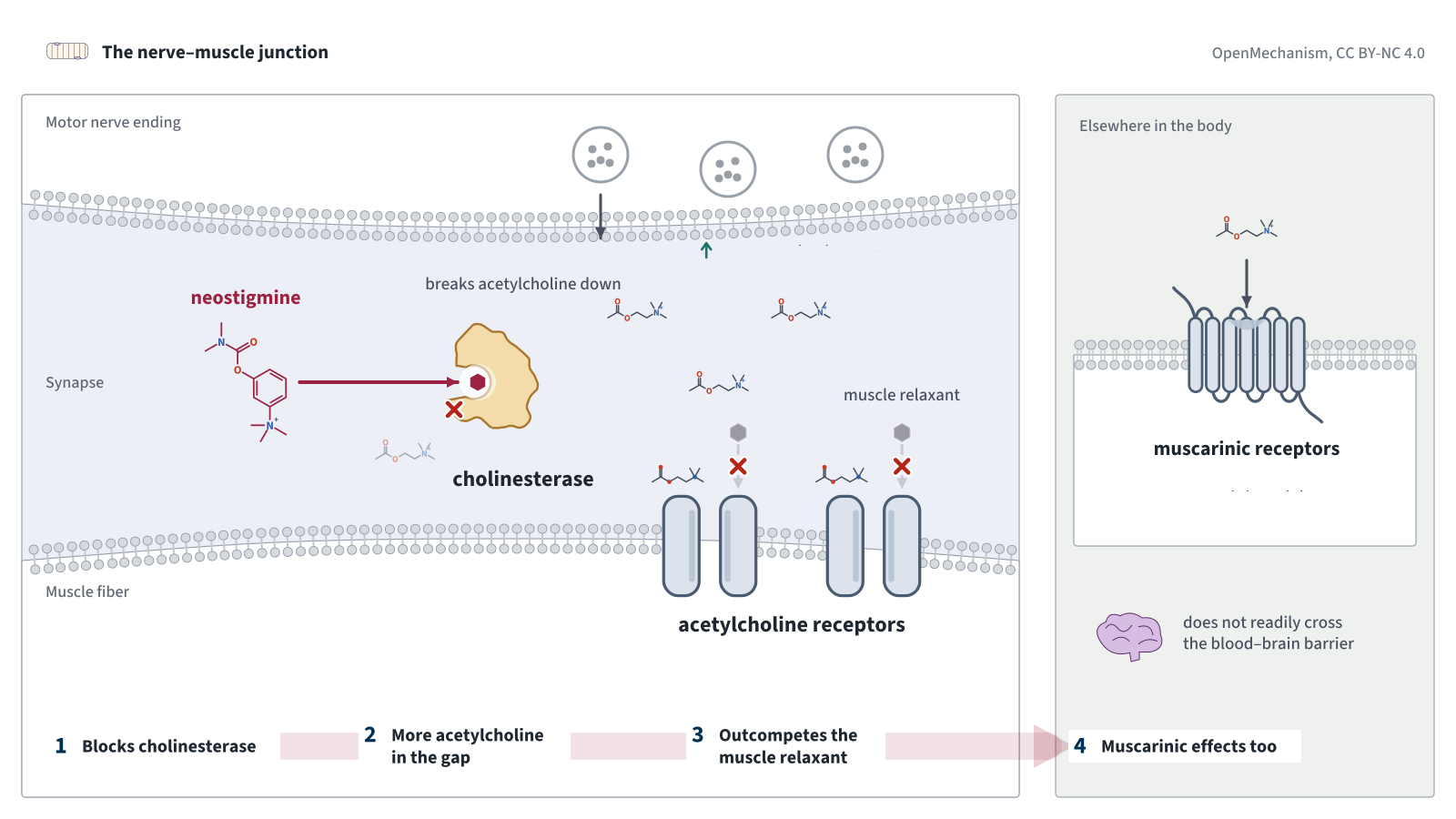
Key terms in this drawing
- cholinesterase
- Acetylcholinesterase (cholinesterase). The enzyme that breaks down acetylcholine; blocking it raises the amount of acetylcholine.
- muscarinic receptors
- Muscarinic receptors (M1 to M5). The receptors that antimuscarinic (anticholinergic) medicines block; they come in five subtypes, M1 to M5.
How it works
Blocks cholinesterase. Neostigmine is a competitive cholinesterase inhibitor: it blocks cholinesterase, the enzyme that breaks acetylcholine down.1
More acetylcholine in the gap. By reducing the breakdown of acetylcholine, neostigmine increases the acetylcholine in the synaptic cleft, the gap between the nerve ending and the muscle.1
Outcompetes the muscle relaxant. This extra acetylcholine competes for the same binding site as non-depolarizing neuromuscular blocking medicines, the muscle relaxants used in surgery, and reverses the neuromuscular block. Neostigmine is used to reverse their effects after surgery.1
Muscarinic effects too. The rise in acetylcholine strengthens both muscarinic and nicotinic cholinergic activity. Neostigmine does not readily cross the blood-brain barrier, so it does not significantly affect cholinergic function in the brain and spinal cord.1
For teachers: download this drawing.
See also
Other acetylcholinesterase inhibitors: donepezil.
Explained: reversing rocuronium with sugammadex or neostigmine.
Related drawings: rocuronium (a non-depolarizing muscle relaxant: the kind of block neostigmine reverses) and sugammadex (reverses rocuronium another way: it wraps around the medicine in the blood).
Body system: brain & nerves.
Sources
- 1Bloxiverz (neostigmine methylsulfate) injection: FDA label1 Indications and Usage; 12.1 Mechanism of Action; 12.2 Pharmacodynamics
- 2ChEMBL CHEMBL278020Target and action classification: Acetylcholinesterase inhibitor
Also used for the drawing
The cholinesterase outline is traced from the crystal structure below.
- 3Human acetylcholinesterase with donepezilPDB 4EY7; Cheung, J. et al. J.Med.Chem. 2012; 55:10282-10286
Spotted a mistake? Report an error (hello@openmechanism.com). Since launch, every published error we fix is listed on the corrections page.
Notes and limits
- A schematic teaching drawing: not to scale, not exact structures, binding poses or a complete pathway, and not a guide to dosing, treatment or how a person will respond.
All recorded limits are on the evidence page, and notes that apply to every page are on How to read a page. Version 1.0.0, not yet medically reviewed.
Cite this page
Tran D. Neostigmine [Internet]. OpenMechanism; 2026 [updated 2026 Oct 16; cited 2026 Oct 16]. Available from: https://openmechanism.com/medicines/neostigmine