Tramadol
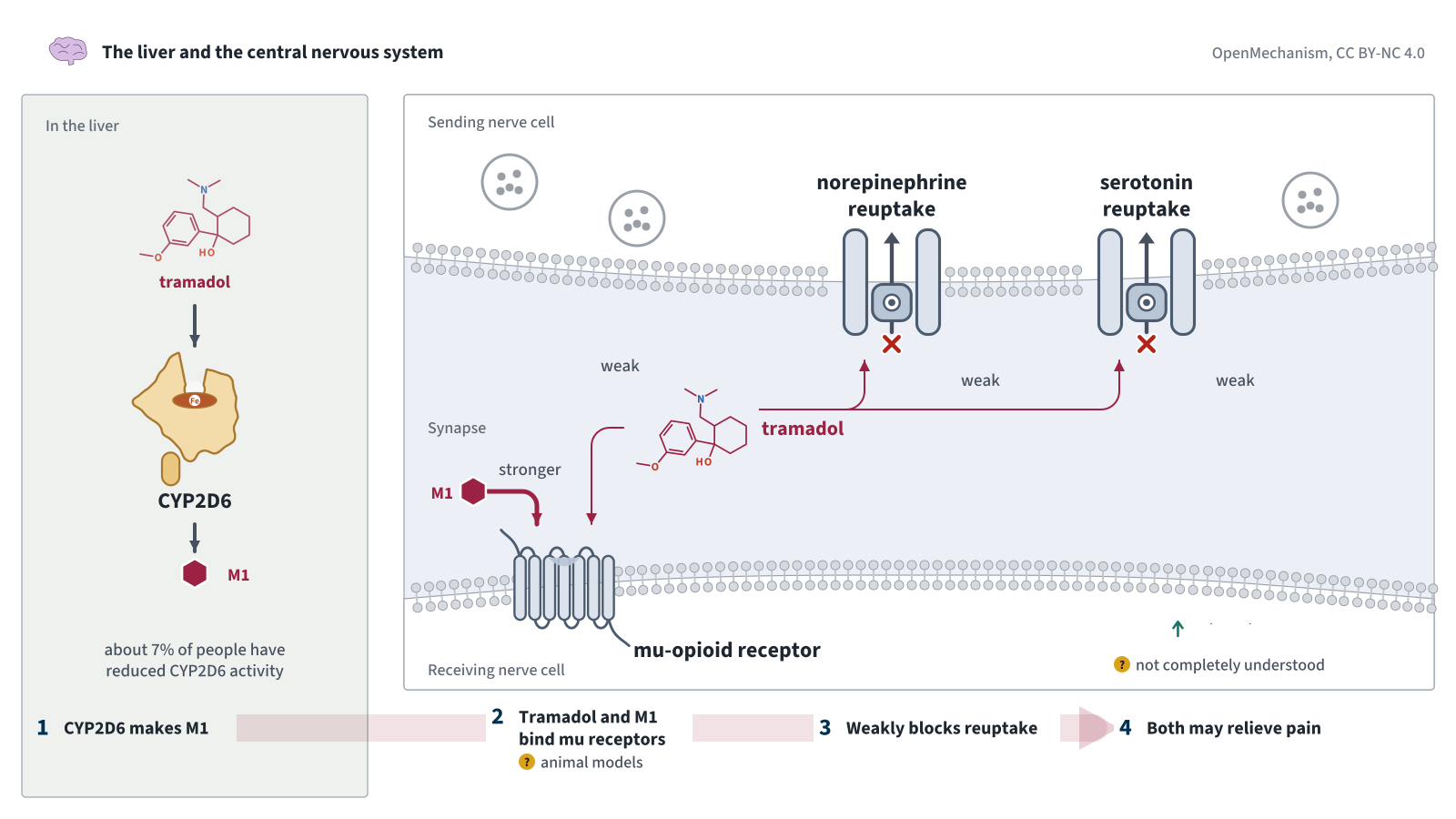
Tramadol binds mu-opioid receptors weakly; its metabolite M1, made by the liver enzyme , binds them more strongly. Tramadol also weakly blocks the of norepinephrine and serotonin. Its pain relief is believed to come from both actions, though its mode of action is not completely understood. It also slows breathing by acting directly on the brainstem's breathing centers. The tramadol tablets label lists it for adults with pain severe enough to need an opioid and for which other treatments are inadequate, and names the risks of addiction, abuse, misuse, overdose and death, which can occur at any dose or duration.
- Acts on
- Mu-opioid receptors (weakly; its metabolite M1 more strongly); norepinephrine and serotonin reuptake (weakly)
- Where
- The liver and the central nervous system
- Medicine type
- Small molecule
- Used for
- Brain & nerves
- Drug class
- Opioids
Step 2: animal models
The tramadol tablets label says: In animal models, M1 is up to 6 times more potent than tramadol in producing analgesia and 200 times more potent in μ-opioid binding.
Study: In Poulsen and colleagues' 1996 report of two randomized, double-blind, placebo-controlled crossover studies of experimental pain, 27 people whose CYP2D6 works normally (15) or poorly (12) took 2 mg/kg of tramadol, a test of the step in people: It is concluded that formation of (+)-M1 by way of CYP2D6 is important for the effect of tramadol on experimental pain.
Poulsen L et al., Clin Pharmacol Ther 1996 (PMID 8988065)
Step 4: not completely understood
The tramadol tablets label says: Although the mode of action is not completely understood, the analgesic effect of tramadol is believed to be due to both binding to μ-opioid receptors and weak inhibition of re-uptake of norepinephrine and serotonin. … Tramadol-induced analgesia is only partially antagonized by the opioid antagonist naloxone in several animal tests.
Clinical study: In Stamer and colleagues' 2003 prospective study of 300 people recovering from abdominal surgery, who after a loading dose gave themselves 1 ml doses of a mix of tramadol (20 mg per ml), dipyrone and metoclopramide by patient-controlled analgesia, comparing the 30 whose CYP2D6 does not work (poor metabolizers, PM) with 241 extensive metabolizers (EM): The percentage of non-responders was significantly higher in the PM group (46.7%) compared with the EM group (21.6%; p=0.005). … Therefore, CYP2D6 genotype has an impact on analgesia with tramadol.
Stamer UM et al., Pain 2003 (PMID 14499440)
Key terms in this drawing
- CYP2D6
- Cytochrome P450 2D6. A liver enzyme that breaks down several medicines; for tramadol it makes the active metabolite M1.
- reuptake
- Reuptake. Nerve cells taking a messenger such as serotonin back up, which helps end its signal.
How it works
CYP2D6 makes M1. Forming M1 depends on the liver enzyme CYP2D6, so medicines that block CYP2D6 can affect it; about 7% of people have reduced CYP2D6 activity, and in studies in healthy people their M1 levels were 40% lower than in people whose CYP2D6 works normally.1
Tramadol and M1 bind mu receptors. Tramadol binds mu-opioid receptors weakly; its metabolite M1 (O-desmethyltramadol) binds them more strongly. In animal models, M1 was 200 times more potent at binding and up to 6 times more potent at relieving pain.1
Weakly blocks reuptake. Tramadol also weakly blocks the reuptake of norepinephrine and serotonin.1
Both may relieve pain. Its mode of action is not completely understood. Its pain relief is believed to come from both actions, and in several animal tests the opioid blocker naloxone only partly blocked that pain relief.1
For teachers: download this drawing.
See also
Condition pages: acute pain and period pain; and severe and persistent pain.
Other opioids: buprenorphine, fentanyl, hydrocodone, loperamide, morphine and oxycodone.
Explained: codeine, tramadol and the CYP2D6 gene; and tramadol and SSRIs such as sertraline.
Body system: brain & nerves.
Sources
- 1Tramadol hydrochloride tablets: FDA label1 Indications and Usage; 12.1 Mechanism of Action; 12.2 Pharmacodynamics; 12.3 Pharmacokinetics
- 2ChEMBL CHEMBL1237044Target and action classification: Mu opioid receptor agonist
- 3The hypoalgesic effect of tramadol in relation to CYP2D6Poulsen L et al. Clin Pharmacol Ther 1996 (abstract)
- 4Impact of CYP2D6 genotype on postoperative tramadol analgesiaStamer UM et al. Pain 2003 (abstract)
Also used for the drawing
The CYP2D6 outline is traced from the crystal structure below.
- 5Human CYP2D6 with quinidinePDB 4WNU; Wang, A. et al. J.Biol.Chem. 2015; 290:5092-5104
Spotted a mistake? Report an error (hello@openmechanism.com). Since launch, every published error we fix is listed on the corrections page.
Notes and limits
- A schematic teaching drawing: not to scale, not exact structures, binding poses or a complete pathway, and not a guide to dosing, treatment or how a person will respond.
- The steps are in the order that explains them; one step is said to cause the next only where the source says so.
- Because addiction, abuse, misuse, overdose and death can occur at any dose or duration and persist over the course of treatment, the tramadol tablets label reserves opioid pain medicines for people whose other options are ineffective, not tolerated or inadequate.
- The label says that although the mode of action is not completely understood, tramadol's analgesic effect is believed to be due to both μ-opioid binding and weak inhibition of norepinephrine and serotonin reuptake.
All recorded limits are on the evidence page, and notes that apply to every page are on How to read a page. Version 1.0.1, medically reviewed by Daniel Tran, PharmD, on 3 November 2026.
Cite this page
Tran D. Tramadol [Internet]. OpenMechanism; 2026 [updated 2026 Nov 3; cited 2026 Nov 3]. Available from: https://openmechanism.com/medicines/tramadol