Parkinson disease
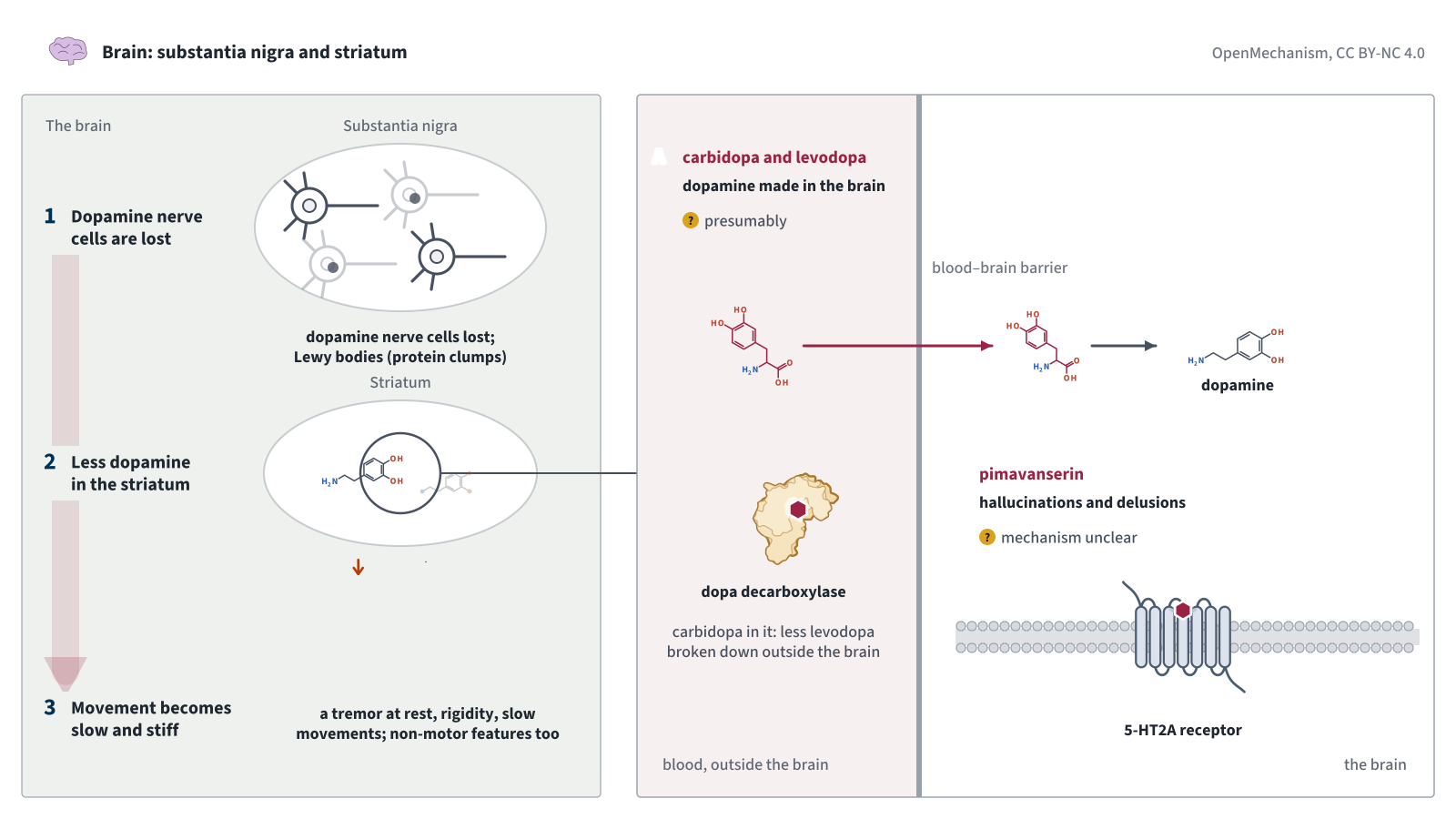
In Parkinson disease, dopamine-making nerve cells in the substantia nigra are lost, and the striatum, the brain area they reach, runs short of dopamine. Movement becomes slow and stiff, with a tremor at rest. Carbidopa and levodopa let the brain make more dopamine; pimavanserin is used for the hallucinations and delusions of Parkinson disease psychosis.
- Where
- Brain: substantia nigra and striatum
- Body system
- Brain & nerves
- Medicines
- 2 medicines
Presumably
The Sinemet (carbidopa and levodopa) label says: However, levodopa, the metabolic precursor of dopamine, does cross the blood-brain barrier, and presumably is converted to dopamine in the brain.
Clinical study: In a 40-week randomized, double-blind trial of three doses of carbidopa-levodopa or placebo in 361 people with early Parkinson disease; the trial measured symptom scores and brain imaging of dopamine nerve endings, not the making of dopamine: The severity of parkinsonism increased more in the placebo group than in all the groups receiving levodopa
Fahn S et al., N Engl J Med 2004 (PMID 15590952)
This study was picked with a literature search and is not yet checked by our reviewer.
Mechanism unclear
The Nuplazid (pimavanserin) label says: The mechanism of action of pimavanserin in the treatment of hallucinations and delusions associated with PDP is unclear.
Source 3: Nuplazid (pimavanserin): FDA label, 1 Indications and Usage; 12.1 Mechanism of Action
Clinical study: In a 6-week randomized, double-blind trial of pimavanserin or placebo in 199 people with Parkinson disease psychosis; the trial measured hallucinations and delusions, not how pimavanserin works: Pimavanserin may benefit patients with Parkinson's disease psychosis for whom few other treatment options exist.
Cummings J et al., Lancet 2014 (PMID 24183563)
This study was picked with a literature search and is not yet checked by our reviewer.
For teachers: download this drawing.
Key terms in this drawing
- 5-HT2A receptor
- Serotonin 2A receptor. One of the serotonin receptors; olanzapine binds it strongly.
What goes wrong
Dopamine nerve cells are lost. Parkinson disease has long been characterized by the loss of dopamine-making (dopaminergic) nerve cells in the substantia nigra, together with protein clumps called Lewy bodies.1
What the source says
“It has long been characterised by the classical motor features of parkinsonism associated with Lewy bodies and loss of dopaminergic neurons in the substantia nigra.”
Source 1Less dopamine in the striatum. The symptoms are related to the depletion of dopamine in the corpus striatum, the brain area those nerve cells reach.2
What the source says
“Current evidence indicates that symptoms of Parkinson's disease are related to depletion of dopamine in the corpus striatum.”
Source 2Movement becomes slow and stiff. Parkinson disease is a progressive disorder that affects the control of the skeletal muscles: a tremor at rest, rigidity and slow movements (bradykinesia). Many people also have important non-motor features.1,2
Where medicines act
- A
Carbidopa and levodopa: dopamine made in the brain
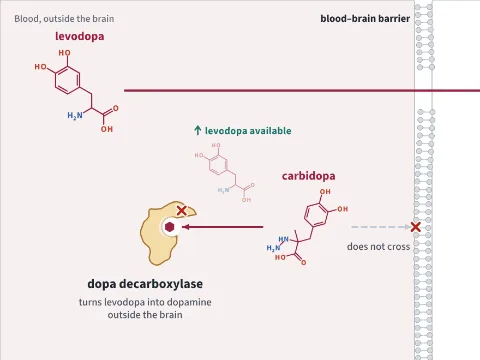
Dopamine itself does not cross the blood-brain barrier, but levodopa does and is presumably turned into dopamine in the brain; carbidopa stops levodopa being broken down outside the brain, so more of it reaches the brain.2
- B
Pimavanserin: hallucinations and delusions
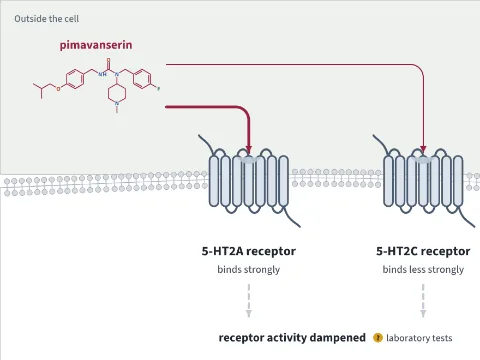
Used for the hallucinations and delusions of Parkinson disease psychosis. How it works is unclear; it may act through serotonin receptors, and less through receptors.3
What the source says
“NUPLAZID ® is indicated for the treatment of hallucinations and delusions associated with Parkinson's disease psychosis”
Source 3“the effect of pimavanserin could be mediated through a combination of inverse agonist and antagonist activity at serotonin 5-HT 2A receptors and to a lesser extent at serotonin 5-HT 2C receptors.”
Source 3
See also
Body system: brain & nerves.
Zoom in: dopamine and movement.
Also used for it: rasagiline (“AZILECT (rasagiline tablets) is indicated for the treatment of Parkinson’s disease (PD).”4) and entacapone (for end-of-dose “wearing-off” of levodopa and carbidopa: “Entacapone Tablets are indicated as an adjunct to levodopa and carbidopa to treat end-of-dose “wearing-off” in patients with Parkinson’s disease”5).
Related medicines: ropinirole.
Side effects: why antipsychotics can cause movement problems and why ropinirole can bring on compulsive urges.
Interactions: levodopa and high-protein meals.
Sources
- 1Parkinson's diseaseKalia LV, Lang AE. Lancet 2015 (abstract). Saved copy
- 2Sinemet (carbidopa and levodopa) tablets: FDA labelClinical Pharmacology: Mechanism of Action; Pharmacodynamics. Saved copy
- 3Nuplazid (pimavanserin): FDA label1 Indications and Usage; 12.1 Mechanism of Action. Saved copy
- 4Azilect (rasagiline): FDA label1 Indications and Usage. Saved copy
- 5Entacapone tablets (Aphena): FDA labelIndications. Saved copy
- 6Levodopa and the progression of Parkinson's diseaseFahn S et al. N Engl J Med 2004 (abstract). Saved copy
- 7Pimavanserin for patients with Parkinson's disease psychosis: a randomised, placebo-controlled phase 3 trialCummings J et al. Lancet 2014 (abstract). Saved copy
- 8Human aromatic L-amino acid decarboxylase (dopa decarboxylase) with carbidopaPDB 9GNS; Baine, J.M. et al. Acs Catalysis 2025;15:8204-8218. The decarboxylase outline in the drawing is traced from this structure. Saved copy
Notes and limits
- The cause of Parkinson disease is unknown; it seems to come from an interplay of genetic and environmental factors.1
- No treatment has been shown to slow the loss of nerve cells; the medicines here treat symptoms.1
Notes that apply to every page are on How to read a page.
Spotted a mistake? Report an error (hello@openmechanism.com). Since launch, every published error we fix is listed on the corrections page.
Cite this page
Tran D. Parkinson disease [Internet]. OpenMechanism; 2026 [updated 2026 Oct 21; cited 2026 Oct 21]. Available from: https://openmechanism.com/conditions/parkinson-disease