Hydroxyzine
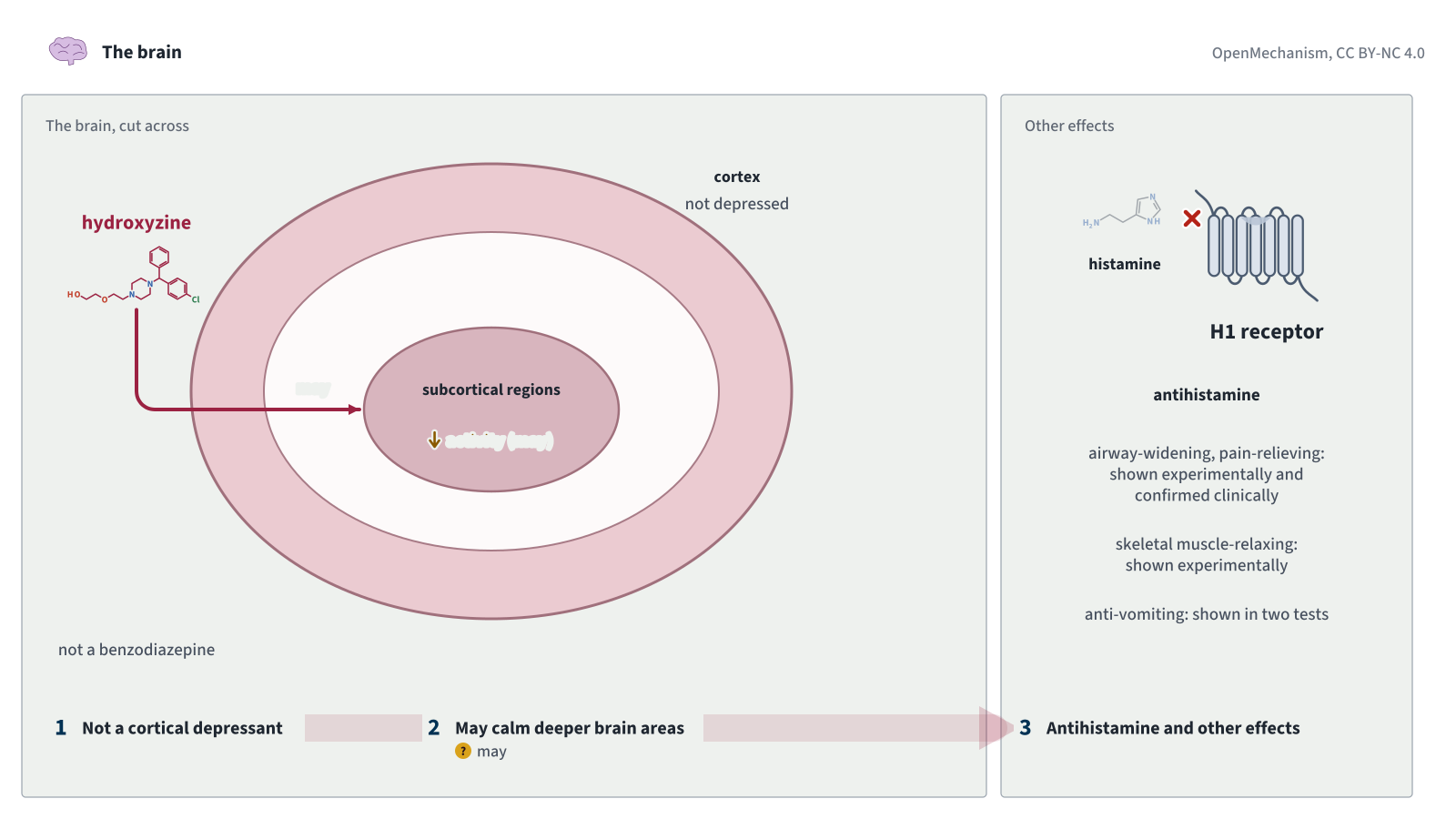
Hydroxyzine is not a benzodiazepine and does not depress the brain's cortex; its calming action may come from suppressing activity in key regions below the cortex. The label lists it for the relief of symptoms of anxiety and tension associated with psychoneurosis, and as an add-on where anxiety shows in physical illness; for itching from allergic conditions such as chronic hives, or caused by histamine; and as a sedative before and after general anesthesia, where the label says hydroxyzine may strengthen the effects of meperidine and barbiturates. It says its effectiveness against anxiety for more than 4 months has not been assessed in systematic clinical studies, and that its antihistamine, airway-widening and pain-relieving effects have been confirmed clinically.
- Acts on
- Possibly key subcortical regions of the brain; histamine
- Where
- The brain
- Medicine type
- Small molecule
- Used for
- Brain & nerves
- Drug class
- Antihistamines
Step 2: may
The hydroxyzine label says: Hydroxyzine is not a cortical depressant, but its action may be due to a suppression of activity in certain key regions of the subcortical area of the central nervous system.
Source 1: Hydroxyzine hydrochloride oral solution: FDA label, Indications and Usage; Clinical Pharmacology
Clinical study: In Llorca and colleagues' 2002 randomized, double-blind trial, 334 adult outpatients with generalized anxiety disorder took hydroxyzine (50 mg a day), bromazepam (6 mg a day) or placebo for 3 months; the trial measured anxiety ratings on the Hamilton Rating Scale for Anxiety (HAM-A), not how hydroxyzine works: In the intent-to-treat analysis, the mean +/- SD change in HAM-A scores from baseline to endpoint was -12.16 +/- 7.74 for hydroxyzine and -9.64 +/- 7.74 for placebo (p =.019).
Llorca PM et al., J Clin Psychiatry 2002 (PMID 12444816)
Key terms in this drawing
- H1 receptor
- Histamine H1 receptor. A histamine receptor; medicines that block it (antihistamines) treat allergies and often make people sleepy.
How it works
Not a cortical depressant. Hydroxyzine is chemically unrelated to the phenothiazines, reserpine, meprobamate and the benzodiazepines, and it does not depress the brain's cortex.1
May calm deeper brain areas. Its action may come from suppressing activity in certain key regions below the cortex (the subcortical area) of the central nervous system.1
Antihistamine and other effects. It blocks histamine H1 receptors. Its antihistamine, airway-widening (bronchodilator) and pain-relieving effects have been shown experimentally and confirmed clinically; skeletal muscle relaxation has been shown experimentally, and an anti-vomiting effect has been shown in two tests (the apomorphine and veriloid tests).1,2
For teachers: download this drawing.
See also
Condition pages: anxiety disorders and chronic hives (urticaria).
Other antihistamines: cetirizine and meclizine.
Body system: brain & nerves.
Sources
- 1Hydroxyzine hydrochloride oral solution: FDA labelIndications and Usage; Clinical Pharmacology
- 2ChEMBL CHEMBL896Target and action classification: Histamine H1 receptor antagonist
- 3Efficacy and safety of hydroxyzine in the treatment of generalized anxiety disorder: a 3-month double-blind studyLlorca PM et al. J Clin Psychiatry 2002 (abstract)
Spotted a mistake? Report an error (hello@openmechanism.com). Since launch, every published error we fix is listed on the corrections page.
Notes and limits
- A schematic teaching drawing: not to scale, not exact structures, binding poses or a complete pathway, and not a guide to dosing, treatment or how a person will respond.
- The steps are in the order that explains them; one step is said to cause the next only where the source says so.
- The label says hydroxyzine's action may be due to a suppression of activity in certain key regions of the subcortical area of the central nervous system.
All recorded limits are on the evidence page, and notes that apply to every page are on How to read a page. Version 1.0.1, medically reviewed by Daniel Tran, PharmD, on 4 November 2026.
Cite this page
Tran D. Hydroxyzine [Internet]. OpenMechanism; 2026 [updated 2026 Nov 4; cited 2026 Nov 4]. Available from: https://openmechanism.com/medicines/hydroxyzine