Neuroblastoma
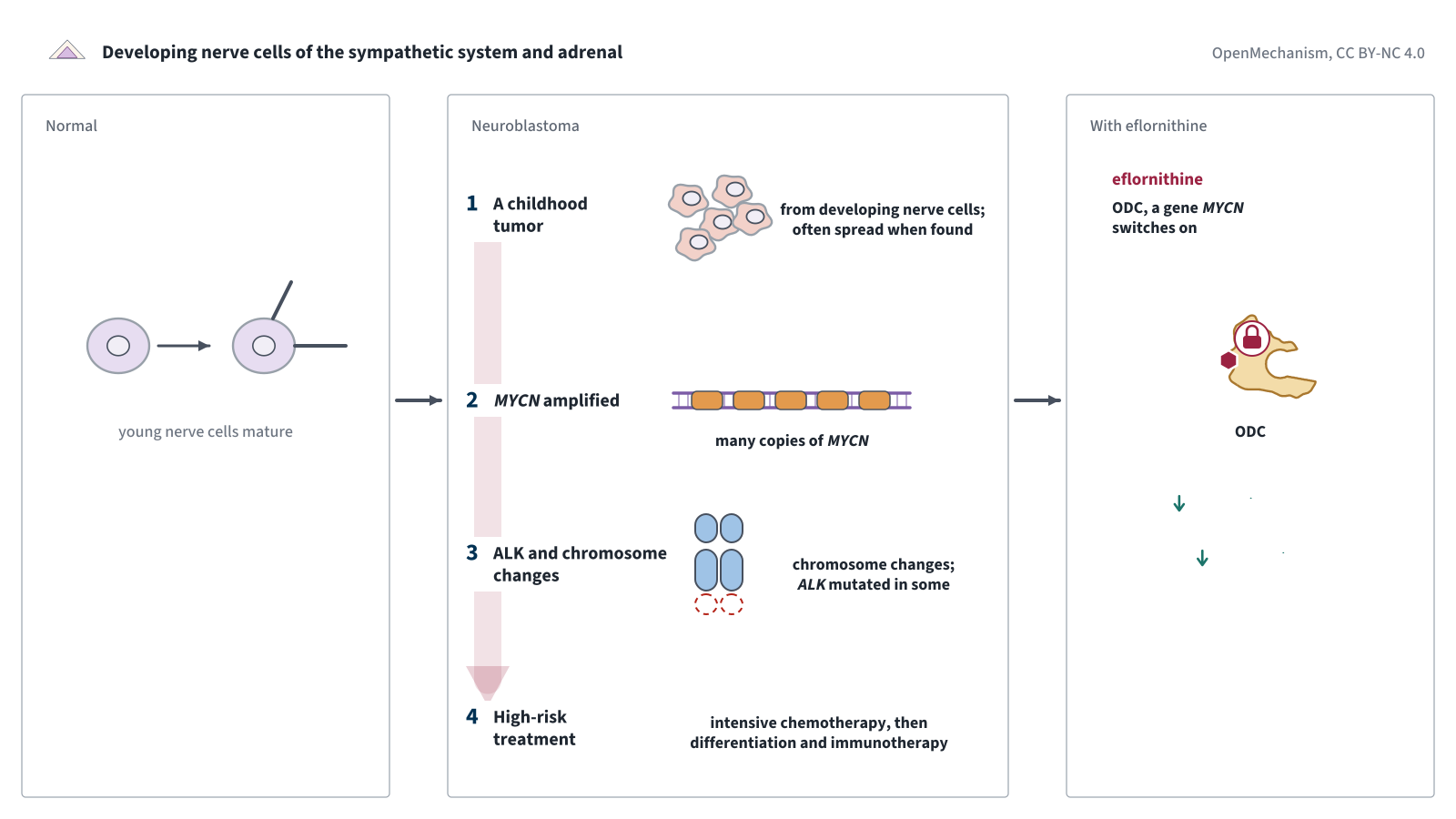
Neuroblastoma, the most common solid tumor outside the brain in childhood, arises from developing nerve cells and has often spread by diagnosis. The most malignant tumors carry many copies of the MYCN gene. Intensive treatment has raised 5-year survival in high-risk disease to 50%. Eflornithine blocks ornithine decarboxylase, a MYCN target, and lowers the risk of relapse.
- Where
- Developing nerve cells of the sympathetic system and adrenal
- Body systems
- Cancer, Brain & nerves
- Medicines
- 1 medicine
For teachers: download this drawing.
Key terms in this drawing
- ALK
- Anaplastic lymphoma kinase. A kinase; changes in its gene are one of the driver mutations in non-small cell lung cancer.
- MYCN
- MYCN oncogene. A cancer-driving gene (oncogene) for a transcription factor; many extra copies of it mark the most malignant neuroblastomas.
- ODC
- Ornithine decarboxylase. The enzyme that starts making polyamines from ornithine; eflornithine blocks it for good.
What goes wrong
A childhood tumor. Neuroblastoma is the most common solid tumor outside the brain in childhood. It arises in young children from the embryonic sympathoadrenal line of nerve cells; it starts early, has often spread by diagnosis, and in infants can go away on its own.1,2
What the source says
“Neuroblastoma is the most common extracranial solid tumour occurring in childhood and has a diverse clinical presentation and course depending on the tumour biology.”
Source 1“Neuroblastoma is a developmental tumor of young children arising from the embryonic sympathoadrenal lineage of the neural crest.”
Source 2“Unique features of these neuroendocrine tumours are the early age of onset, the high frequency of metastatic disease at diagnosis and the tendency for spontaneous regression of tumours in infancy.”
Source 1MYCN amplified. The most malignant tumors carry many copies (amplification) of the cancer gene, which makes a transcription factor; this usually means poor survival, even when the tumor has not spread.1
What the source says
“The most malignant tumours have amplification of the MYCN oncogene (encoding a transcription factor), which is usually associated with poor survival, even in localized disease.”
Source 1ALK and chromosome changes. Changes to parts of chromosomes are frequent and mean a worse outcome. is mutated in 10 to 15% of tumors and in most of the rare family cases.1
What the source says
“Segmental chromosome alterations are frequent in neuroblastoma and are associated with worse outcome.”
Source 1“The rare familial neuroblastomas are usually associated with germline mutations in ALK, which is mutated in 10-15% of primary tumours, and provides a potential therapeutic target.”
Source 1High-risk treatment. For high-risk disease, intensive chemotherapy, then treatment of the last remaining cells with differentiation therapy and immunotherapy, has raised 5-year survival to 50%.1
What the source says
“Advances in therapy for patients with high-risk disease include intensive induction chemotherapy and myeloablative chemotherapy, followed by the treatment of minimal residual disease using differentiation therapy and immunotherapy; these have improved 5-year overall survival to 50%.”
Source 1
Where medicines act
- A
Eflornithine: polyamine making blocked
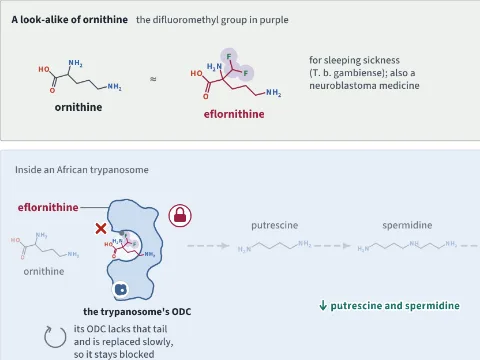
Eflornithine permanently blocks ornithine decarboxylase (), the first enzyme in making polyamines and a gene that MYCN switches on; polyamines help cells multiply. It lowers the risk of relapse in high-risk neuroblastoma that has at least partly responded to earlier treatment, including anti-GD2 immunotherapy.3
What the source says
“Eflornithine is an irreversible inhibitor of the enzyme ornithine decarboxylase (ODC), the first and rate-limiting enzyme in the biosynthesis of polyamines and a transcriptional target of MYCN”
Source 3“Polyamines are involved in differentiation and proliferation of mammalian cells and are important for neoplastic transformation.”
Source 3“IWILFIN is an ornithine decarboxylase inhibitor indicated to reduce the risk of relapse in adult and pediatric patients with high-risk neuroblastoma (HRNB) who have demonstrated at least a partial response to prior multiagent, multimodality therapy including anti-GD2 immunotherapy.”
Source 3
See also
Body systems: cancer and brain & nerves.
Also used for it: cyclophosphamide (“Cyclophosphamide Tablets is indicated for the treatment of: … neuroblastoma (disseminated disease)”4); doxorubicin (“Doxorubicin Hydrochloride Injection is indicated for the treatment of … metastatic neuroblastoma”5); and vincristine (“Vincristine Sulfate Injection has also been shown to be useful in combination with other oncolytic agents in Hodgkin's disease, non–Hodgkin's malignant lymphomas, rhabdomyosarcoma, neuroblastoma, and Wilms' tumor.”6).
Other conditions: acute lymphoblastic leukemia, B-cell lymphomas, Hodgkin lymphoma, acute myeloid leukemia, breast cancer and ovarian cancer.
Side effects: why vincristine can damage nerves.
Sources
- 1NeuroblastomaMatthay KK et al. Nat Rev Dis Primers 2016 (abstract). Saved copy
- 2Neuroblastoma: molecular pathogenesis and therapyLouis CU, Shohet JM. Annu Rev Med 2015 (abstract). Saved copy
- 3Iwilfin (eflornithine): FDA label1 Indications and Usage; 12.1 Mechanism of Action. Saved copy
- 4Cyclophosphamide tablets (Baxter): FDA label1 Indications and Usage. Saved copy
- 5Doxorubicin hydrochloride injection (Pfizer): FDA label1 Indications and Usage. Saved copy
- 6Vincristine sulfate injection (Hospira): FDA labelIndications and Usage. Saved copy
- 7Human ornithine decarboxylase (ODC) with its cofactor and an inhibitorPDB 2OO0; Dufe, V.T. et al. Biochem.J. 2007;405:261-268. The ODC outline in the drawing is traced from this structure. Saved copy
Notes and limits
- Many other genes that may help start the tumor are still being studied.1
Notes that apply to every page are on How to read a page.
Spotted a mistake? Report an error (hello@openmechanism.com). Since launch, every published error we fix is listed on the corrections page.
Cite this page
Tran D. Neuroblastoma [Internet]. OpenMechanism; 2026 [updated 2026 Oct 21; cited 2026 Oct 21]. Available from: https://openmechanism.com/conditions/neuroblastoma