Ethosuximide
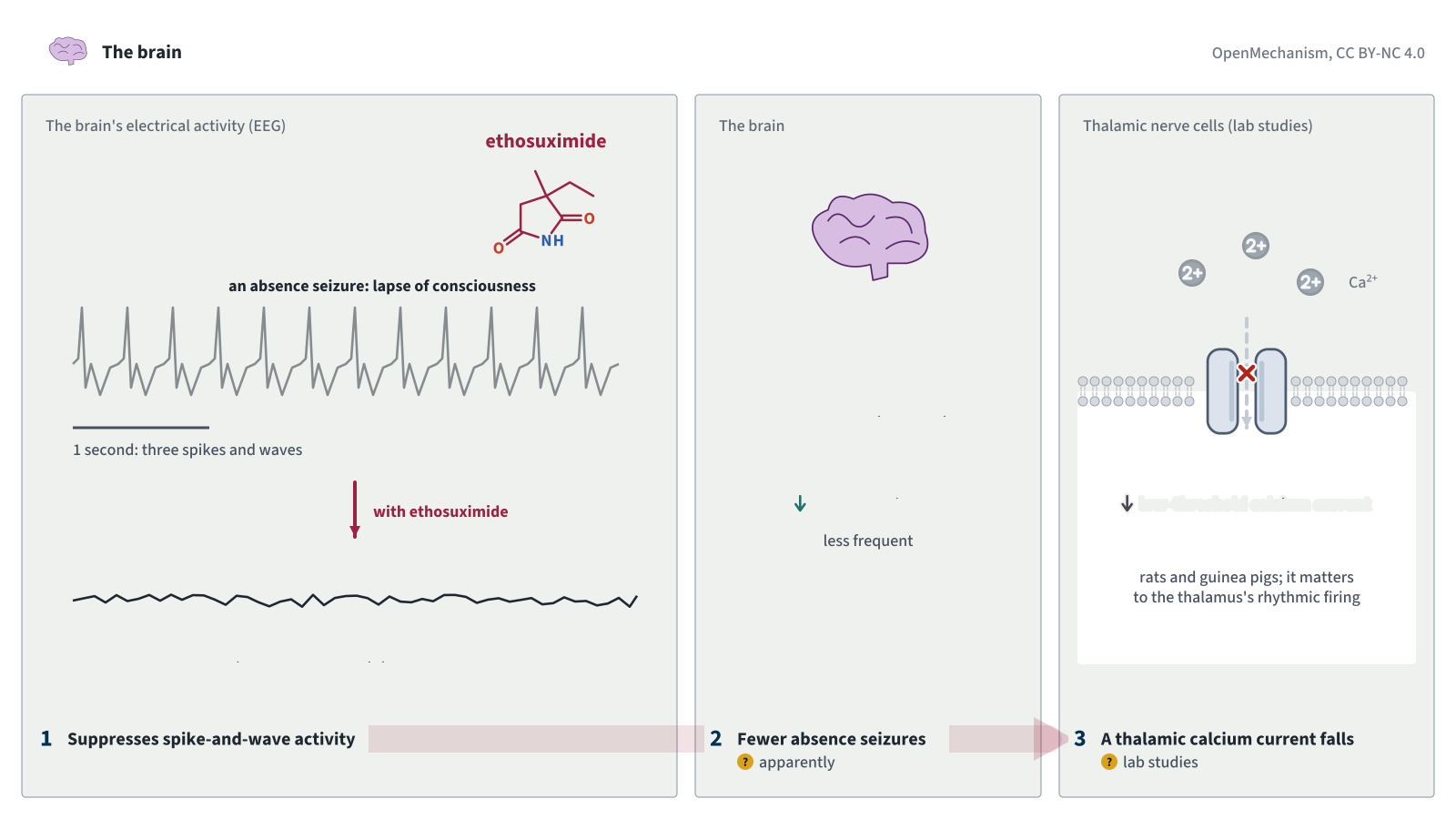
Ethosuximide suppresses the three-per-second spike-and-wave activity that comes with the lapses of consciousness of absence seizures, which become less frequent, apparently because it depresses the motor cortex and raises the brain's threshold to convulsive stimuli. In lab studies of thalamic nerve cells from rats and guinea pigs, it reduced a low-threshold calcium current that matters to the thalamus's rhythmic firing.
- Acts on
- Spike-and-wave activity; in lab studies, a thalamic calcium current
- Where
- The brain
- Medicine type
- Small molecule
- Used for
- Brain & nerves
Step 2: apparently
The ethosuximide label says: The frequency of epileptiform attacks is reduced, apparently by depression of the motor cortex and elevation of the threshold of the central nervous system to convulsive stimuli.
Source 1: Ethosuximide (Mylan): FDA label, Indications and Usage; Clinical Pharmacology
Clinical study: In a randomized, double-blind trial in 453 children with newly diagnosed childhood absence epilepsy, comparing ethosuximide, valproic acid and lamotrigine; the trial measured freedom from treatment failure, not how ethosuximide works: After 16 weeks of therapy, the freedom-from-failure rates for ethosuximide and valproic acid were similar (53% and 58%, respectively;
Glauser TA et al., N Engl J Med 2010 (PMID 20200383)
This study was picked with a literature search and is not yet checked by our reviewer.
Step 3: lab studies
A study of thalamic nerve cells from rats and guinea pigs says: Given the importance of LTCC in thalamic oscillatory behavior, a reduction in this current by ethosuximide would be a mechanism of action compatible with the known anticonvulsant effects of this drug in typical absence seizures.
Clinical study: In a randomized, double-blind trial in 453 children with newly diagnosed childhood absence epilepsy, comparing ethosuximide, valproic acid and lamotrigine; the trial measured freedom from treatment failure, not how ethosuximide works: After 16 weeks of therapy, the freedom-from-failure rates for ethosuximide and valproic acid were similar (53% and 58%, respectively;
Glauser TA et al., N Engl J Med 2010 (PMID 20200383)
This study was picked with a literature search and is not yet checked by our reviewer.
How it works
Suppresses spike-and-wave activity. Ethosuximide suppresses the paroxysmal three-per-second spike-and-wave activity that comes with the lapses of consciousness of absence (petit mal) seizures.1
Fewer absence seizures. The seizures become less frequent, apparently because it depresses the motor cortex and raises the threshold of the central nervous system to convulsive stimuli.1
A thalamic calcium current falls. In lab studies of thalamic nerve cells from rats and guinea pigs, it reduced the low-threshold calcium current, which matters to the thalamus's rhythmic firing; such a reduction would fit its effect in absence seizures.2
For teachers: download this drawing.
See also
Condition pages: epilepsy.
Related drawings: lamotrigine (another antiseizure medicine; lab studies suggest it blocks sodium channels).
Body system: brain & nerves.
Sources
- 1Ethosuximide (Mylan): FDA labelIndications and Usage; Clinical Pharmacology
- 2Characterization of ethosuximide reduction of low-threshold calcium current in thalamic neuronsCoulter DA et al., Ann Neurol 1989 (abstract)
- 3ChEMBL CHEMBL696Target and action classification: Voltage-gated T-type calcium channel blocker
- 4Ethosuximide, valproic acid, and lamotrigine in childhood absence epilepsyGlauser TA et al. N Engl J Med 2010 (abstract)
Spotted a mistake? Report an error (hello@openmechanism.com). Since launch, every published error we fix is listed on the corrections page.
Notes and limits
- A schematic teaching drawing: not to scale, not exact structures, binding poses or a complete pathway, and not a guide to dosing, treatment or how a person will respond.
- The label says the effect comes about 'apparently' this way.
- Shown in isolated nerve cells from animals; the label names no target.
All recorded limits are on the evidence page, and notes that apply to every page are on How to read a page. Version 1.0.0, not yet medically reviewed.
Cite this page
Tran D. Ethosuximide [Internet]. OpenMechanism; 2026 [updated 2026 Oct 18; cited 2026 Oct 18]. Available from: https://openmechanism.com/medicines/ethosuximide