Carbamazepine
In laboratory studies of nerve cells, carbamazepine holds back the flow of sodium through sodium channels, as phenytoin and lamotrigine do. Its label lists it for use against seizures, with evidence from studies in people with partial seizures with complex symptoms, generalized tonic-clonic seizures or mixed seizure patterns (absence seizures do not appear to be controlled), and for the pain of true trigeminal neuralgia. It says how carbamazepine works remains unknown; in rats and mice it worked against induced seizures, and it appears to act by reducing responses relayed through chains of nerve cells and blocking the strengthening of connections after rapid firing. In the liver, is the main enzyme that turns it into an epoxide that also works against seizures in animals, and on a fixed dose carbamazepine speeds up its own breakdown over 3 to 5 weeks.
- Acts on
- Sodium channels in nerve cells (in laboratory studies); the label says its mechanism remains unknown
- Where
- Nerve cells in the brain
- Medicine type
- Small molecule
- Used for
- Brain & nerves
- Drug class
- Sodium channel blockers (antiseizure)
Also called Tegretol and Tegretol-XR (carbamazepine XR tablets).
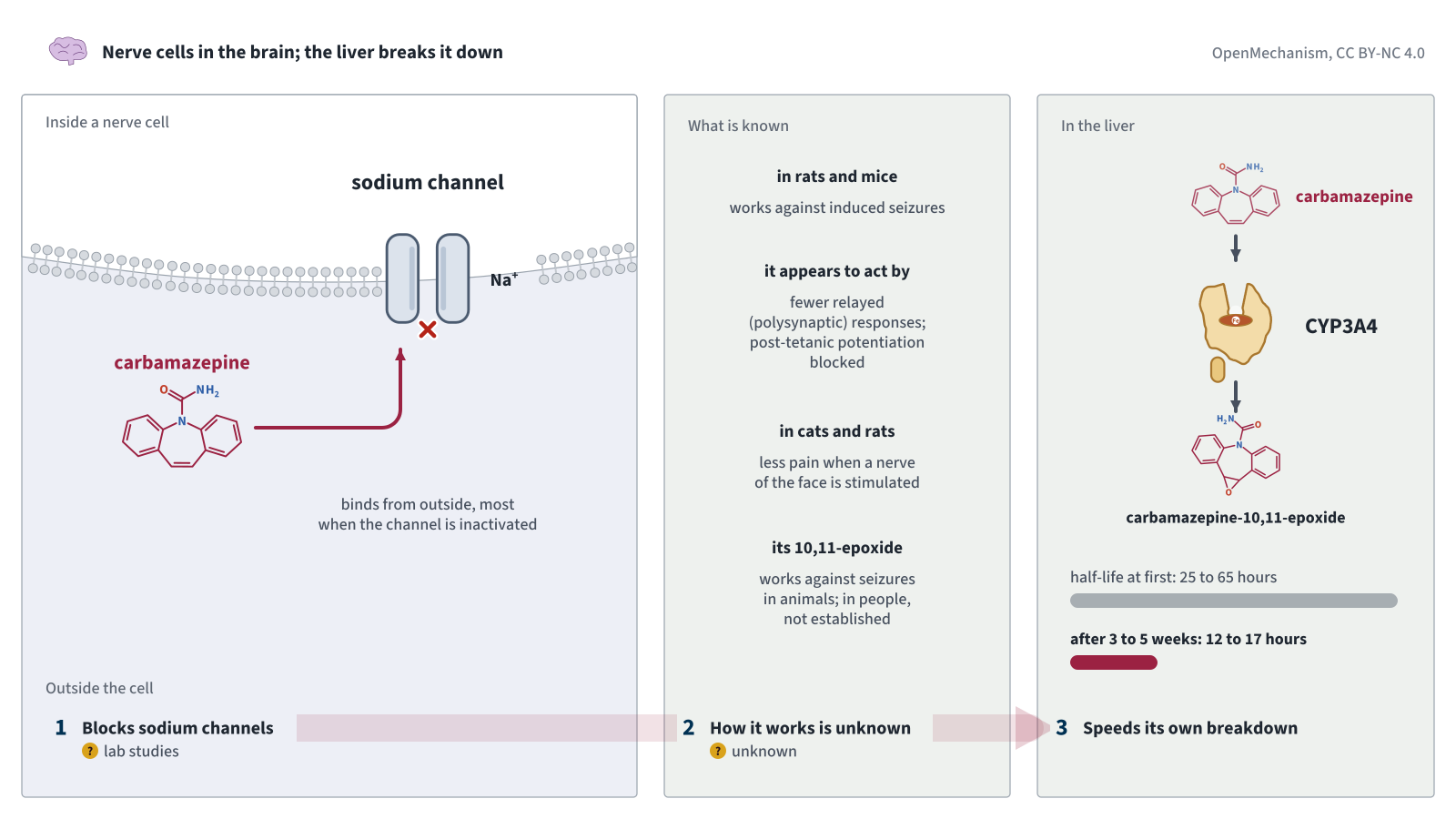
Step 1: lab studies
A laboratory study of sodium currents in nerve cells (Kuo 1998) says: These drugs all show voltage-dependent inhibition of Na+ currents, which has been implicated as the major mechanism underlying the antiepileptic effect. … Altogether these findings suggest that phenytoin, carbamazepine, and lamotrigine bind to a common receptor located on the extracellular side of the Na+ channel.
Clinical study: In SANAD, Marson and colleagues' 2007 unblinded randomized trial, 1721 people with partial epilepsy for whom carbamazepine was deemed standard treatment were randomly assigned carbamazepine, gabapentin, lamotrigine, oxcarbazepine or topiramate; the trial measured time to treatment failure and time to a 12-month remission, not how carbamazepine works: For time to treatment failure, lamotrigine was significantly better than carbamazepine (hazard ratio [HR] 0.78 [95% CI 0.63-0.97]), gabapentin (0.65 [0.52-0.80]), and topiramate (0.64 [0.52-0.79]), and had a non-significant advantage compared with oxcarbazepine (1.15 [0.86-1.54]). For time to 12-month remission carbamazepine was significantly better than gabapentin (0.75 [0.63-0.90]), and estimates suggest a non-significant advantage for carbamazepine against lamotrigine (0.91 [0.77-1.09]), topiramate (0.86 [0.72-1.03]), and oxcarbazepine (0.92 [0.73-1.18]).
Marson AG et al., Lancet 2007 (PMID 17382827)
Step 2: unknown
The Tegretol label says: It appears to act by reducing polysynaptic responses and blocking the post-tetanic potentiation. … The mechanism of action remains unknown.
Clinical study: In Mattson and colleagues' 1985 double-blind randomized trial, 622 adults with partial and secondarily generalized tonic-clonic seizures were randomly assigned carbamazepine, phenobarbital, phenytoin or primidone and followed for two years or until the medicine failed to control seizures or caused unacceptable side effects; the trial measured seizure control and side effects, not how carbamazepine works: Control of tonic-clonic seizures did not differ significantly with the various drugs. Carbamazepine provided complete control of partial seizures more often than primidone or phenobarbital (P less than 0.03).
Mattson RH et al., N Engl J Med 1985 (PMID 3925335)
Key terms in this drawing
- CYP3A4
- Cytochrome P450 3A4. One of the cytochrome P450 enzymes that break down medicines, atorvastatin among them; some antibiotics and antifungals can block it.
- half-life
- Half-life. The time it takes for the amount in the blood to fall by half.
How it works
Blocks sodium channels. In laboratory studies of nerve cells, carbamazepine, like phenytoin and lamotrigine, held back the flow of sodium through sodium channels, depending on the voltage, an effect that has been implicated as the main way these medicines work against seizures. The study's findings suggest it binds the channel from the outside; it binds much more strongly when the channel is inactivated than when it is at rest.1
How it works is unknown. The label says its mechanism of action remains unknown. In rats and mice with induced seizures it worked against seizures, and it appears to act by reducing responses relayed through chains of nerve cells (polysynaptic responses) and by blocking post-tetanic potentiation, the strengthening of a connection after a burst of rapid firing. In cats and rats it greatly reduced or abolished pain caused by stimulating a nerve of the face. Its main metabolite, carbamazepine-10,11-epoxide, also works against seizures in animal models; whether this matters in people has not been established.2
Speeds its own breakdown. In the liver, CYP3A4 is the main enzyme that turns carbamazepine into carbamazepine-10,11-epoxide. Carbamazepine speeds up its own breakdown: its of 25 to 65 hours at first falls to 12 to 17 hours with repeated doses, a change that is complete after 3 to 5 weeks of a fixed dosing regimen.2
For teachers: download this drawing.
See also
Condition pages: bipolar disorder and epilepsy.
Other sodium channel blockers (antiseizure): lamotrigine, oxcarbazepine, phenytoin and topiramate.
Explained: carbamazepine and the HLA-B*15:02 variant; and why carbamazepine speeds up its own breakdown.
Body system: brain & nerves.
Sources
- 1A common anticonvulsant binding site for phenytoin, carbamazepine, and lamotrigine in neuronal Na+ channelsKuo CC, Mol Pharmacol 1998 (abstract)
- 2Tegretol and Tegretol-XR (carbamazepine): FDA labelIndications and Usage; Clinical Pharmacology: Mechanism of Action; Pharmacokinetics; Boxed Warning
- 3ChEMBL CHEMBL108Target and action classification: Sodium channel alpha subunit blocker
- 4
- 5Comparison of carbamazepine, phenobarbital, phenytoin, and primidone in partial and secondarily generalized tonic-clonic seizuresMattson RH et al. N Engl J Med 1985 (abstract)
Also used for the drawing
The page and its drawing place carbamazepine's action in nerve cells in the brain, on the laboratory study below: carbamazepine reduced the sodium current of nerve cells from the hippocampus, removed in surgery from eight people with temporal lobe epilepsy that medicines had not controlled. The CYP3A4 outline is traced from the crystal structure below.
- 6Human CYP3A4 with ritonavirPDB 3NXU; Sevrioukova, I.F., Poulos, T.L. Proc.Natl.Acad.Sci.USA 2010; 107:18422-18427
- 7Carbamazepine effects on Na+ currents in human dentate granule cells from epileptogenic tissueReckziegel G et al. Epilepsia 1999 (abstract)
Spotted a mistake? Report an error (hello@openmechanism.com). Since launch, every published error we fix is listed on the corrections page.
Notes and limits
- A schematic teaching drawing: not to scale, not exact structures, binding poses or a complete pathway, and not a guide to dosing, treatment or how a person will respond.
- The Tegretol label has a boxed warning: serious and sometimes fatal skin reactions, including toxic epidermal necrolysis and Stevens-Johnson syndrome, have been reported, and studies in patients of Chinese ancestry found a strong association with the HLA-B*1502 gene variant; aplastic anemia and agranulocytosis have also been reported.
- Shown in laboratory studies of nerve cells (Kuo 1998); the Tegretol label's mechanism section does not describe sodium channels and says the mechanism of action remains unknown.
- The label says the mechanism of action remains unknown; the actions it describes were seen in rats, mice and cats, and the significance of the epoxide's activity has not been established.
All recorded limits are on the evidence page, and notes that apply to every page are on How to read a page. Version 1.0.1, medically reviewed by Daniel Tran, PharmD, on 7 November 2026.
Cite this page
Tran D. Carbamazepine [Internet]. OpenMechanism; 2026 [updated 2026 Nov 7; cited 2026 Nov 7]. Available from: https://openmechanism.com/medicines/carbamazepine