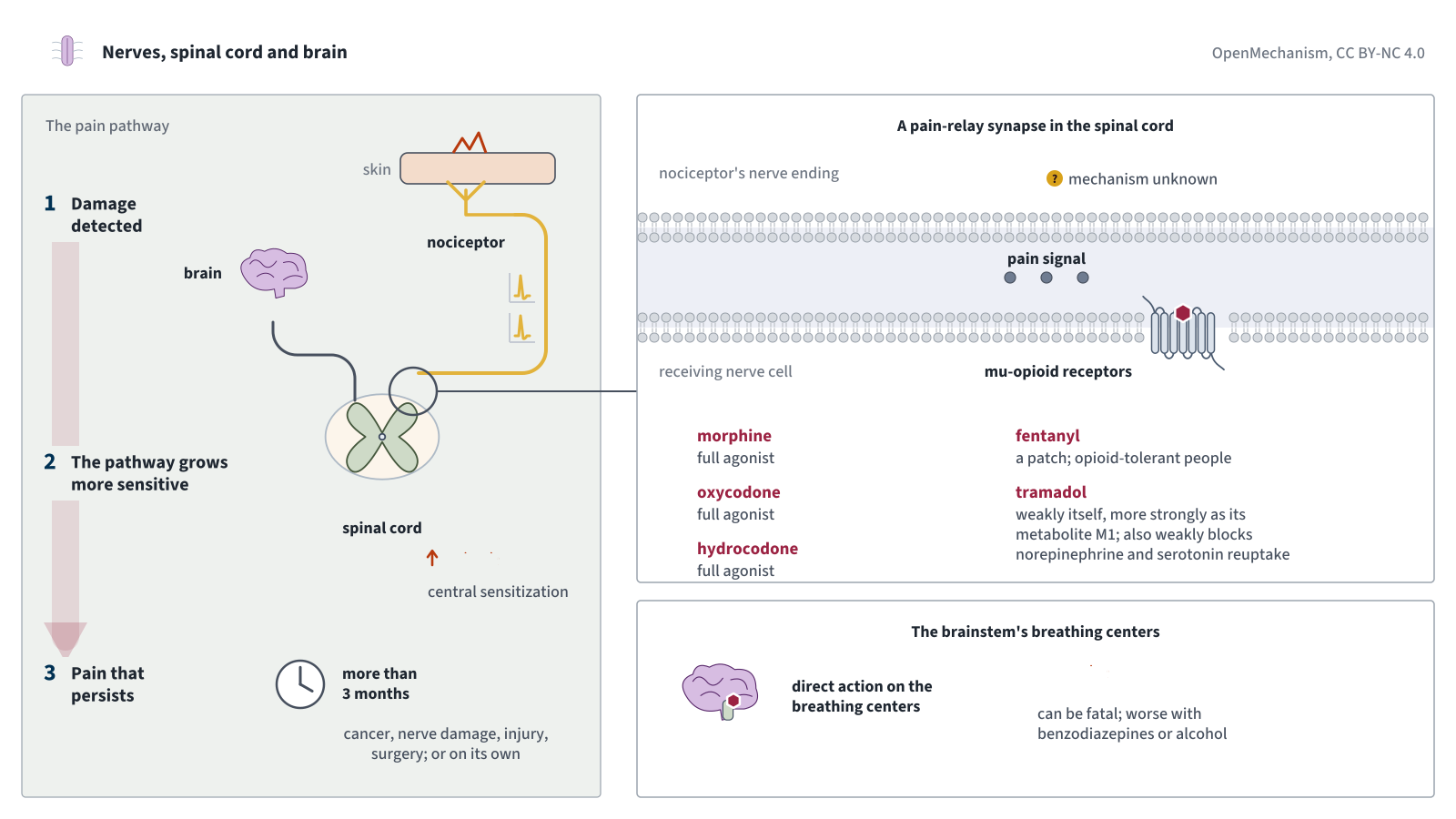
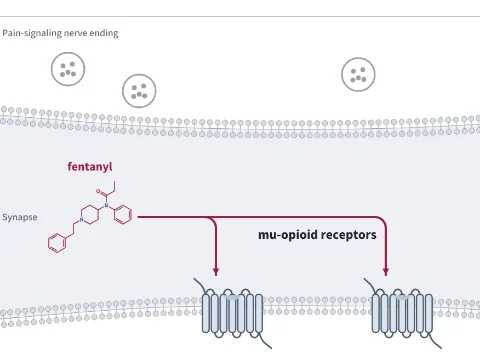
Pain begins when nociceptors, nerve cells that detect potentially damaging stimuli, send signals relayed to the brain. With persistent injury the pathway grows more sensitive, and pain that persists or recurs for more than 3 months is chronic. Opioids act mainly on mu-opioid receptors, found in the brain and spinal cord; exactly how they relieve pain is unknown. Each of their labels names the risks of addiction, abuse, misuse, overdose and death; MS Contin's boxed warning adds slowed breathing that can be life-threatening or fatal.
What goes wrong in severe and persistent pain, and where medicines act. Schematic, not to scale. License CC BY-NC 4.0.
?Mechanism unknown
The MS Contin label says: The precise mechanism of the analgesic action is unknown. However, specific CNS opioid receptors for endogenous compounds with opioid-like activity have been identified throughout the brain and spinal cord and are thought to play a role in the analgesic effects of this drug.
Clinical study: Krebs and colleagues' 2018 12-month randomized trial in 240 people from Veterans Affairs primary care clinics with moderate to severe chronic back pain or hip or knee osteoarthritis pain despite using pain medicines compared opioids (first immediate-release morphine, oxycodone, or hydrocodone with acetaminophen) with non-opioid medicines; it measured function and pain, not how opioids work: Groups did not significantly differ on pain-related function over 12 months (overall P = .58); mean 12-month BPI interference was 3.4 for the opioid group and 3.3 for the nonopioid group (difference, 0.1 [95% CI, -0.5 to 0.7]). Pain intensity was significantly better in the nonopioid group over 12 months (overall P = .03); mean 12-month BPI severity was 4.0 for the opioid group and 3.5 for the nonopioid group (difference, 0.5 [95% CI, 0.0 to 1.0]).Krebs EE et al., JAMA 2018 (PMID 29509867)
Agonist. A molecule that binds a receptor and activates it, as the body's own messenger does.
reuptake
Reuptake. Nerve cells taking a messenger such as serotonin back up, which helps end its signal.
What goes wrong
Damage detected. Pain starts with nociceptors, sensory nerve cells that detect extremes of temperature and pressure and chemicals released by injury, and turn them into electrical signals that are relayed to higher brain centers. When intense, such stimuli cause acute pain.1,2
What the source says
“Specialized peripheral sensory neurons known as nociceptors alert us to potentially damaging stimuli at the skin by detecting extremes in temperature and pressure and injury-related chemicals, and transducing these stimuli into long-ranging electrical signals that are relayed to higher brain centers.”
“When intense, these stimuli generate acute pain, and in the setting of persistent injury, both peripheral and central nervous system components of the pain transmission pathway exhibit tremendous plasticity, enhancing pain signals and producing hypersensitivity.”
The pathway grows more sensitive. With persistent injury, the nerves of the pain pathway, outside and inside the brain and spinal cord, change: they enhance pain signals and produce hypersensitivity to pain. Input from nociceptors can cause a prolonged but reversible rise in the excitability of pain-relaying neurons in the spinal cord and brain (central sensitization).2,3
What the source says
“When intense, these stimuli generate acute pain, and in the setting of persistent injury, both peripheral and central nervous system components of the pain transmission pathway exhibit tremendous plasticity, enhancing pain signals and producing hypersensitivity.”
“Nociceptor inputs can trigger a prolonged but reversible increase in the excitability and synaptic efficacy of neurons in central nociceptive pathways, the phenomenon of central sensitization.”
“We have certainly come a long way since the first discovery of activity-dependent synaptic plasticity in the spinal cord and the revelation that it occurs and produces pain hypersensitivity in patients.”
Pain that persists. When these changes persist, a chronic pain condition may result. Chronic pain is pain that persists or recurs for more than 3 months. It may be seen as a disease in its own right, as in fibromyalgia or nonspecific low back pain, or follow another disease, as in pain related to cancer, nerve damage, injury or surgery.2,4
What the source says
“When plasticity facilitates protective reflexes, it can be beneficial, but when the changes persist, a chronic pain condition may result.”
“In conditions such as fibromyalgia or nonspecific low-back pain, chronic pain may be conceived as a disease in its own right; in our proposal, we call this subgroup "chronic primary pain”
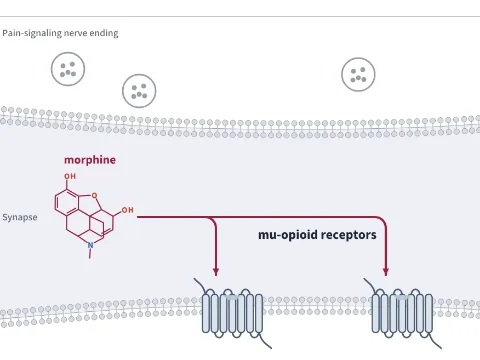
A full opioid , acting mainly at mu-opioid receptors, with no ceiling to its pain relief, though side effects such as slowed breathing may limit the dose; exactly how it relieves pain is unknown.5
Used for (extended-release tablets)Severe and persistent pain: needing an opioid, when other options, including immediate-release opioids, cannot treat it adequately
What the label says
“MS CONTIN is indicated for the management of severe and persistent pain that requires an opioid analgesic and that cannot be adequately treated with alternative options, including immediate-release opioids.”
“Morphine is a full opioid agonist and is relatively selective for the mu-opioid receptor, although it can bind to other opioid receptors at higher doses.”
“However, specific CNS opioid receptors for endogenous compounds with opioid-like activity have been identified throughout the brain and spinal cord and are thought to play a role in the analgesic effects of this drug.”
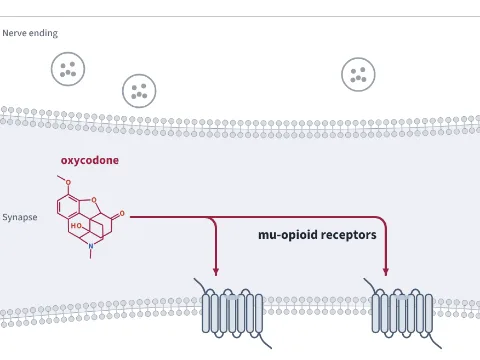
A full opioid agonist, acting mainly at mu-opioid receptors, with no ceiling to its pain relief, though side effects such as slowed breathing may limit the dose; exactly how it relieves pain is unknown.6
Used for (extended-release tablets)Severe and persistent pain: needing an opioid, when other options, including immediate-release opioids, cannot treat it adequately; in adults and opioid-tolerant children 11 and older
What the label says
“OXYCONTIN is indicated for the management of severe and persistent pain that requires an opioid analgesic and that cannot be adequately treated with alternative options, including immediate-release opioids, in: Adults; and Opioid-tolerant pediatric patients 11 years of age and older”
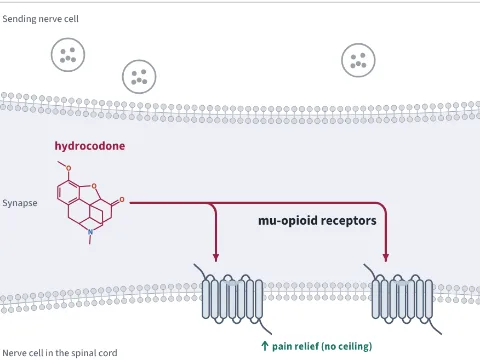
A full opioid agonist, acting mainly at mu-opioid receptors, with no ceiling to its pain relief, though side effects such as slowed breathing may limit the dose; exactly how it relieves pain is unknown.7
Used for (extended-release tablets)Severe and persistent pain: needing an opioid, when other options, including immediate-release opioids, cannot treat it adequately
What the label says
“HYSINGLA ER is indicated for the management of severe and persistent pain that requires an opioid analgesic and that cannot be adequately treated with alternative options, including immediate-release opioids.”
“Hydrocodone is a full opioid agonist with relative selectivity for the mu-opioid receptor, although it can interact with other opioid receptors at higher doses.”
An opioid agonist given through the skin, acting mainly at mu-opioid receptors.8
Used forSevere and persistent pain: in opioid-tolerant people, needing an opioid, when other options, including immediate-release opioids, cannot treat it adequately
What the label says
“Fentanyl transdermal system is indicated for the management of severe and persistent pain in opioid-tolerant patients that requires an opioid analgesic and that cannot be adequately treated with alternative options, including immediate-release opioids.”
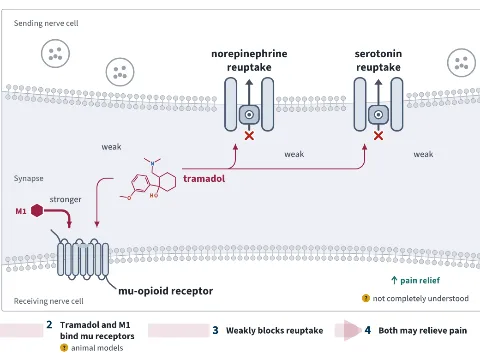
Binds mu-opioid receptors, weakly itself and more strongly through its metabolite M1, and weakly blocks norepinephrine and serotonin ; how it works is not completely understood.9
Used forPain severe enough to need an opioid: in adults, when other treatments are inadequate
What the label says
“Tramadol hydrochloride tablets are indicated in adults for the management of pain severe enough to require an opioid analgesic and for which alternative treatments are inadequate.”
“Although the mode of action is not completely understood, the analgesic effect of tramadol is believed to be due to both binding to μ-opioid receptors and weak inhibition of re-uptake of norepinephrine and serotonin.”
“Opioid activity is due to both low affinity binding of the parent compound and higher affinity binding of the O -demethylated metabolite M1 to μ-opioid receptors.”
Because addiction, abuse, misuse, overdose and death can occur at any dose or duration and persist over the course of treatment, the MS Contin label reserves opioid pain medicines for people whose other options are ineffective, not tolerated or inadequate, and says MS Contin is not indicated as an as-needed pain medicine.5
Its boxed warning adds that serious, life-threatening or fatal slowed breathing can occur, especially when starting or after raising the dose; that crushing, chewing or dissolving the tablets can cause rapid release and absorption of a potentially fatal dose of morphine; that even one dose taken by accident, especially by a child, can cause a fatal overdose; that opioids with benzodiazepines, other central nervous system (CNS) depressants or alcohol can cause profound sedation, slowed breathing, coma and death; and that using opioids for a long time in pregnancy carries a risk of opioid withdrawal in the newborn (neonatal opioid withdrawal syndrome), which may be life-threatening if not recognized and treated.5
Morphine slows breathing by acting directly on the brainstem's breathing centers, and it slows the gut, which can cause constipation. The label also warns that an opioid can paradoxically increase pain or sensitivity to pain (opioid-induced hyperalgesia), and says its mechanism is not fully understood.5
In a 12-month trial in people with moderate to severe chronic back pain or hip or knee osteoarthritis pain, opioids were not better than non-opioid medicines for pain-related function; pain intensity was lower with non-opioid medicines (by 0.5 points on a 0-to-10 scale, where the trial counted a 1-point improvement as clinically important), and side effects were more common with opioids.10
text bf00f32b9ee5…; drawings c10d1772da10…; notes 151f881e0f83…
AI source check
Claude Opus 5.5 (AI source check), 3 November 2026: 49 statements compared with their sources, 9 flagged for the reviewer. An automated check, not a medical review.
Conflict of interest
Fentanyl: Pfizer, the reviewer's former employer, makes or markets this medicine. Details
Next review due
4 May 2028
Cite this page
Tran D. Severe and persistent pain [Internet]. OpenMechanism; 2026 [updated 2026 Nov 3; cited 2026 Nov 3]. Available from: https://openmechanism.com/conditions/severe-persistent-pain