Ketamine
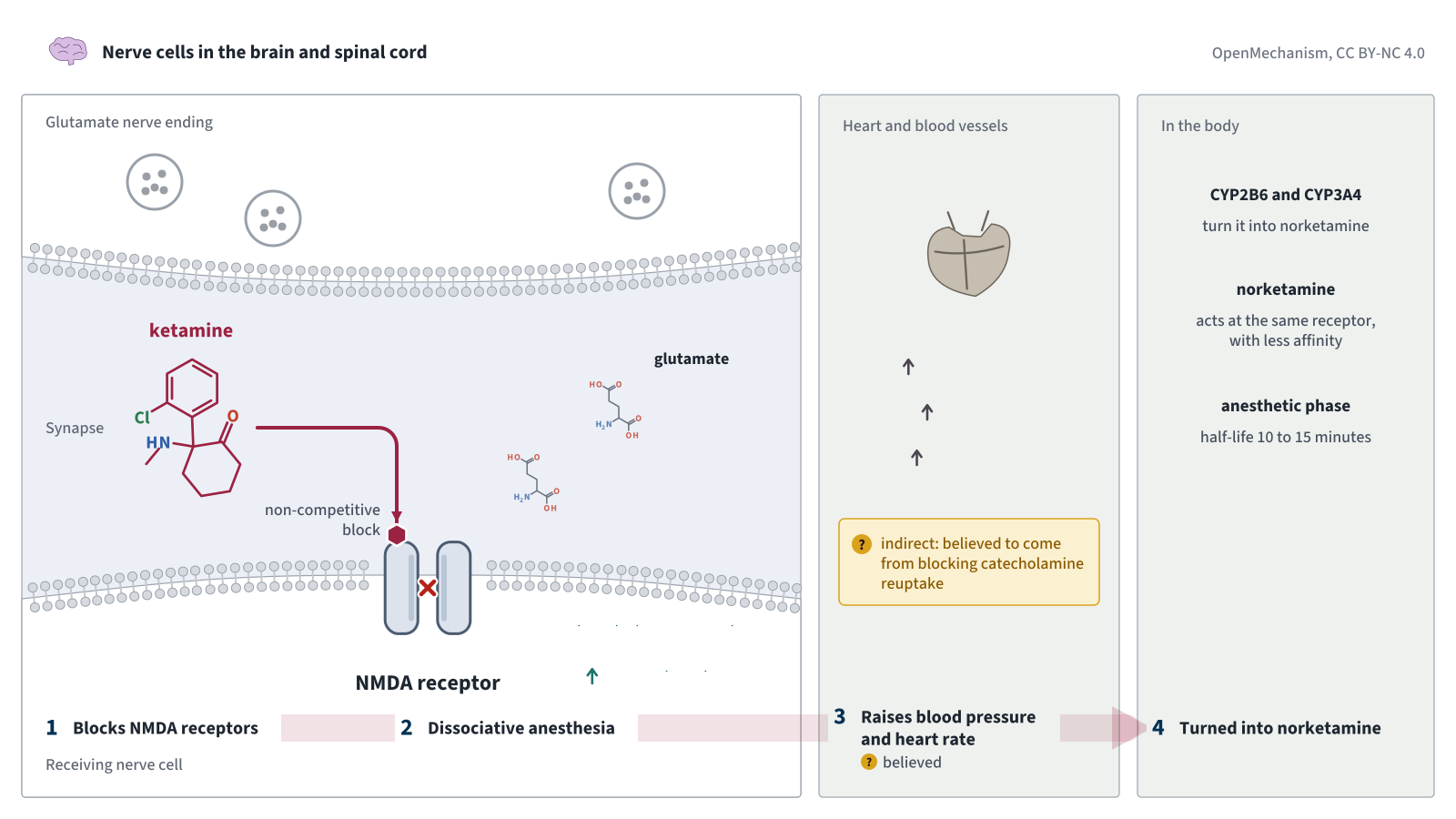
Ketamine blocks , glutamate receptors that are ion channels, in the central nervous system. It brings on a dissociative anesthesia with deep pain relief, in which throat reflexes stay normal and breathing is stimulated. It raises blood pressure and heart rate, believed to be by blocking the of catecholamines. The enzymes and turn it into norketamine, which acts at the same receptor with less .
- Acts on
- NMDA receptors (glutamate receptors)
- Where
- Nerve cells in the brain and spinal cord
- Medicine type
- Small molecule
- Used for
- Brain & nerves
- Drug class
- General anesthetics
Also called Ketalar.
Indirect: believed to come from blocking catecholamine reuptake
The Ketalar label says: Ketamine increases blood pressure, heart rate, and cardiac output. … Cardiovascular effects of ketamine are indirect and believed to be mediated by inhibition of both central and peripheral catecholamine reuptake.
Clinical study: In a physiology study in six healthy volunteers under ketamine anesthesia, which recorded the sympathetic nerves to the muscles and measured catecholamines in the blood (reuptake itself was not measured): During ketamine anesthesia, both epinephrine (15 +/- 10 pg/ml to 256 +/- 193 pg/ml) and norepinephrine (250 +/- 105 pg/ml to 570 +/- 270 pg/ml) plasma concentrations significantly increased, as did heart rate (67 +/- 13 beats/min to 113 +/- 15 beats/min). … Thus, our results do not support the assumption that ketamine anesthesia increases sympathetic nerve activity in a generalized fashion.
Kienbaum P et al., Anesthesiology 2000 (PMID 10638904)
This study was picked with a literature search and is not yet checked by our reviewer.
Step 3: believed
The Ketalar label says: Ketamine increases blood pressure, heart rate, and cardiac output. … Cardiovascular effects of ketamine are indirect and believed to be mediated by inhibition of both central and peripheral catecholamine reuptake.
Clinical study: In a physiology study in six healthy volunteers under ketamine anesthesia, which recorded the sympathetic nerves to the muscles and measured catecholamines in the blood (reuptake itself was not measured): During ketamine anesthesia, both epinephrine (15 +/- 10 pg/ml to 256 +/- 193 pg/ml) and norepinephrine (250 +/- 105 pg/ml to 570 +/- 270 pg/ml) plasma concentrations significantly increased, as did heart rate (67 +/- 13 beats/min to 113 +/- 15 beats/min). … Thus, our results do not support the assumption that ketamine anesthesia increases sympathetic nerve activity in a generalized fashion.
Kienbaum P et al., Anesthesiology 2000 (PMID 10638904)
This study was picked with a literature search and is not yet checked by our reviewer.
Key terms in this drawing (6)
- affinity
- Binding affinity. How strongly a molecule binds its target.
- CYP2B6
- Cytochrome P450 2B6. One of the cytochrome P450 enzymes that break down medicines; with CYP3A4, it turns ketamine into norketamine.
- CYP3A4
- Cytochrome P450 3A4. One of the cytochrome P450 enzymes that break down medicines, atorvastatin among them; some antibiotics and antifungals can block it.
- half-life
- Half-life. The time it takes for the amount in the blood to fall by half.
- NMDA receptor
- N-methyl-D-aspartate receptor. A glutamate receptor that works as an ion channel; ketamine blocks it.
- reuptake
- Reuptake. Nerve cells taking a messenger such as serotonin back up, which helps end its signal.
How it works
Blocks NMDA receptors. Ketamine is a non-selective, non-competitive blocker () of the NMDA receptor, a glutamate receptor that is an ion channel. Its action is mainly due to this block in the central nervous system.1
Dissociative anesthesia. A rapidly acting general anesthetic, ketamine brings on a dissociative state with deep pain relief, in which throat reflexes stay normal and muscle tone stays normal or slightly raised. Breathing and circulation are stimulated; only occasionally is breathing briefly and slightly slowed.1
Raises blood pressure and heart rate. Ketamine raises blood pressure, heart rate and the heart's output. These effects are indirect and are believed to come from blocking the reuptake of catecholamines, both in the central nervous system and in the rest of the body. The rise in blood pressure peaks within a few minutes of an injection and usually settles within 15 minutes.1
Turned into norketamine. The enzymes CYP2B6 and CYP3A4 turn ketamine into norketamine, its main active product in the blood, which acts at the same receptor with less affinity. After an injection into a vein, the anesthetic effect matches a first phase in which blood levels fall with a of 10 to 15 minutes.1
For teachers: download this drawing.
See also
Other general anesthetics: fentanyl and propofol.
Body system: brain & nerves.
Sources
- 1Ketalar (ketamine) injection: FDA label12.1 Mechanism of Action; 12.2 Pharmacodynamics; 12.3 Pharmacokinetics
- 2ChEMBL CHEMBL742Target and action classification: Glutamate [NMDA] receptor negative allosteric modulator
- 3Racemic ketamine decreases muscle sympathetic activity but maintains the neural response to hypotensive challenges in humansKienbaum P et al. Anesthesiology 2000 (abstract)
Spotted a mistake? Report an error (hello@openmechanism.com). Since launch, every published error we fix is listed on the corrections page.
Notes and limits
- A schematic teaching drawing: not to scale, not exact structures, binding poses or a complete pathway, and not a guide to dosing, treatment or how a person will respond.
- The label says the cardiovascular effects are indirect and believed to be mediated by inhibition of both central and peripheral catecholamine reuptake.
All recorded limits are on the evidence page, and notes that apply to every page are on How to read a page. Version 1.0.0, not yet medically reviewed.
Cite this page
Tran D. Ketamine [Internet]. OpenMechanism; 2026 [updated 2026 Oct 16; cited 2026 Oct 16]. Available from: https://openmechanism.com/medicines/ketamine