A schematic teaching drawing: not to scale, not exact structures, binding poses or a complete pathway, and not a guide to dosing, treatment or how a person will respond.
The steps are in the order that explains them; one step is said to cause the next only where the source says so.
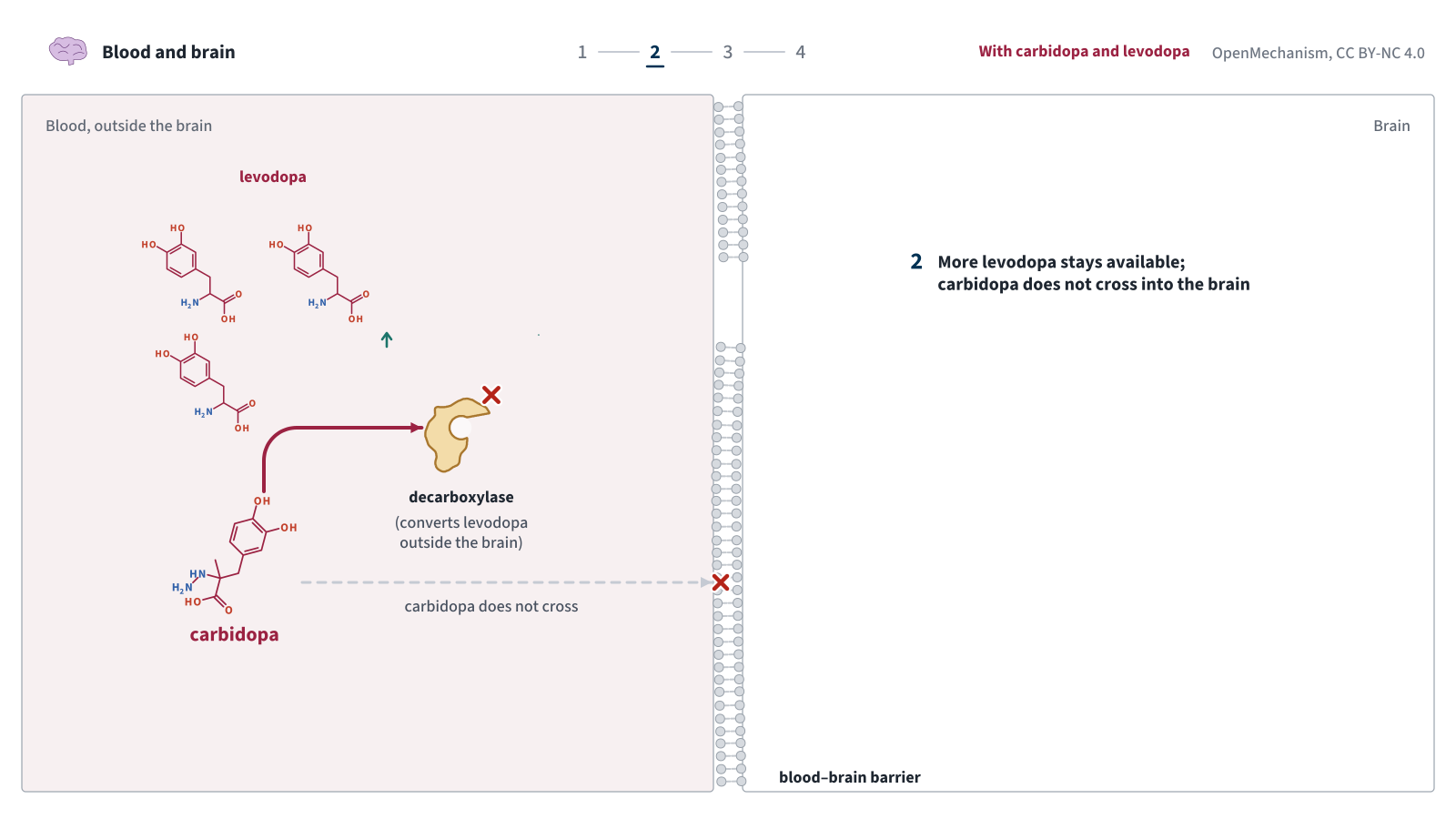
A boundary restriction; no transport arrow into brain.
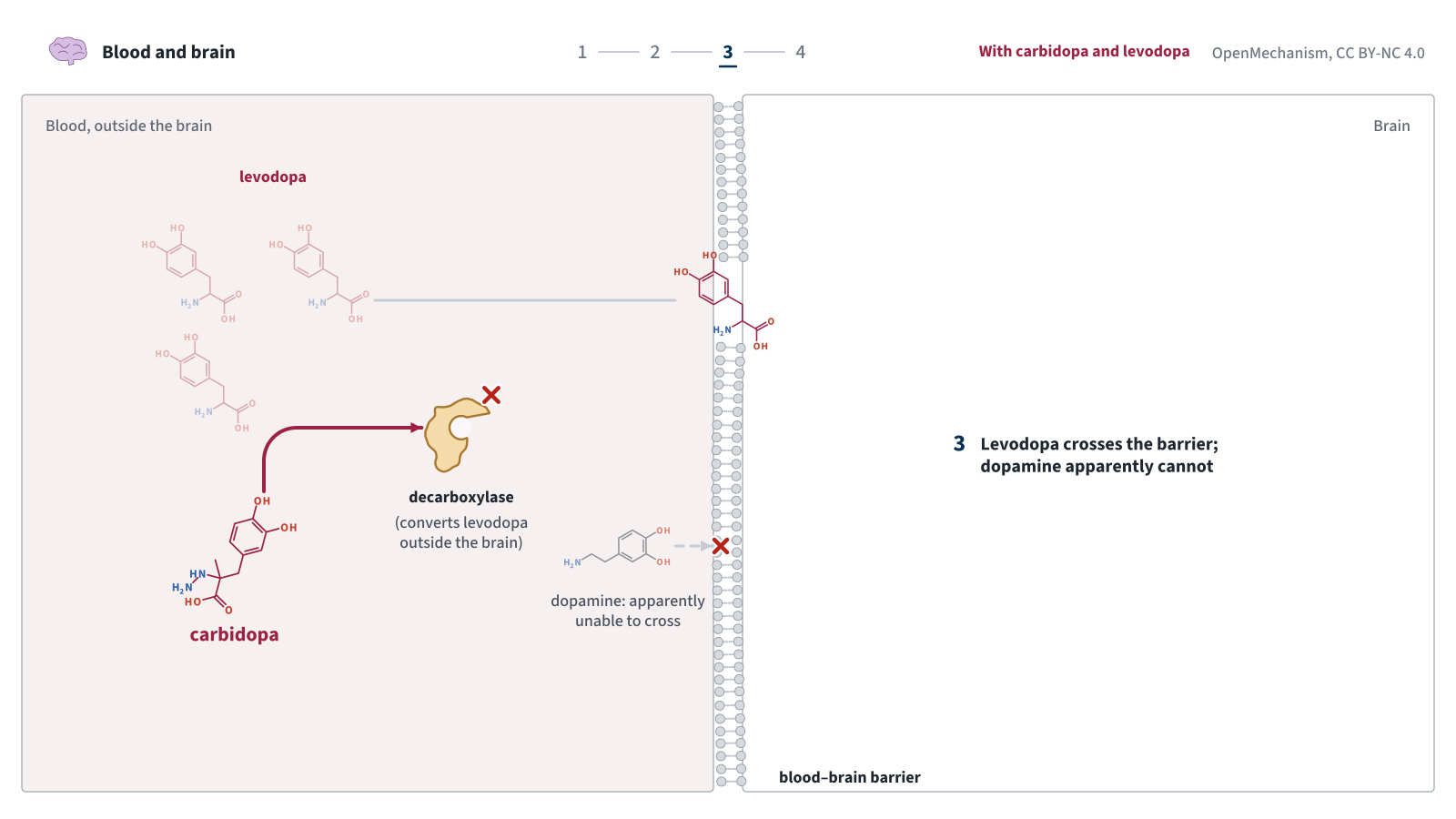
Keep label qualifier for dopamine; no numeric permeability model.
Presumed / thought label mechanism; no clinical effect size or disease modification.
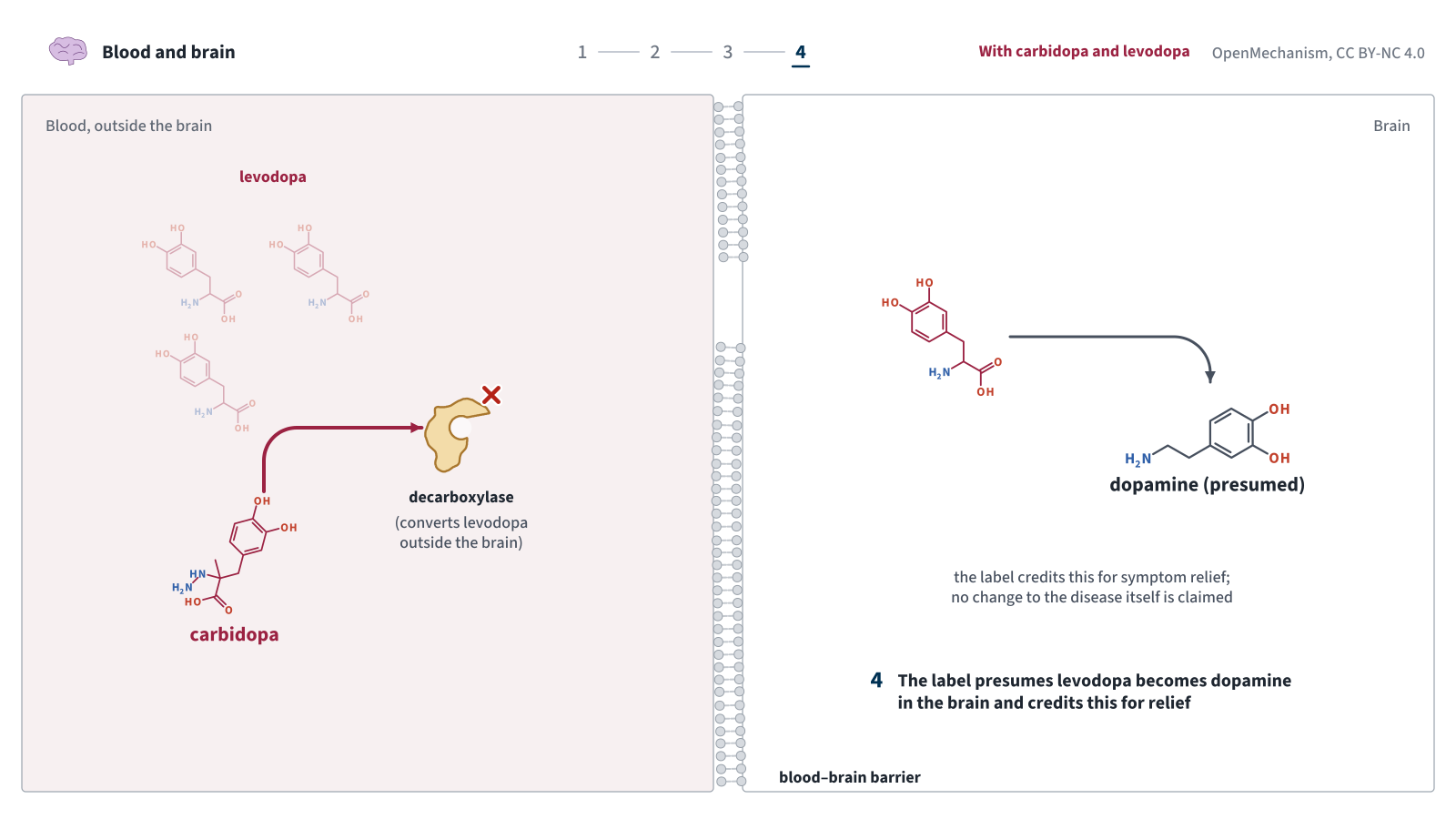
Presumed conversion / thought mechanism; symptom relief is not disease modification.
SINEMET immediate-release oral tablets; no extrapolation to extended-release formulations.
Central conversion and symptomatic mechanism retain the current label’s presumptive wording; no neuroprotection claim.
Carbidopa stays outside the BBB. Dopamine formation in brain and symptomatic relief retain presumed/thought wording; no disease modification or numeric permeability is inferred.
The drawings are schematic and not to scale; each step shows only what its statements say, and the time between steps is not a measured time. They replace the record player's views, which stay available: original record animation.
Every limit as recorded
Player duration and motion are explanatory, not measured biological kinetics.
Human pharmacology as summarized in the official label; molecular detail is schematic.
A boundary restriction; no transport arrow into brain.
Keep label qualifier for dopamine; no numeric permeability model.
Presumed / thought label mechanism; no clinical effect size or disease modification.
Presumed conversion / thought mechanism; symptom relief is not disease modification.
Source-backed motion explanation.
Timing, particle counts, paths, spacing and geometry are illustrative; no measured rates, distances, concentrations or clinical response implied.
Original 2D glyphs and class icons are schematic references, not molecular folds, binding poses or to-scale anatomy.
Motion and cue order are an authored explanatory layer. Only declared, separately source-bound relations carry biological meaning.
Manual playback / seek / replay; no autoplay. A still frame alone does not imply the entire process happened at one time.
SINEMET immediate-release oral tablets; no extrapolation to extended-release formulations.
Central conversion and symptomatic mechanism retain the current label’s presumptive wording; no neuroprotection claim.
Abstract, not-to-scale mechanism; no molecular pose or clinical response prediction.
Source-backed.
Carbidopa stays outside the BBB. Dopamine formation in brain and symptomatic relief retain presumed/thought wording; no disease modification or numeric permeability is inferred.
The record's notes on each step
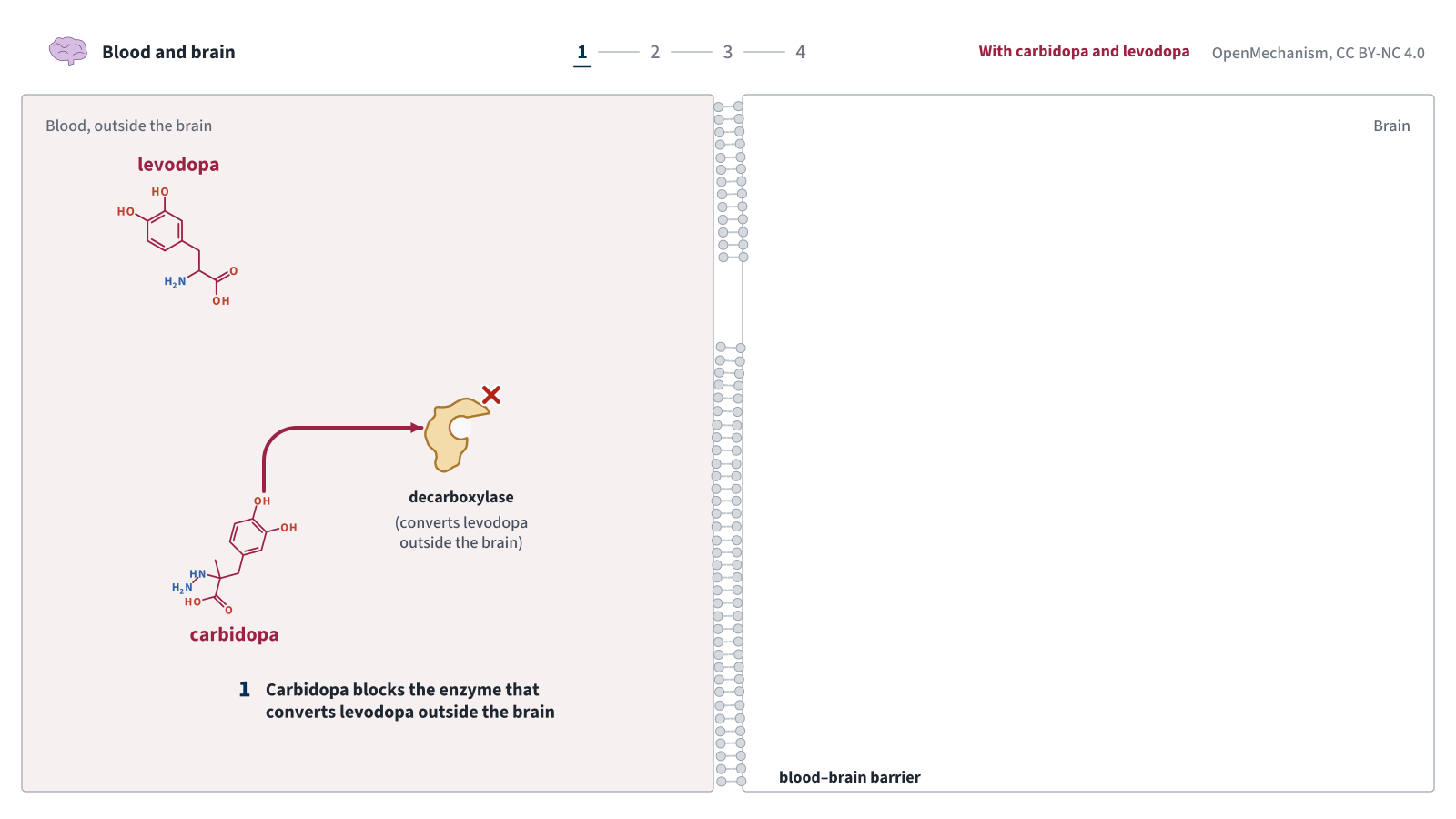
Step 1: Carbidopa inhibits peripheral aromatic amino-acid decarboxylation; this does not assert a molecular binding pose.
Step 2: Less peripheral conversion leaves more unchanged levodopa available. Carbidopa does not cross the BBB.
Step 3: Levodopa crosses the BBB; dopamine is apparently unable to do so. This barrier picture is schematic.
Step 4: The label presumes conversion to brain dopamine and attributes symptomatic relief to that process; not a proven disease-modifying sequence.
Tran D. How levodopa reaches the brain [Internet]. OpenMechanism; 2026 [updated 2026 Oct 13; cited 2026 Oct 13]. Available from: https://openmechanism.com/animations/levodopa-bbb