Entacapone
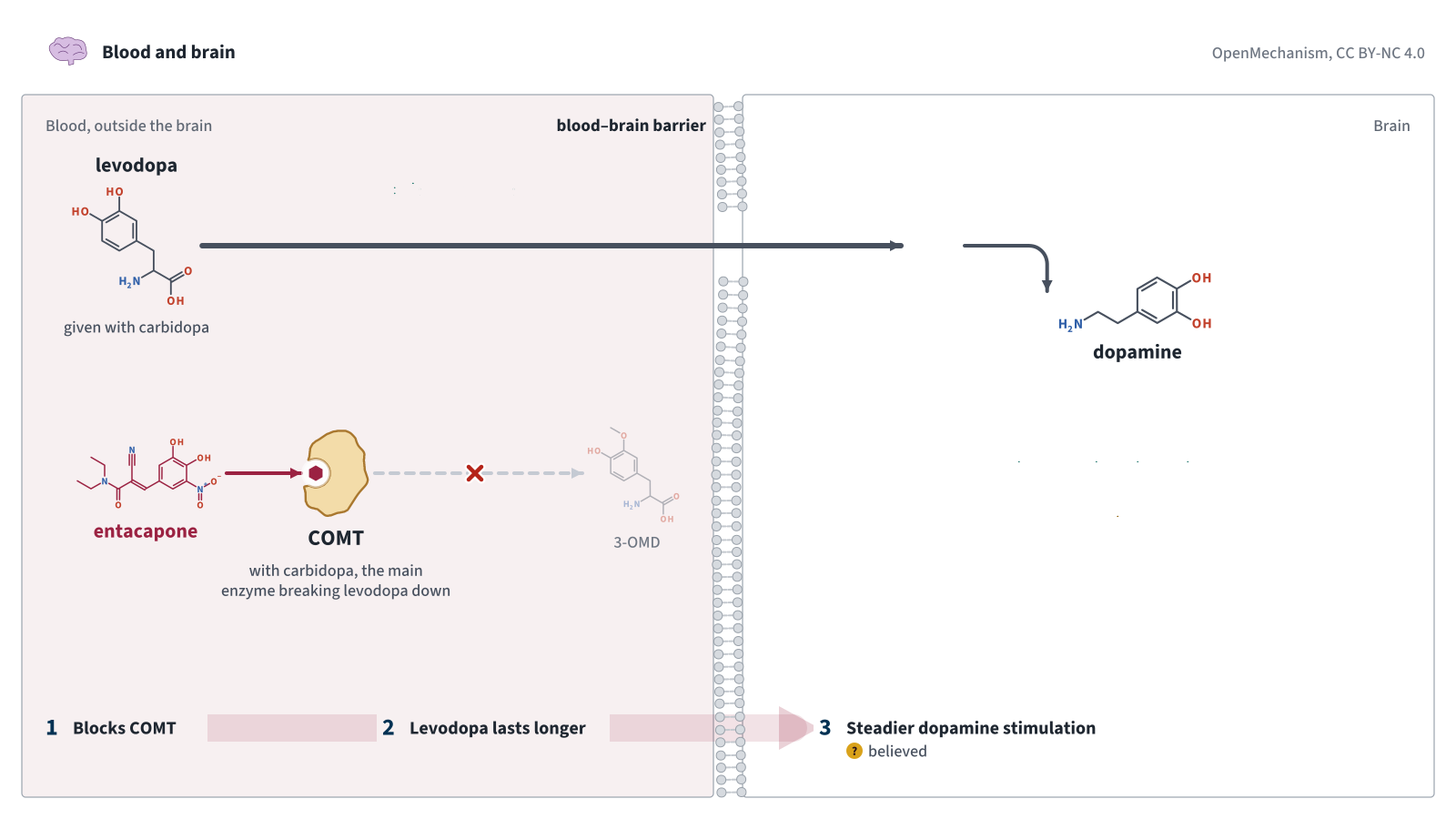
Entacapone selectively and reversibly blocks COMT, an enzyme that clears catechols such as levodopa. With carbidopa, COMT is the main enzyme breaking levodopa down, so with entacapone levodopa levels in the blood are higher and last longer. This is believed to give steadier dopamine stimulation in the brain and greater effects on Parkinson's disease, with more of levodopa's side effects.
- Acts on
- Catechol O-methyltransferase (COMT)
- Where
- Organs that break levodopa down; then the brain
- Medicine type
- Small molecule
- Used for
- Brain & nerves
Step 3: believed
The entacapone label says: It is believed that at a given frequency of levodopa administration, these more sustained plasma levels of levodopa result in more constant dopaminergic stimulation in the brain, leading to greater effects on the signs and symptoms of Parkinson’s disease.
Source 1: Entacapone tablets (Aphena): FDA label, Indications; Clinical Pharmacology: Mechanism of Action
Clinical study: In a randomized, double-blind trial in 205 people with Parkinson's disease and motor fluctuations, adding entacapone or placebo to each levodopa dose for 24 weeks; the trial measured time with symptoms relieved, not how entacapone works: entacapone treatment increased the percent "on" time by 5.0 percentage points
Parkinson Study Group, Ann Neurol 1997 (PMID 9392574)
This study was picked with a literature search and is not yet checked by our reviewer.
How it works
Blocks COMT. Entacapone is a selective, reversible inhibitor of COMT, the enzyme that moves a methyl group from S-adenosyl-L-methionine onto catechols, such as dopa and the catecholamines, to clear them.1
Levodopa lasts longer. With a decarboxylase inhibitor such as carbidopa, COMT becomes the main enzyme breaking levodopa down, to 3-O-methyldopa (3-OMD). With entacapone, levodopa levels in the blood are higher and more sustained.1
Steadier dopamine stimulation. These more sustained levels are believed to give more constant dopamine stimulation in the brain and greater effects on the signs and symptoms of Parkinson's disease; they also bring more of levodopa's side effects.1
For teachers: download this drawing.
See also
Condition pages: Parkinson disease.
Related drawings: carbidopa and levodopa (the levodopa that entacapone makes last longer).
Body system: brain & nerves.
Sources
- 1Entacapone tablets (Aphena): FDA labelIndications; Clinical Pharmacology: Mechanism of Action
- 2ChEMBL CHEMBL953Target and action classification: Catechol O-methyltransferase inhibitor
- 3Entacapone improves motor fluctuations in levodopa-treated Parkinson's disease patientsParkinson Study Group. Ann Neurol 1997 (abstract)
Also used for the drawing
The COMT outline is traced from the crystal structure below.
- 4Human catechol O-methyltransferase (COMT) with S-adenosylmethionine and 3,5-dinitrocatecholPDB 3BWY; Rutherford, K. et al. J.Mol.Biol. 2008; 380:120-130
Spotted a mistake? Report an error (hello@openmechanism.com). Since launch, every published error we fix is listed on the corrections page.
Notes and limits
- A schematic teaching drawing: not to scale, not exact structures, binding poses or a complete pathway, and not a guide to dosing, treatment or how a person will respond.
- The label: believed.
All recorded limits are on the evidence page, and notes that apply to every page are on How to read a page. Version 1.0.0, not yet medically reviewed.
Cite this page
Tran D. Entacapone [Internet]. OpenMechanism; 2026 [updated 2026 Oct 18; cited 2026 Oct 18]. Available from: https://openmechanism.com/medicines/entacapone