Pimavanserin
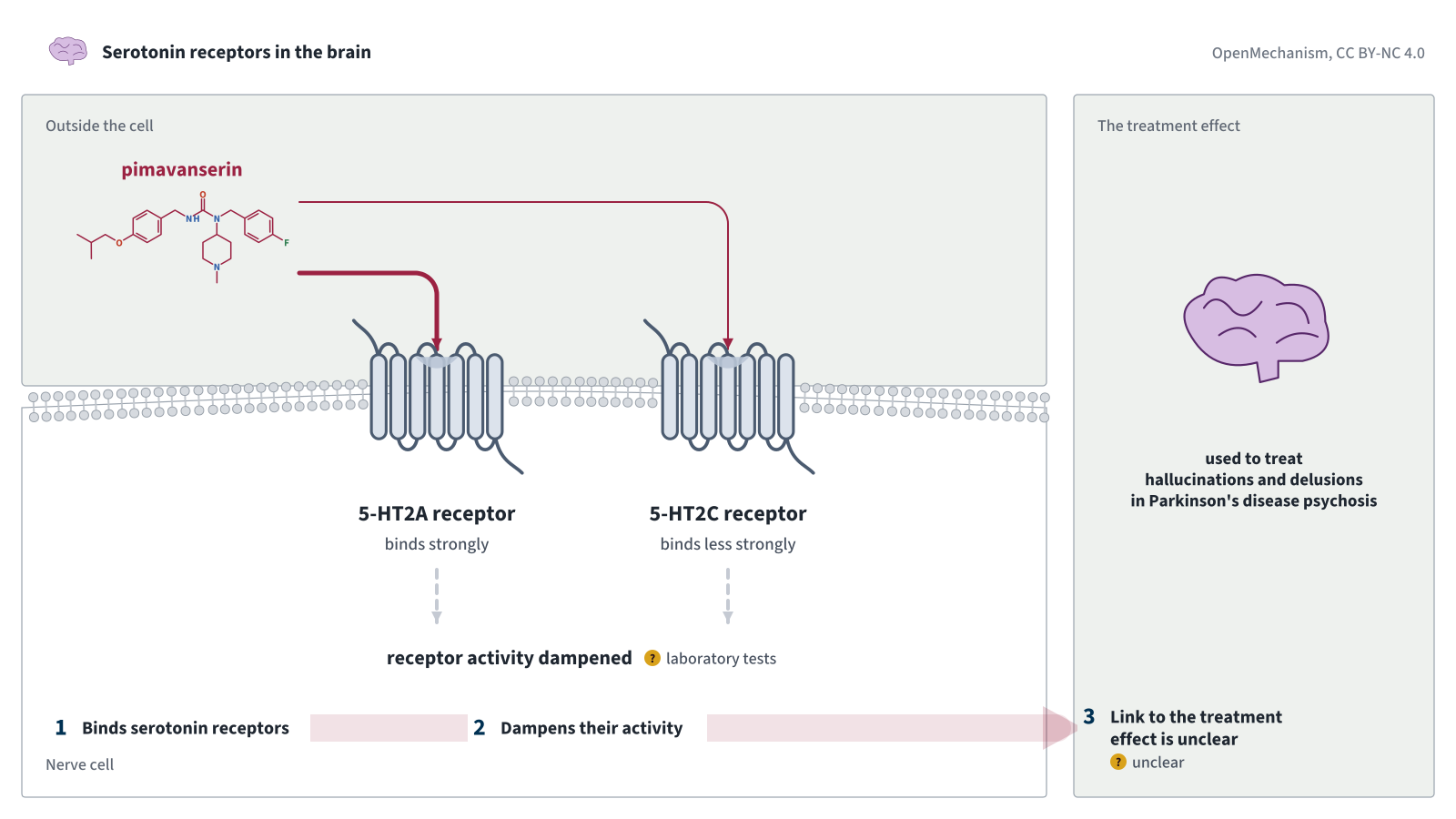
The Nuplazid label calls pimavanserin an atypical antipsychotic. In laboratory tests, it binds strongly to serotonin receptors, and less to , and dampens their activity. The label suggests this could explain its effect but says the mechanism in treating hallucinations and delusions associated with Parkinson's disease psychosis is unclear.
- Acts on
- Serotonin 5-HT2A receptor, serotonin 5-HT2C receptor
- Where
- Serotonin receptors in the brain
- Medicine type
- Small molecule
- Used for
- Brain & nerves
Also called Nuplazid.
Laboratory tests
The Nuplazid label says: In vitro , pimavanserin acts as an inverse agonist and antagonist at serotonin 5-HT 2A receptors with high binding affinity (K i value 0.087 nM) and at serotonin 5-HT 2C receptors with lower binding affinity (K i value 0.44 nM).
Clinical study: In Cummings and colleagues' 2014 randomized, double-blind, 6-week trial, 199 adults aged 40 or older with Parkinson's disease psychosis were randomly assigned to pimavanserin 40 mg a day or placebo after a 2-week lead-in without study medicine to limit the placebo response; the trial measured psychotic symptoms on a rating scale (SAPS-PD), not the receptor actions seen in laboratory tests: For 90 recipients of placebo and 95 recipients of pimavanserin included in the primary analysis, pimavanserin was associated with a -5·79 decrease in SAPS-PD scores compared with -2·73 for placebo (difference -3·06, 95% CI -4·91 to -1·20; p=0·001; Cohen's d 0·50).
Cummings J et al., Lancet 2014 (PMID 24183563)
Step 3: unclear
The Nuplazid label says: The mechanism of action of pimavanserin in the treatment of hallucinations and delusions associated with PDP is unclear.
Key terms in this drawing
- 5-HT2A receptor
- Serotonin 2A receptor. One of the serotonin receptors; olanzapine binds it strongly.
- 5-HT2C receptor
- Serotonin 2C receptor. One of the serotonin receptors; olanzapine binds it strongly.
How it works
Binds serotonin receptors. In laboratory tests, pimavanserin binds strongly to serotonin 5-HT2A receptors and less strongly to 5-HT2C receptors. The label says it has no appreciable for , including D2, or for muscarinic, histamine or adrenergic receptors.1
Dampens their activity. The label identifies inverse and activity at these in vitro.1
Link to the treatment effect is unclear. The label says the mechanism in treating hallucinations and delusions associated with Parkinson's disease psychosis is unclear, and that the effect could come from these actions at 5-HT2A receptors and, to a lesser extent, at 5-HT2C receptors.1
For teachers: download this drawing or build a slide deck.
See also
Condition pages: Parkinson disease.
Body system: brain & nerves.
Sources
- 1Nuplazid (pimavanserin tartrate): FDA label1 Indications and Usage; 12.1 Mechanism of Action; 12.2 Pharmacodynamics
- 2ChEMBL CHEMBL2111101Target and action classification: Serotonin 2a (5-HT2a) receptor inverse agonist
- 3Pimavanserin for patients with Parkinson's disease psychosis: a randomised, placebo-controlled phase 3 trialCummings J et al. Lancet 2014 (abstract)
Also used for the drawing
The drawing places pimavanserin's binding at serotonin receptors in the brain. The Nuplazid label gives its receptor binding from laboratory (in vitro) tests and names no place; this PET (positron emission tomography) study in four healthy volunteers, given single doses of 1 to 100 mg, measured the binding of ACP-103 at 5-HT2A receptors in the human brain, and a 2015 review gives ACP-103 as pimavanserin's other name: "Pimavanserin (ACP-103)".
- 4PET analysis of the 5-HT2A receptor inverse agonist ACP-103 in human brainNordstrom AL et al., Int J Neuropsychopharmacol 2008 (abstract)
- 5PimavanserinHunter NS et al., Drugs Today (Barc) 2015 (abstract)
Spotted a mistake? Report an error (hello@openmechanism.com). Since launch, every published error we fix is listed on the corrections page.
Notes and limits
- A schematic teaching drawing: not to scale, not exact structures, binding poses or a complete pathway, and not a guide to dosing, treatment or how a person will respond.
- Other medicines in the same family may not follow every step or share the same clinical endpoint.
- The steps are in the order that explains them; one step is said to cause the next only where the source says so.
- The label says the mechanism of action of pimavanserin in the treatment of hallucinations and delusions associated with Parkinson's disease psychosis is unclear, and that its effect could be mediated through a combination of inverse agonist and antagonist activity at serotonin 5-HT2A receptors and to a lesser extent at serotonin 5-HT2C receptors.
All recorded limits are on the evidence page, and notes that apply to every page are on How to read a page. Version 1.0.1, medically reviewed by Daniel Tran, PharmD, on 7 November 2026.
Cite this page
Tran D. Pimavanserin [Internet]. OpenMechanism; 2026 [updated 2026 Nov 7; cited 2026 Nov 7]. Available from: https://openmechanism.com/medicines/pimavanserin