Deutetrabenazine
Deutetrabenazine is extensively metabolized in the liver into its active deuterated metabolites, α-dihydrotetrabenazine (α-HTBZ) and β-HTBZ; in laboratory experiments this was done mainly by carbonyl reductase. These metabolites reversibly block VMAT2 (vesicular monoamine transporter 2), so fewer monoamines are taken up into synaptic vesicles and monoamine stores are depleted. The label says the precise mechanism of deutetrabenazine in tardive dyskinesia and in chorea in Huntington's disease is unknown, but is believed to be related to its effect as a reversible depletor of monoamines, such as dopamine, serotonin, norepinephrine and histamine, from nerve terminals. Its label lists it for adults with chorea associated with Huntington's disease and for adults with tardive dyskinesia.
- Acts on
- VMAT2 (vesicular monoamine transporter 2)
- Where
- Synaptic vesicles
- Medicine type
- Small molecule
- Used for
- Brain & nerves
- Drug class
- VMAT2 inhibitors
Also called Austedo and Austedo XR (extended-release deutetrabenazine tablets).
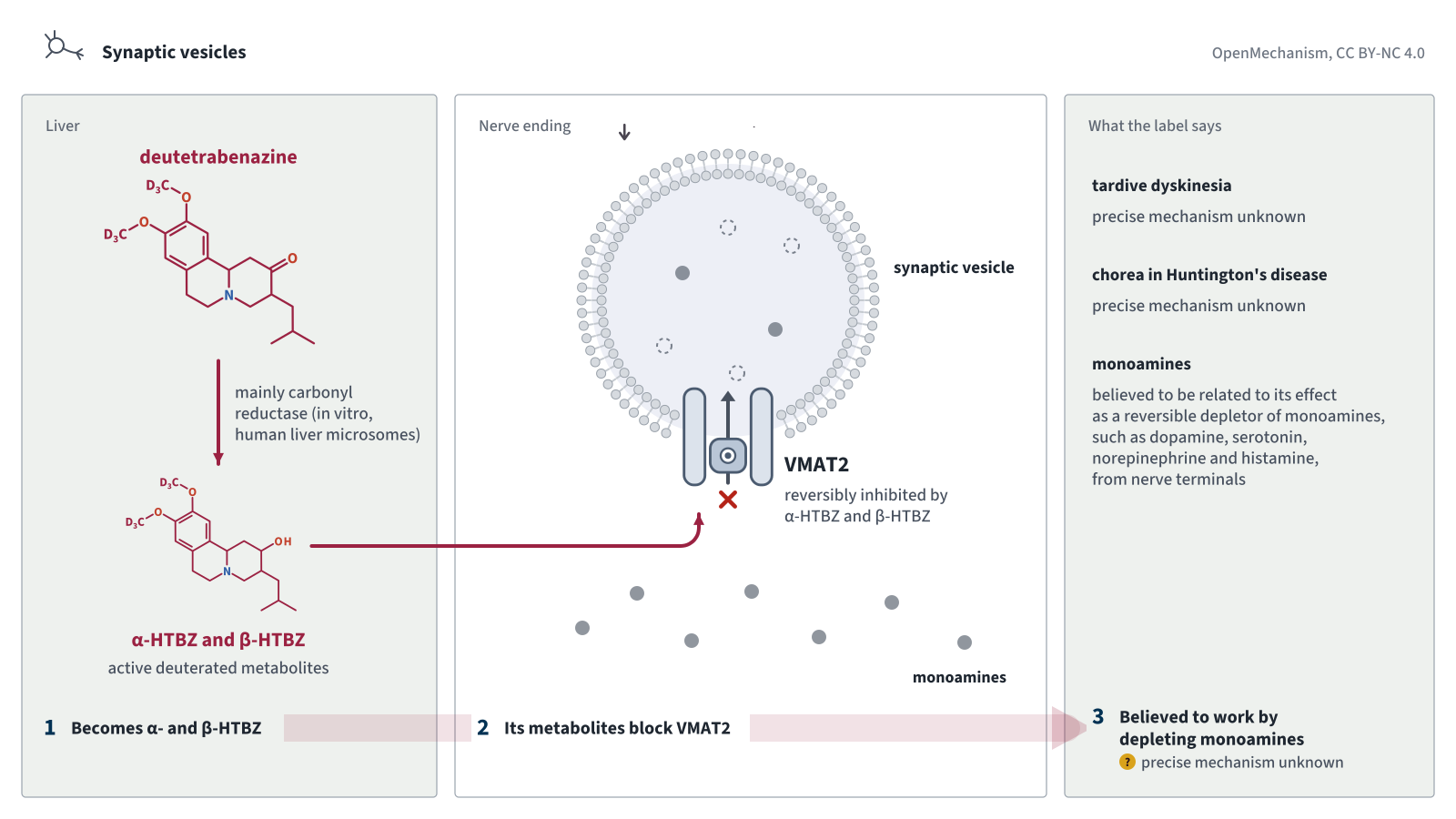
Step 3: precise mechanism unknown
The Austedo label says: The precise mechanism by which deutetrabenazine exerts its effects in the treatment of tardive dyskinesia and chorea in patients with Huntington’s disease is unknown but is believed to be related to its effect as a reversible depletor of monoamines (such as dopamine, serotonin, norepinephrine, and histamine) from nerve terminals.
Clinical study: In the Huntington Study Group's 2016 randomized, double-blind trial, 90 adults with Huntington disease and chorea (a chorea score of 8 or higher) who could walk were assigned to deutetrabenazine (45 people) or placebo (45 people), the dose adjusted over 8 weeks to an optimal level and kept there for 4 more (its abstract gives no doses; the Austedo label's account of this trial, its Study 1, gives at most 48 mg a day and p<0.0001); the trial measured chorea scores, not how deutetrabenazine works: In the deutetrabenazine group, the mean total maximal chorea scores improved from 12.1 (95% CI, 11.2-12.9) to 7.7 (95% CI, 6.5-8.9), whereas in the placebo group, scores improved from 13.2 (95% CI, 12.2-14.3) to 11.3 (95% CI, 10.0-12.5); the mean between-group difference was -2.5 units (95% CI, -3.7 to -1.3) (P < .001).
Huntington Study Group et al., JAMA 2016 (PMID 27380342)
Clinical study: In Anderson and colleagues' 2017 randomized, double-blind trial (AIM-TD), 298 adults with tardive dyskinesia were assigned to deutetrabenazine (12, 24 or 36 mg a day) or placebo for 12 weeks, and 222 were analyzed for efficacy, those with an abnormal involuntary movement (AIMS) score of 6 or more at the start and at least one later rating; the trial measured AIMS scores, not how deutetrabenazine works: From baseline to week 12, the least-squares mean AIMS score improved by -3·3 points (SE 0·42) in the deutetrabenazine 36 mg/day group, -3·2 points (0·45) in the 24 mg/day group, and -2·1 points (0·42) in the 12 mg/day group, with a treatment difference of -1·9 points (SE 0·58, 95% CI -3·09 to -0·79; p=0·001), -1·8 points (0·60, -3·00 to -0·63; p=0·003), and -0·7 points (0·57, -1·84 to 0·42; p=0·217), respectively, versus -1·4 points (0·41) in the placebo group.
Anderson KE et al., Lancet Psychiatry 2017 (PMID 28668671)
How it works
Becomes α- and β-HTBZ. Deutetrabenazine is extensively metabolized in the liver, so after it is taken by mouth, its blood levels are low compared with those of its active deuterated metabolites. In laboratory (in vitro) experiments with human liver microsomes, it was extensively converted, mainly by carbonyl reductase, into its major active metabolites, α-dihydrotetrabenazine (α-HTBZ) and β-HTBZ.1
Its metabolites block VMAT2. Its major circulating metabolites, α-HTBZ and β-HTBZ, are reversible inhibitors of VMAT2 (vesicular monoamine transporter 2), so fewer monoamines are taken up into synaptic vesicles and monoamine stores are depleted.1
Believed to work by depleting monoamines. The label says the precise mechanism of deutetrabenazine in tardive dyskinesia and in chorea in Huntington's disease is unknown, but is believed to be related to its effect as a reversible depletor of monoamines, such as dopamine, serotonin, norepinephrine and histamine, from nerve terminals.1
For teachers: download this drawing.
See also
Condition pages: Huntington disease and tardive dyskinesia.
Other VMAT2 inhibitors: tetrabenazine and valbenazine.
More medicines for brain & nerves: acetaminophen, alprazolam, amitriptyline, amphetamine, aripiprazole, atomoxetine, brivaracetam, buprenorphine and 65 more.
Body system: brain & nerves.
Sources
- 1Austedo (deutetrabenazine): FDA label1 Indications and Usage; 12.1 Mechanism of Action; 12.3 Pharmacokinetics; Boxed Warning; 5.1 Depression and Suicidality in Patients with Huntington's Disease; 14 Clinical Studies
- 2Effect of Deutetrabenazine on Chorea Among Patients With Huntington Disease: A Randomized Clinical TrialHuntington Study Group et al. JAMA 2016 (abstract)
- 3Deutetrabenazine for treatment of involuntary movements in patients with tardive dyskinesia (AIM-TD): a double-blind, randomised, placebo-controlled, phase 3 trialAnderson KE et al. Lancet Psychiatry 2017 (abstract)
Spotted a mistake? Report an error (hello@openmechanism.com). Since launch, every published error we fix is listed on the corrections page.
Notes and limits
- A schematic teaching drawing: not to scale, not exact structures, binding poses or a complete pathway, and not a guide to dosing, treatment or how a person will respond.
- The steps are in the order that explains them; one step is said to cause the next only where the source says so.
- The Austedo label has a boxed warning: Austedo XR and Austedo can increase the risk of depression and suicidal thoughts and behavior (suicidality) in patients with Huntington's disease. The same warning rules them out for patients who are suicidal and for patients with untreated or inadequately treated depression.
- The label's warnings add that patients with Huntington's disease are at increased risk for depression and for suicidal thoughts or behaviors.
- The label says the precise mechanism by which deutetrabenazine works in tardive dyskinesia and in chorea in Huntington's disease is unknown, but is believed to be related to its effect as a reversible depletor of monoamines from nerve terminals.
All recorded limits are on the evidence page, and notes that apply to every page are on How to read a page. Version 1.0.1, medically reviewed by Daniel Tran, PharmD, on 6 November 2026.
Cite this page
Tran D. Deutetrabenazine [Internet]. OpenMechanism; 2026 [updated 2026 Nov 6; cited 2026 Nov 6]. Available from: https://openmechanism.com/medicines/deutetrabenazine