Inotersen
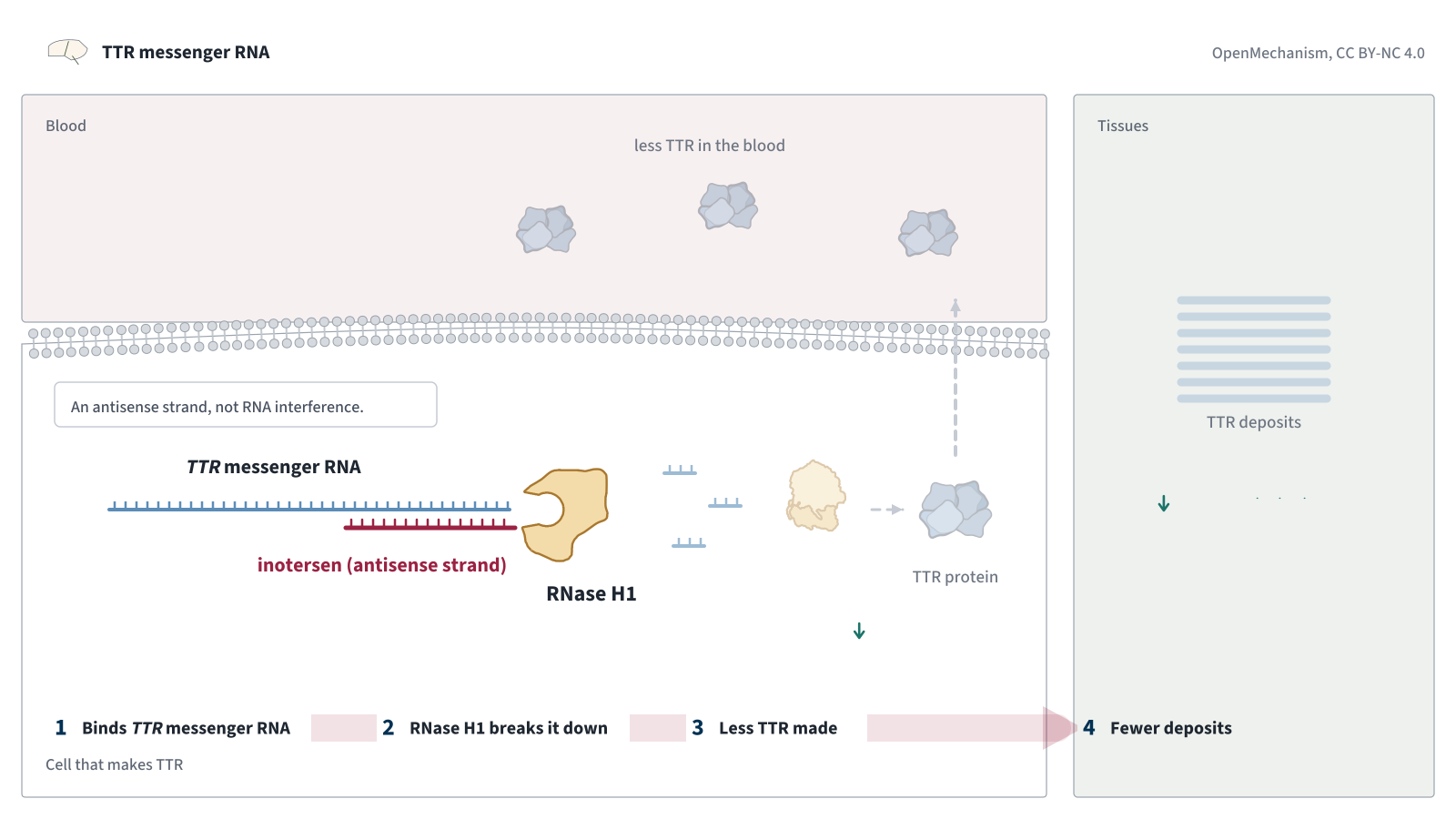
Inotersen is an antisense strand that binds the for transthyretin (), both normal and mutant, leading to its breakdown by . Less TTR protein is made, which the label links to fewer TTR deposits in tissues.
- Acts on
- TTR messenger RNA, RNaseH1
- Where
- TTR messenger RNA
- Medicine type
- Oligonucleotide
- Used for
- Brain & nerves
Key terms in this drawing
- mRNA
- Messenger RNA. A copy of a gene that a cell reads to make a protein.
- RNA
- Ribonucleic acid. A molecule copied from DNA; messenger RNA carries a gene's instructions.
- RNase H1
- Ribonuclease H1. A cell enzyme that cuts RNA when it is paired with a DNA-like strand.
- TTR
- Transthyretin. A blood protein that can misfold and build up as amyloid.
How it works
Binds TTR messenger RNA. The antisense oligonucleotide binds mutant and wild-type TTR mRNA.1
RNase H1 breaks it down. The FDA regulatory review identifies RNaseH1-mediated degradation after hybridization.2
Less TTR made. Reduced transcript availability lowers serum TTR protein.1
Fewer deposits. The label links this action to lower tissue TTR deposits.1
For teachers: download this drawing or build a slide deck.
See also
Condition pages: hereditary transthyretin amyloidosis.
More medicines for brain & nerves: acetaminophen, alprazolam, amitriptyline, amphetamine, aripiprazole, atomoxetine, brivaracetam, buprenorphine and 67 more.
Body system: brain & nerves.
Sources
- 1DailyMed FDA SPL · Inotersen: antisense-directed transcript degradation12.1 Mechanism of Action
- 2FDA Clinical Pharmacology Review · Inotersen: antisense-directed transcript degradation3.2 Mechanism table, printed page6 / PDF page7; ReferenceID4282036
- 3ChEMBL CHEMBL4297770Target and action classification: Transthyretin mRNA antisense inhibitor
Also used for the drawing
The ribosome, TTR and RNase H1 outlines are traced from the electron microscopy and crystal structures below.
- 4Human ribosome decoding an mRNAPDB 8G60; Holm, M. et al. Nature 2023; 617:200-207
- 5Human transthyretin (TTR) tetramer with tafamidis in its two thyroxine-binding sitesPDB 3TCT; Bulawa, C.E. et al. Proc.Natl.Acad.Sci.USA 2012; 109:9629-9634
- 6The catalytic domain of human RNase H1 on an RNA/DNA hybridPDB 2QK9; Nowotny, M. et al. Mol.Cell 2007; 28:264-276
Spotted a mistake? Report an error (hello@openmechanism.com). Since launch, every published error we fix is listed on the corrections page.
Notes and limits
- A schematic teaching drawing: not to scale, not exact structures, binding poses or a complete pathway, and not a guide to dosing, treatment or how a person will respond.
- Other medicines in the same family may not follow every step or share the same clinical endpoint.
- The steps are in the order that explains them; one step is said to cause the next only where the source says so.
- This single-stranded antisense route differs from siRNA-mediated RNA interference and from splice modulation.
- The recipe does not assert immediate removal of every pre-existing deposit or one complete intracellular delivery route.
- The checked FDA product is discontinued. This history example does not imply current availability or establish that discontinuation was for safety.
All recorded limits are on the evidence page, and notes that apply to every page are on How to read a page. Version 1.0.0, not yet medically reviewed.
Cite this page
Tran D. Inotersen [Internet]. OpenMechanism; 2026 [updated 2026 Oct 16; cited 2026 Oct 16]. Available from: https://openmechanism.com/medicines/inotersen