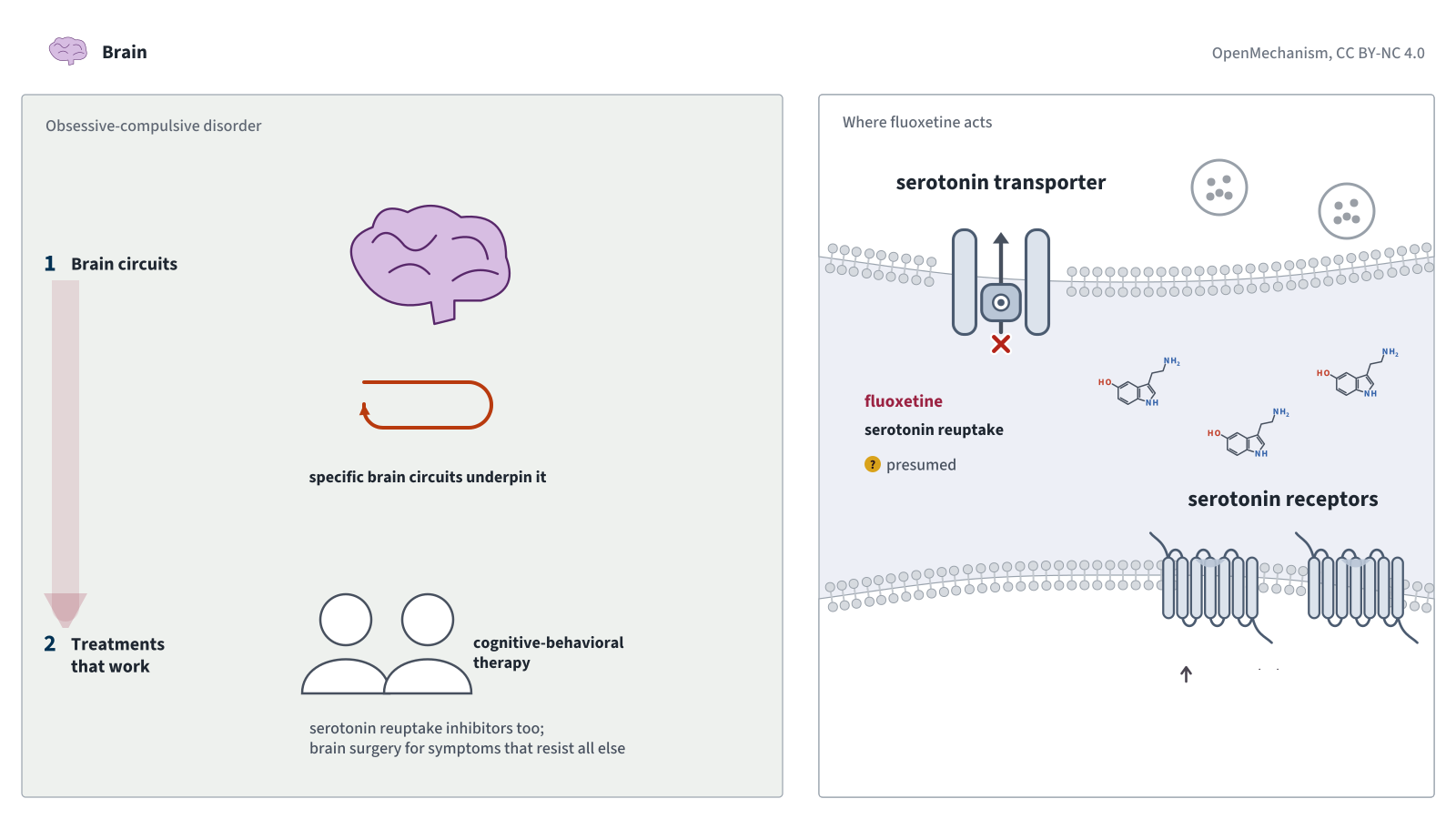
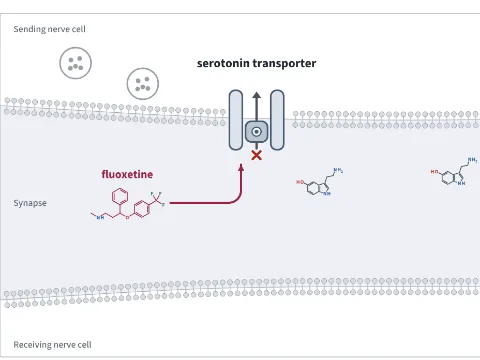
Obsessive-compulsive disorder is common and long-lasting, is linked to substantial disability worldwide, and is the main example of a group of related disorders that are often missed and undertreated. Specific brain circuits underpin it. A 2019 review names serotonin reuptake inhibitors and cognitive-behavioral therapy as effective treatments. Fluoxetine is thought to work by blocking serotonin reuptake.
What goes wrong in obsessive-compulsive disorder (OCD), and where medicines act. Schematic, not to scale. License CC BY-NC 4.0.
?Presumed
The Prozac (fluoxetine) label says: Although the exact mechanism of PROZAC is unknown, it is presumed to be linked to its inhibition of CNS neuronal uptake of serotonin.
Clinical study: In Tollefson and colleagues' 1994 report of two randomized, double-blind, 13-week trials of fixed doses of fluoxetine (20, 40 or 60 mg a day) or placebo in 355 outpatients aged 15 to 70 with obsessive-compulsive disorder; the trials measured how severe the disorder was, not how fluoxetine works: Fluoxetine was associated with a statistically significant reduction in OCD severity, including time engaged in obsessional and/or compulsive behaviors.Tollefson GD et al., Arch Gen Psychiatry 1994 (PMID 8031229)
Treatments that work. A 2019 review names serotonin inhibitors and cognitive-behavioral therapy as effective treatments, and brain surgery for symptoms that resist all else.1
What the source says
“Effective treatments for OCD include serotonin reuptake inhibitors and cognitive-behavioural therapy, and neurosurgery for those with intractable symptoms.”
Also used for it: sertraline (for obsessive-compulsive disorder: “ZOLOFT is a selective serotonin reuptake inhibitor (SSRI) indicated for the treatment of ( 1 ): • Major depressive disorder (MDD) • Obsessive-compulsive disorder (OCD) …”3).
text a4069f082e56…; drawings a5eff99fdf05…; notes c64093eac6cb…
AI source check
Claude Opus 5.5 (AI source check), 7 November 2026: 24 statements compared with their sources, 0 flagged for the reviewer. An automated check, not a medical review.
Next review due
8 May 2028
Cite this page
Tran D. Obsessive-compulsive disorder (OCD) [Internet]. OpenMechanism; 2026 [updated 2026 Nov 7; cited 2026 Nov 7]. Available from: https://openmechanism.com/conditions/ocd