Donepezil
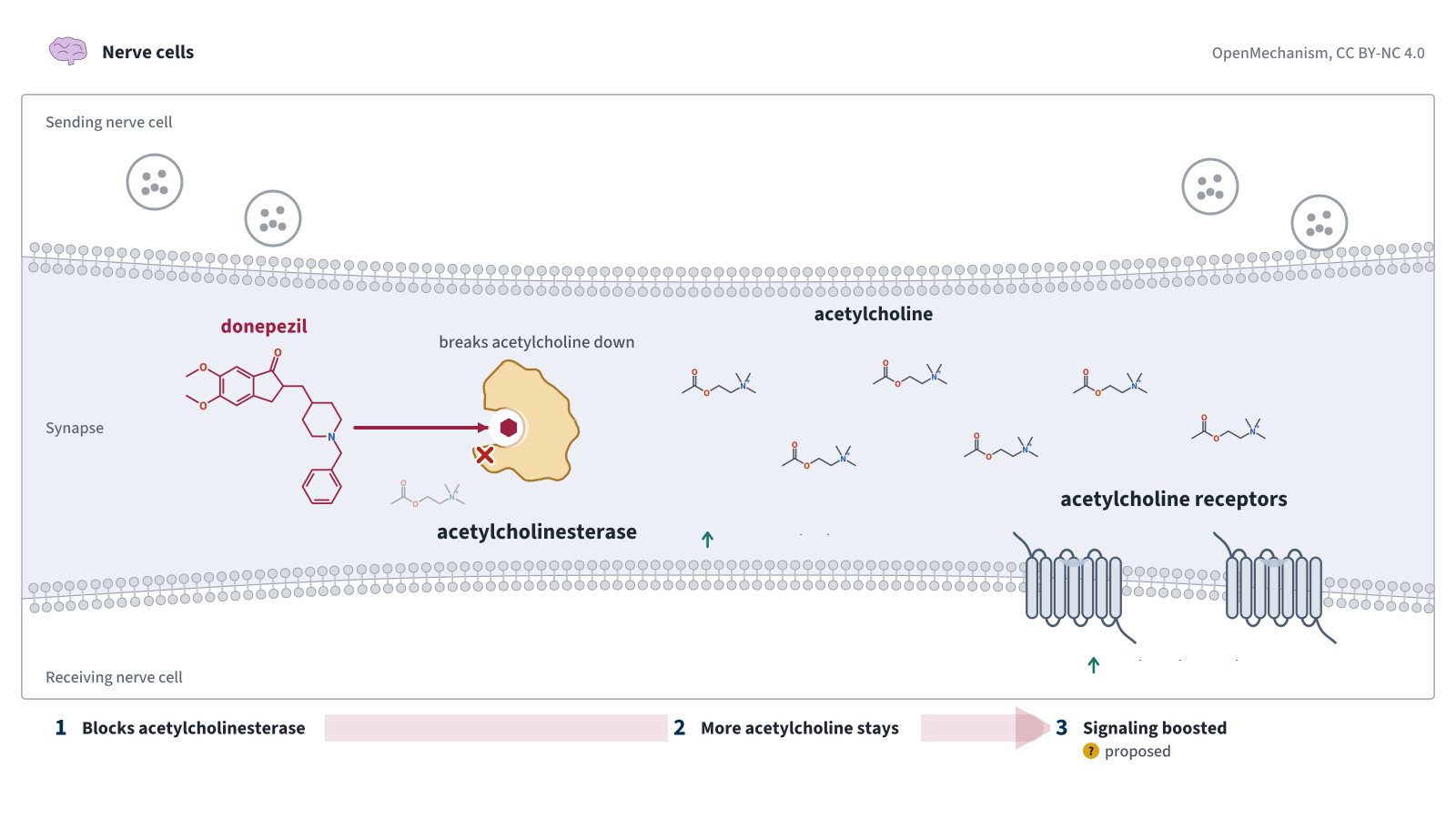
Donepezil reversibly blocks , the enzyme that breaks down the messenger acetylcholine, so more acetylcholine stays available and cholinergic signaling is enhanced. The label says current theories tie some of the cognitive symptoms of Alzheimer disease to too little cholinergic signaling, and that donepezil is postulated to work by enhancing it; it also says there is no evidence that donepezil changes the course of the disease itself. The Aricept label lists it for dementia of the Alzheimer's type and says its efficacy has been shown in mild, moderate and severe Alzheimer disease.
- Acts on
- Acetylcholinesterase
- Where
- Nerve signaling that uses acetylcholine
- Medicine type
- Small molecule
- Used for
- Brain & nerves
Also called Aricept.
Step 3: proposed
The Aricept label says: Donepezil hydrochloride is postulated to exert its therapeutic effect by enhancing cholinergic function.
Source 1: Aricept (donepezil hydrochloride): FDA label, 1 Indications and Usage; 12.1 Mechanism of Action
Clinical study: In Rogers and colleagues' 1998 randomized, double-blind trial of donepezil (5 or 10 mg a day) or placebo for 12 weeks in 468 people with mild to moderately severe Alzheimer disease; the trial measured cognition and global function, and how much donepezil inhibited acetylcholinesterase activity in red blood cells: The use of donepezil produced statistically significant improvements in ADAS-cog, CIBIC plus, and Mini-Mental State Examination scores, relative to placebo.
Rogers SL et al., Arch Intern Med 1998 (PMID 9588436)
Key terms in this drawing
- acetylcholinesterase
- Acetylcholinesterase. The enzyme that breaks down acetylcholine; blocking it raises the amount of acetylcholine.
How it works
Blocks acetylcholinesterase. Donepezil reversibly inhibits acetylcholinesterase, the enzyme that breaks down (hydrolyzes) acetylcholine.1
More acetylcholine stays. Reduced breakdown increases acetylcholine concentration.1
Signaling boosted. The label says the raised acetylcholine enhances cholinergic function (nerve signaling that uses acetylcholine), and that this is postulated to be how donepezil exerts its therapeutic effect.1
For teachers: download this drawing or build a slide deck.
See also
Condition pages: Alzheimer disease.
Other acetylcholinesterase inhibitors: neostigmine.
Other anti-dementia medicines: lecanemab and memantine.
Body system: brain & nerves.
Sources
- 1Aricept (donepezil hydrochloride): FDA label1 Indications and Usage; 12.1 Mechanism of Action
- 2ChEMBL CHEMBL502Target and action classification: Acetylcholinesterase inhibitor
- 3Donepezil improves cognition and global function in Alzheimer disease: a 15-week, double-blind, placebo-controlled study. Donepezil Study GroupRogers SL et al. Arch Intern Med 1998 (abstract)
Also used for the drawing
The acetylcholinesterase outline is traced from the crystal structure below.
- 4Human acetylcholinesterase with donepezilPDB 4EY7; Cheung, J. et al. J.Med.Chem. 2012; 55:10282-10286
Spotted a mistake? Report an error (hello@openmechanism.com). Since launch, every published error we fix is listed on the corrections page.
Notes and limits
- A schematic teaching drawing: not to scale, not exact structures, binding poses or a complete pathway, and not a guide to dosing, treatment or how a person will respond.
- The steps are in the order that explains them; one step is said to cause the next only where the source says so.
- The label says donepezil is postulated to exert its therapeutic effect by enhancing cholinergic function, and that there is no evidence it alters the course of the underlying dementing process.
All recorded limits are on the evidence page, and notes that apply to every page are on How to read a page. Version 1.0.1, medically reviewed by Daniel Tran, PharmD, on 6 November 2026.
Cite this page
Tran D. Donepezil [Internet]. OpenMechanism; 2026 [updated 2026 Nov 6; cited 2026 Nov 6]. Available from: https://openmechanism.com/medicines/donepezil