Ziprasidone
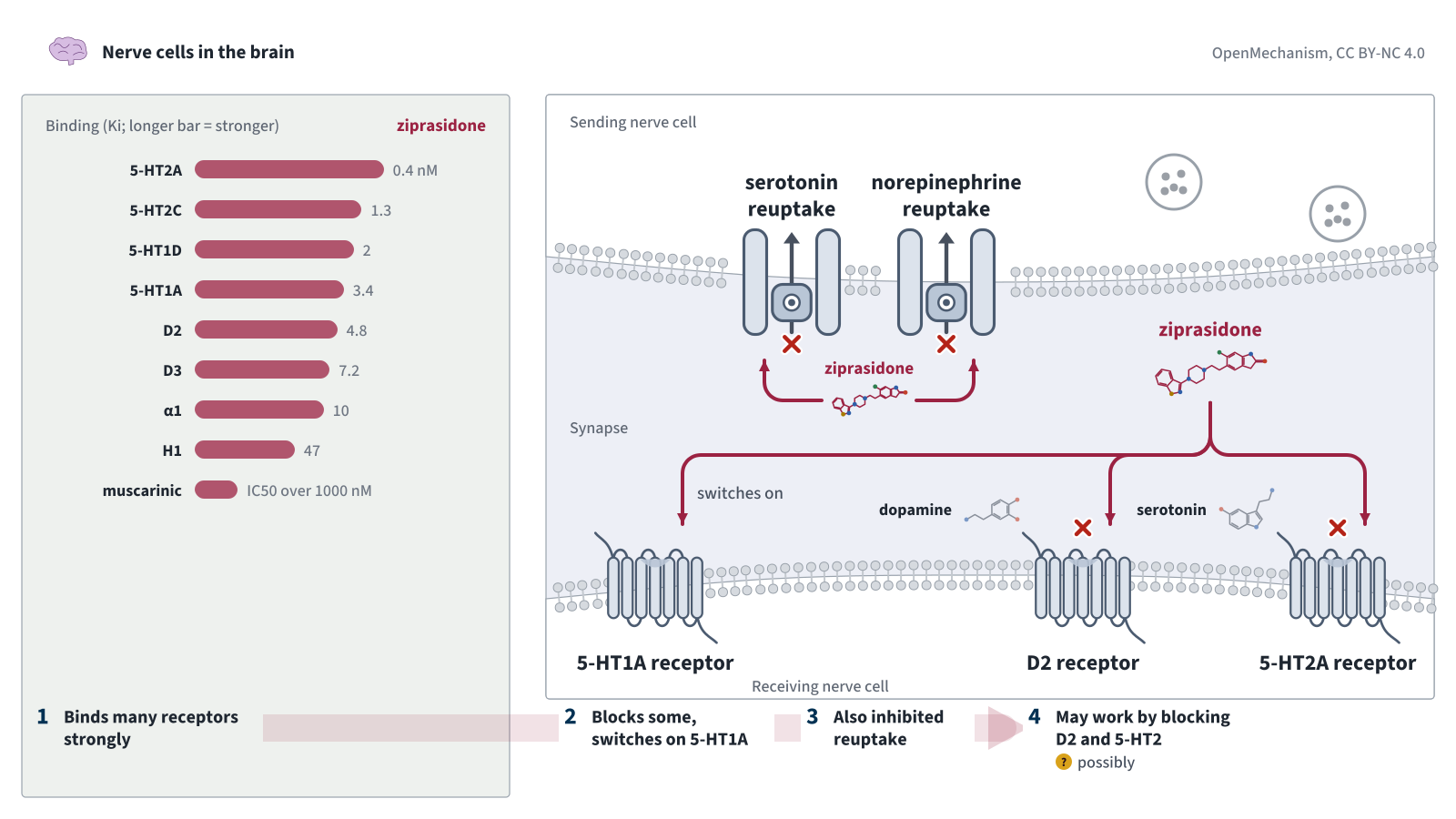
Ziprasidone binds dopamine D2 and D3, several and adrenergic α1 receptors relatively strongly. It blocks D2, and , switches on , and also inhibited the of serotonin and norepinephrine. The Geodon label lists the capsules for adults with schizophrenia and for adults with bipolar I disorder, alone for the acute treatment of manic or mixed episodes or with lithium or valproate as maintenance treatment, and the injection into muscle for acute agitation in adults with schizophrenia. The label says its effect in these uses could come from blocking D2 and 5-HT2 receptors together.
- Acts on
- Dopamine D2 and serotonin 5-HT2A receptors, among others
- Where
- Nerve cells in the brain
- Medicine type
- Small molecule
- Used for
- Brain & nerves
- Drug class
- Antipsychotics
Also called Geodon.
Step 4: possibly
The Geodon label says: The mechanism of action of ziprasidone in the treatment of the listed indications could be mediated through a combination of dopamine type 2 (D2) and serotonin type 2 (5HT2) antagonism.
Clinical study: In Daniel and colleagues' 1999 randomized, double-blind, 6-week trial, 302 people with an acute worsening of schizophrenia or schizoaffective disorder were randomly assigned to ziprasidone 80 or 160 mg a day or placebo; the trial measured symptoms on rating scales, not how ziprasidone works: Both doses of ziprasidone were statistically significantly more effective than placebo in improving the PANSS total, BPRS total, BPRS core items, CGI-S, and PANSS negative subscale scores (p < .05).
Daniel DG et al., Neuropsychopharmacology 1999 (PMID 10192829)
Key terms in this drawing (6)
- 5-HT1A receptor
- Serotonin 1A receptor. One of the serotonin receptors; in lab studies, buspirone binds it strongly.
- 5-HT1D receptor
- Serotonin 1D receptor. A serotonin receptor; sumatriptan is presumed to work in migraine by switching on 5-HT1B and 5-HT1D receptors on blood vessels inside the skull and on trigeminal sensory nerves.
- 5-HT2A receptor
- Serotonin 2A receptor. One of the serotonin receptors; olanzapine binds it strongly.
- 5-HT2C receptor
- Serotonin 2C receptor. One of the serotonin receptors; olanzapine binds it strongly.
- D2 receptor
- Dopamine D2 receptor. A dopamine receptor; in Parkinson disease, ropinirole's effect is thought to be related to its ability to stimulate D2 receptors in the caudate-putamen of the brain.
- reuptake
- Reuptake. Nerve cells taking a messenger such as serotonin back up, which helps end its signal.
How it works
Binds many receptors strongly. Ziprasidone binds dopamine D2 and D3, serotonin 5-HT2A, , 5-HT1A and 5-HT1D, and adrenergic α1 receptors with relatively high (Ki 0.4 to 10 nM), and histamine with moderate affinity (Ki 47 nM); it shows no appreciable affinity for muscarinic (cholinergic) receptors.1
Blocks some, switches on 5-HT1A. It is a blocker () at D2, 5-HT2A and 5-HT1D receptors, and switches on (is an at) 5-HT1A receptors.1
Also inhibited reuptake. Ziprasidone also inhibited the reuptake of serotonin and norepinephrine from the synapse.1
May work by blocking D2 and 5-HT2. Ziprasidone's effect in its approved uses could come from a combination of blocking dopamine D2 and serotonin 5-HT2 receptors.1
For teachers: download this drawing.
See also
Condition pages: bipolar disorder and schizophrenia.
Other antipsychotics: aripiprazole, clozapine, haloperidol, olanzapine, quetiapine and risperidone.
Body system: brain & nerves.
Sources
- 1Geodon (ziprasidone): FDA label1 Indications and Usage; 12.1 Mechanism of Action; 12.2 Pharmacodynamics
- 2ChEMBL CHEMBL708Target and action classification: Dopamine D2 receptor antagonist; Serotonin 2a (5-HT2a) receptor antagonist; Serotonin 2c (5-HT2c) receptor antagonist
- 3Ziprasidone 80 mg/day and 160 mg/day in the acute exacerbation of schizophrenia and schizoaffective disorder: a 6-week placebo-controlled trial. Ziprasidone Study GroupDaniel DG et al. Neuropsychopharmacology 1999 (abstract)
Also used for the drawing
The drawing places ziprasidone's binding in the brain. The Geodon label names the receptors it binds but not where they are; this PET study of 16 patients with schizophrenia or schizoaffective disorder, randomly assigned to 40, 80, 120 or 160 mg of ziprasidone a day, measured its occupancy of dopamine D2 and serotonin 5-HT2 receptors in regions of the brain after 3 weeks.
- 4A PET study of dopamine D2 and serotonin 5-HT2 receptor occupancy in patients with schizophrenia treated with therapeutic doses of ziprasidoneMamo D et al., Am J Psychiatry 2004 (abstract)
Spotted a mistake? Report an error (hello@openmechanism.com). Since launch, every published error we fix is listed on the corrections page.
Notes and limits
- A schematic teaching drawing: not to scale, not exact structures, binding poses or a complete pathway, and not a guide to dosing, treatment or how a person will respond.
- The steps are in the order that explains them; one step is said to cause the next only where the source says so.
- The label says ziprasidone has a greater capacity than several other antipsychotics to prolong the QT/QTc interval, and that in some other medicines a prolonged QTc interval is associated with the ability to cause torsade de pointes, a potentially fatal heart rhythm, and sudden death; it says whether ziprasidone will cause torsade de pointes or increase the rate of sudden death is not yet known.
- The label says the mechanism of action of ziprasidone in the treatment of the listed indications could be mediated through a combination of dopamine type 2 (D2) and serotonin type 2 (5HT2) antagonism.
All recorded limits are on the evidence page, and notes that apply to every page are on How to read a page. Version 1.0.1, medically reviewed by Daniel Tran, PharmD, on 7 November 2026.
Cite this page
Tran D. Ziprasidone [Internet]. OpenMechanism; 2026 [updated 2026 Nov 7; cited 2026 Nov 7]. Available from: https://openmechanism.com/medicines/ziprasidone