Cyanide poisoning
Cyanide, often met in house fires, stops cells using oxygen at cytochrome c oxidase in their mitochondria; without rapid treatment a high dose can kill within minutes. Hydroxocobalamin binds cyanide; a 2011 review names the cyanide antidote kit as the other antidote available in the United States.
- Where
- Cells' mitochondria
- Body systems
- Brain & nerves; Heart, vessels & cholesterol
- Medicines
- 1 medicine
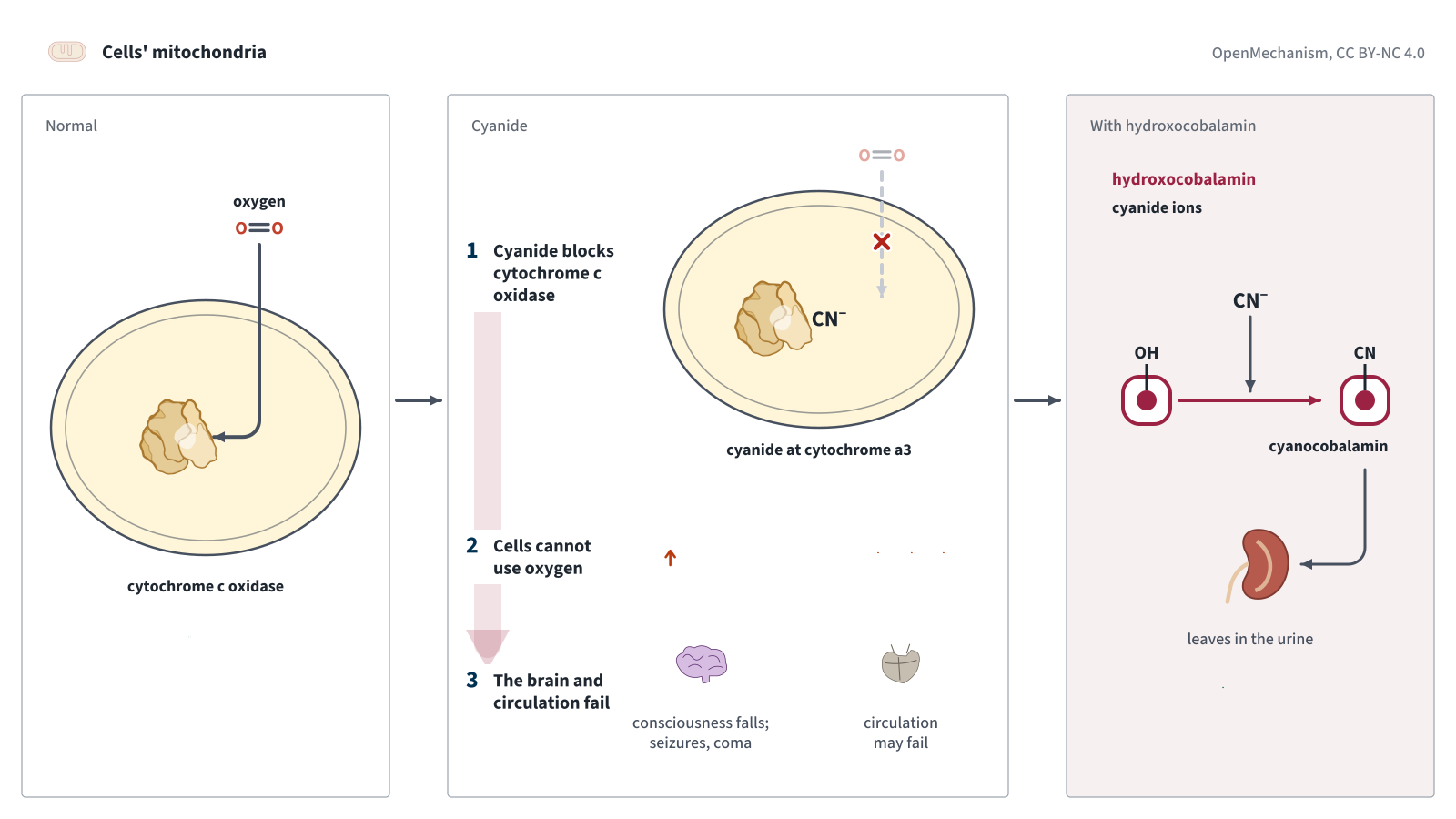
For teachers: download this drawing.
What goes wrong
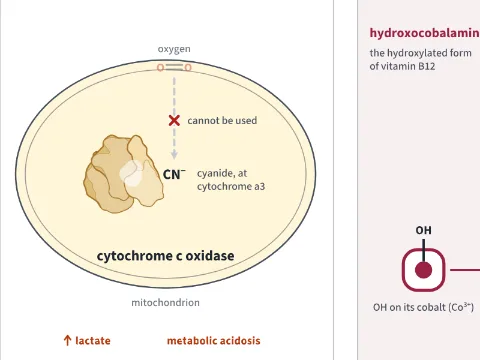
Cyanide blocks cytochrome c oxidase. Cyanide binds rapidly, and reversibly, to cytochrome a3, part of the cytochrome c oxidase complex in mitochondria.1,2
Cells cannot use oxygen. Blocking cytochrome a3 stops the cell using oxygen and forces it into anaerobic metabolism, with lactate made, cells short of oxygen and metabolic acidosis.1
What the source says
“Inhibition of cytochrome a3 prevents the cell from using oxygen and forces anaerobic metabolism, resulting in lactate production, cellular hypoxia and metabolic acidosis.”
Source 1The brain and circulation fail. Signs usually begin less than a minute after breathing cyanide in, or within a few minutes after swallowing it. As the lack of oxygen progresses, consciousness falls, with seizures and coma, and the circulation may become unstable; without rapid treatment, a high dose can kill within minutes.1,2
What the source says
“Signs and symptoms of cyanide poisoning usually occur less than 1 minute after inhalation and within a few minutes after ingestion.”
Source 2“As hypoxia progresses, progressively lower levels of consciousness, seizures, and coma can occur.”
Source 2“As poisoning progresses, hemodynamic status may become unstable.”
Source 2“In the absence of rapid and adequate treatment, exposure to a high dose of cyanide can result in death within minutes due to the inhibition of cytochrome oxidase resulting in arrest of cellular respiration.”
Source 1
Where medicines act
In the blood
- A
Hydroxocobalamin targets Cyanide ions
Binds cyanide ions, becoming cyanocobalamin, which leaves in the urine.1,2
Used forCyanide poisoning: known or suspected
What the label says
“CYANOKIT is indicated for the treatment of known or suspected cyanide poisoning.”
Source 1“Each hydroxocobalamin molecule can bind one cyanide ion by substituting it for the hydroxo ligand linked to the trivalent cobalt ion, to form cyanocobalamin, which is then excreted in the urine.”
Source 1“Because it binds with cyanide without forming methemoglobin, hydroxocobalamin can be used to treat patients without compromising the oxygen-carrying capacity of hemoglobin.”
Source 2
See also
Body systems: brain & nerves; and heart, vessels & cholesterol.
Other conditions: acetaminophen overdose; ethylene glycol and methanol poisoning; methemoglobinemia; heavy metal poisoning; and hereditary transthyretin amyloidosis.
Sources
- 1Cyanokit (hydroxocobalamin): FDA label1 Indications and Usage; 12.1 Mechanism of Action. Saved copy
- 2A review of acute cyanide poisoning with a treatment updateHamel J. Crit Care Nurse 2011 (abstract). Saved copy
- 3Cyanide poisoning and its treatmentGracia R, Shepherd G. Pharmacotherapy 2004 (abstract). Saved copy
- 4Bovine heart cytochrome c oxidase, fully oxidized (the catalytic core, subunits I to III, drawn; the site of cytochrome a3 and CuB marked)PDB 5B1A; Yano, N. et al. J.Biol.Chem. 2016;291:23882-23894. The cytochrome c oxidase outline in the drawing is traced from this structure. Saved copy
Notes and limits
- In massive cyanide poisoning, other enzyme systems may be involved too.1
- A 2011 review names two antidotes available in the United States, the cyanide antidote kit and hydroxocobalamin; another review calls residential fires a frequent source of cyanide.2,3
Notes that apply to every page are on How to read a page.
Spotted a mistake? Report an error (hello@openmechanism.com). Since launch, every published error we fix is listed on the corrections page.
Cite this page
Tran D. Cyanide poisoning [Internet]. OpenMechanism; 2026 [updated 2026 Oct 20; cited 2026 Oct 20]. Available from: https://openmechanism.com/conditions/cyanide-poisoning