Alzheimer disease
Alzheimer disease is defined by amyloid-beta plaques outside nerve cells and tau tangles inside them. It is understood as a loss of normal synapse function and of cell clearance pathways, in which amyloid-beta and tau play important parts; memory is typically impaired first. Donepezil raises acetylcholine by blocking its breakdown; lecanemab, an antibody, binds clumped amyloid-beta and reduces plaques.
- Where
- Brain
- Body system
- Brain & nerves
- Medicines
- 2 medicines
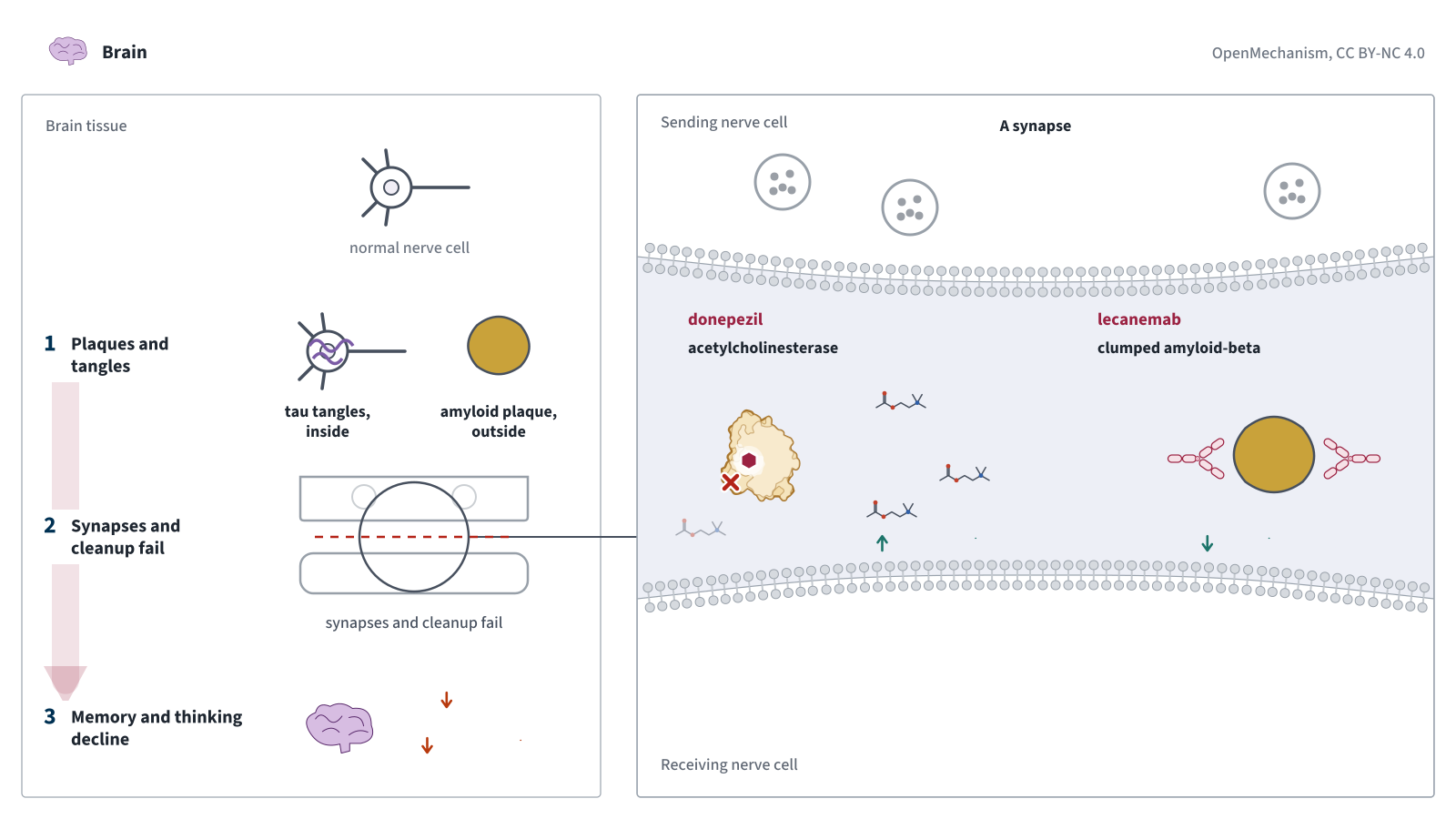
For teachers: download this drawing.
Key terms in this drawing
- acetylcholinesterase
- Acetylcholinesterase. The enzyme that breaks down acetylcholine; blocking it raises the amount of acetylcholine.
What goes wrong
Plaques and tangles. Amyloid-beta deposited outside nerve cells as plaques, and phosphorylated tau gathered inside them as tangles, remain the main criteria for diagnosing it under the microscope.1
What the source says
“The presence of extracellular β-amyloid deposition as neuritic plaques and intracellular accumulation of hyperphosphorylated tau as neurofibrillary tangles remains the primary neuropathologic criteria for AD diagnosis.”
Source 1Synapses and cleanup fail. It results from a loss of normal synapse function and of the cell's clearance pathways, in which amyloid-beta and tau play important parts.2
What the source says
“the brain disorder that results from a complex interplay of loss of synaptic homeostasis and dysfunction in the highly interrelated endosomal/lysosomal clearance pathways in which the precursors, aggregated species and post-translationally modified products of Aβ and tau play important roles.”
Source 2Memory and thinking decline. It typically impairs memory first; some of its effects on thinking are put down to a shortage of the messenger acetylcholine.2,3
What the source says
“AD is a genetic and sporadic neurodegenerative disease that causes an amnestic cognitive impairment in its prototypical presentation”
Source 2“Current theories on the pathogenesis of the cognitive signs and symptoms of Alzheimer’s disease attribute some of them to a deficiency of cholinergic neurotransmission.”
Source 3
Where medicines act
- A
Donepezil: more acetylcholine
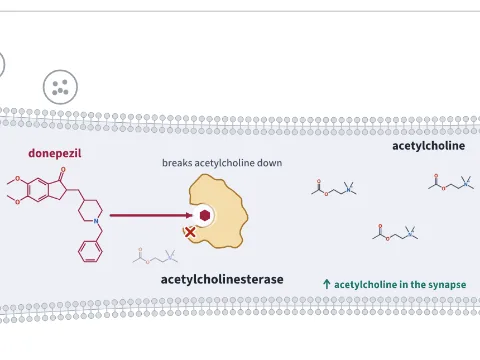
Donepezil blocks , the enzyme that breaks down acetylcholine, so more acetylcholine is available; there is no evidence it changes the course of the disease. It treats Alzheimer-type dementia.3
What the source says
“This is accomplished by increasing the concentration of acetylcholine through reversible inhibition of its hydrolysis by acetylcholinesterase.”
Source 3“There is no evidence that donepezil alters the course of the underlying dementing process.”
Source 3“ARICEPT is indicated for the treatment of dementia of the Alzheimer’s type.”
Source 3 - B
Lecanemab: amyloid plaques reduced
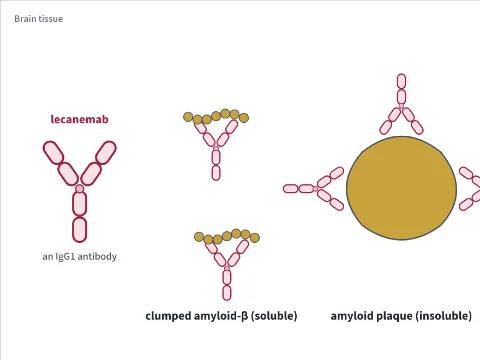
Lecanemab is an antibody against clumped amyloid-beta and reduces amyloid plaques; it is started at the stage of mild cognitive impairment or mild dementia.4
What the source says
“Lecanemab-irmb is a humanized immunoglobulin gamma 1 (IgG1) monoclonal antibody directed against aggregated soluble and insoluble forms of amyloid beta.”
Source 4“LEQEMBI reduces amyloid beta plaques”
Source 4“Treatment with LEQEMBI should be initiated in patients with mild cognitive impairment or mild dementia stage of disease”
Source 4
See also
Body system: brain & nerves.
Related medicines: memantine.
Sources
- 1Alzheimer disease: an update on pathobiology and treatment strategiesLong JM, Holtzman DM. Cell 2019 (abstract). Saved copy
- 2Alzheimer diseaseKnopman DS et al. Nat Rev Dis Primers 2021 (abstract). Saved copy
- 3Aricept (donepezil): FDA label1 Indications and Usage; 12.1 Mechanism of Action. Saved copy
- 4Leqembi (lecanemab): FDA label1 Indications and Usage; 12.1 Mechanism of Action. Saved copy
- 5Human acetylcholinesterase with donepezilPDB 4EY7; Cheung, J. et al. J.Med.Chem. 2012;55:10282-10286. The acetylcholinesterase outline in the drawing is traced from this structure. Saved copy
Notes and limits
- Other brain and blood vessel diseases change how much it affects a person.2
- Treatments that substantially change its course are still being sought.2
Notes that apply to every page are on How to read a page.
Spotted a mistake? Report an error (hello@openmechanism.com). Since launch, every published error we fix is listed on the corrections page.
Cite this page
Tran D. Alzheimer disease [Internet]. OpenMechanism; 2026 [updated 2026 Oct 16; cited 2026 Oct 16]. Available from: https://openmechanism.com/conditions/alzheimer-disease