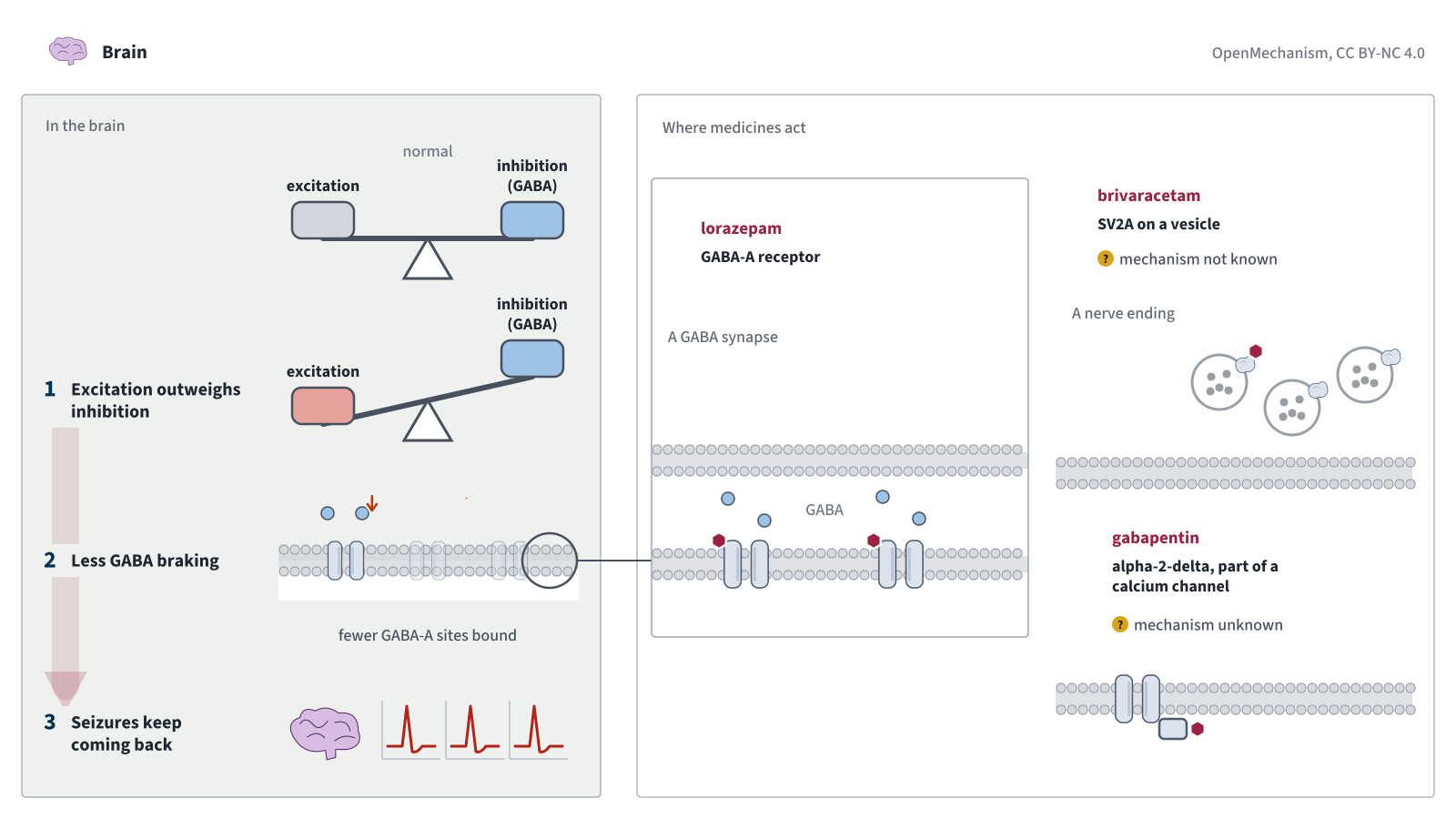
When GABA's inhibition no longer balances excitation, seizures may follow; less GABA braking has been found in human epileptic brain tissue. Epilepsy is seizures that keep coming back unprovoked. Brivaracetam binds SV2A on synaptic vesicles; lorazepam binds the benzodiazepine site of GABA-A receptors and strengthens GABA's inhibition; and gabapentin binds part of a calcium channel (in laboratory studies). The brivaracetam and gabapentin labels say exactly how these two work against seizures is not known.
What goes wrong in epilepsy, and where medicines act. Schematic, not to scale. License CC BY-NC 4.0.
?Mechanism not known
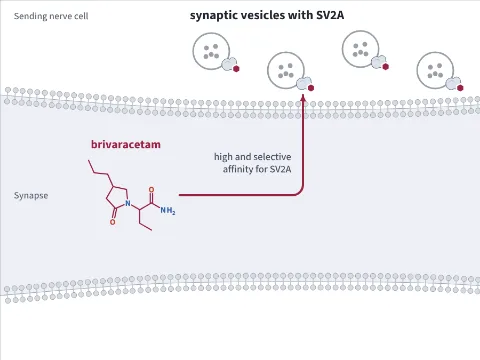
The Briviact (brivaracetam) label says: The precise mechanism by which BRIVIACT exerts its anticonvulsant activity is not known. Brivaracetam displays a high and selective affinity for synaptic vesicle protein 2A (SV2A) in the brain, which may contribute to the anticonvulsant effect.
Clinical study: In Klein and colleagues' 2015 randomized, double-blind trial in 768 adults with partial-onset seizures not controlled by one or two other medicines, who had not taken levetiracetam in the 90 days before, adding brivaracetam (100 or 200 mg a day) for 12 weeks lowered how often seizures came compared with placebo; the trial measured the effect, not how it works: Adjunctive BRV 100 and 200 mg/day was efficacious in reducing POS in adults without concomitant levetiracetam useKlein P et al., Epilepsia 2015 (PMID 26471380)
?Mechanism unknown
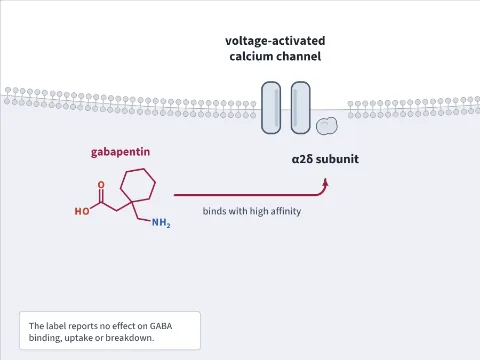
The Neurontin (gabapentin) label says: The precise mechanisms by which gabapentin produces its analgesic and antiepileptic actions are unknown. Gabapentin is structurally related to the neurotransmitter gamma-aminobutyric acid (GABA) but has no effect on GABA binding, uptake, or degradation. In vitro studies have shown that gabapentin binds with high-affinity to the α2δ subunit of voltage-activated calcium channels; however, the relationship of this binding to the therapeutic effects of gabapentin is unknown.
Clinical study: In Anhut and colleagues' 1994 randomized, double-blind 12-week trial in 272 people with partial seizures not controlled by one or two other medicines, more of those given gabapentin (900 mg a day) as an add-on had their seizures at least halved than those given placebo; the trial measured the effect, not how it works: Responder rate was 22.9% in the 900-mg/day group and 10.1% in the placebo group (p = 0.020, Fisher's exact test).Anhut H et al., Epilepsia 1994 (PMID 8082624)
Gamma-aminobutyric acid. The main inhibitory messenger in the central nervous system.
GABA-A receptor
Gamma-aminobutyric acid type A receptor. A receptor channel on nerve cells that GABA switches on; benzodiazepines also bind it.
SV2A
Synaptic vesicle protein 2A. A protein of synaptic vesicles in the brain.
What goes wrong
Excitation outweighs inhibition. In a person without epilepsy, a seizure is often explained as a loss of the normal balance between excitation and inhibition, while in epilepsy seizures usually arise in a nervous system that has already changed; , the cortex's main inhibitory messenger, normally keeps excitation in check.1,2
What the source says
“A common way to explain seizures in a normal individual is that a disruption has occurred in the normal balance of excitation and inhibition.”
“understanding seizures in the brain of an individual with epilepsy is more difficult because seizures are typically superimposed on an altered nervous system.”
“gamma-Aminobutyric acid (GABA), the principal inhibitory neurotransmitter in the cerebral cortex, maintains the inhibitory tone that counterbalances neuronal excitation. When this balance is perturbed, seizures may ensue.”
Seizures keep coming back. Epilepsy is defined by seizures that keep coming back unprovoked; in temporal lobe epilepsy, for example, genes, development and changes in nerve cells (neuronal plasticity) play major roles in creating an underlying state of overexcitability.1
What the source says
“the state of recurrent unprovoked seizures that defines epilepsy itself.”
“Using temporal lobe epilepsy as an example, it is clear that genes, developmental mechanisms, and neuronal plasticity play major roles in creating a state of underlying hyperexcitability.”
Binds , a protein of synaptic vesicles, strongly and selectively, which may contribute to its effect against seizures; the label says exactly how it works against seizures is not known.3
Used forPartial-onset seizures: 1 month of age and older
What the label says
“Brivaracetam displays a high and selective affinity for synaptic vesicle protein 2A (SV2A) in the brain, which may contribute to the anticonvulsant effect.”
Lorazepamtargets the benzodiazepine site of GABA-A receptors
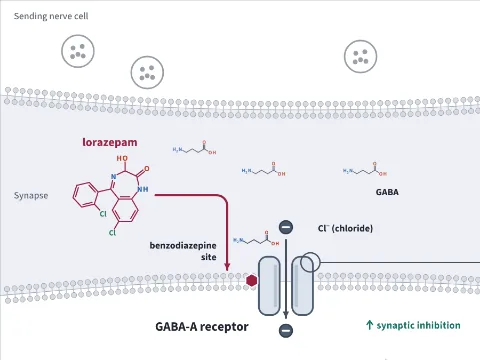
Binds the benzodiazepine site of GABA-A receptors in the brain and strengthens GABA's inhibition at synapses; its effects include less seizure activity.4,5
Used forStatus epilepticus: the injection
What the label says
“Lorazepam exerts its effect for the treatment of anxiety disorders through binding to the benzodiazepine site of the gamma-aminobutyric acid-A (GABA A ) receptors in the brain and enhances GABA-mediated synaptic inhibition.”
Gabapentintargets the alpha-2-delta part of calcium channels
Binds the alpha-2-delta part of voltage-gated calcium channels (in laboratory studies); the label says how this relates to its effect is unknown. It is related to GABA in structure but has no effect on GABA binding, uptake or breakdown.6
Used forPartial-onset seizures: add-on treatment, age 3 and older
What the label says
“The precise mechanisms by which gabapentin produces its analgesic and antiepileptic actions are unknown. Gabapentin is structurally related to the neurotransmitter gamma-aminobutyric acid (GABA) but has no effect on GABA binding, uptake, or degradation. In vitro studies have shown that gabapentin binds with high-affinity to the α2δ subunit of voltage-activated calcium channels; however, the relationship of this binding to the therapeutic effects of gabapentin is unknown.”
“Adjunctive therapy in the treatment of partial onset seizures, with and without secondary generalization, in adults and pediatric patients 3 years and older with epilepsy”
Also used for it: midazolam (“NAYZILAM is indicated for the acute treatment of intermittent, stereotypic episodes of frequent seizure activity (i.e., seizure clusters, acute repetitive seizures) that are distinct from a patient's usual seizure pattern in patients with epilepsy 12 years of age and older.”7); phenytoin (“treatment of generalized tonic-clonic (grand mal) and complex partial (psychomotor, temporal lobe) seizures”8); carbamazepine (“Tegretol is indicated for use as an anticonvulsant drug. Evidence supporting efficacy of Tegretol as an anticonvulsant was derived from active drug-controlled studies that enrolled patients with the following seizure types: Partial seizures with complex symptomatology (psychomotor, temporal lobe). … Generalized tonic-clonic seizures (grand mal). Mixed seizure patterns which include the above, or other partial or generalized seizures. Absence seizures (petit mal) do not appear to be controlled by Tegretol”9); oxcarbazepine (“monotherapy or adjunctive therapy in the treatment of partial-onset seizures in adults and as monotherapy in the treatment of partial-onset seizures in pediatric patients aged 4 years and above, and as adjunctive therapy in pediatric patients aged 2 years and above with partial-onset seizures”10); and ethosuximide (for absence (petit mal) epilepsy: “Ethosuximide is indicated for the control of absence (petit mal) epilepsy.”11).
text 4c13d622d342…; drawings 23d5b0a1ae80…; notes 704544bdd93f…
AI source check
Claude Opus 5.5 (AI source check), 4 November 2026: 45 statements compared with their sources, 8 flagged for the reviewer. An automated check, not a medical review.
Conflict of interest
Midazolam: Pfizer, the reviewer's former employer, makes or markets this medicine. Phenytoin: Pfizer, the reviewer's former employer, makes or markets this medicine. Details
Next review due
5 May 2028
Cite this page
Tran D. Epilepsy [Internet]. OpenMechanism; 2026 [updated 2026 Nov 4; cited 2026 Nov 4]. Available from: https://openmechanism.com/conditions/epilepsy