Patisiran
Patisiran is a carried to the liver in lipid particles. It leads to the breakdown of for transthyretin (), both normal and mutant, so less TTR protein is made; the label links this to fewer TTR deposits in tissues.
- Acts on
- Mutant and wild-type TTR messenger RNA
- Where
- Cells that make TTR
- Used for
- Brain & nerves
Also called Onpattro.
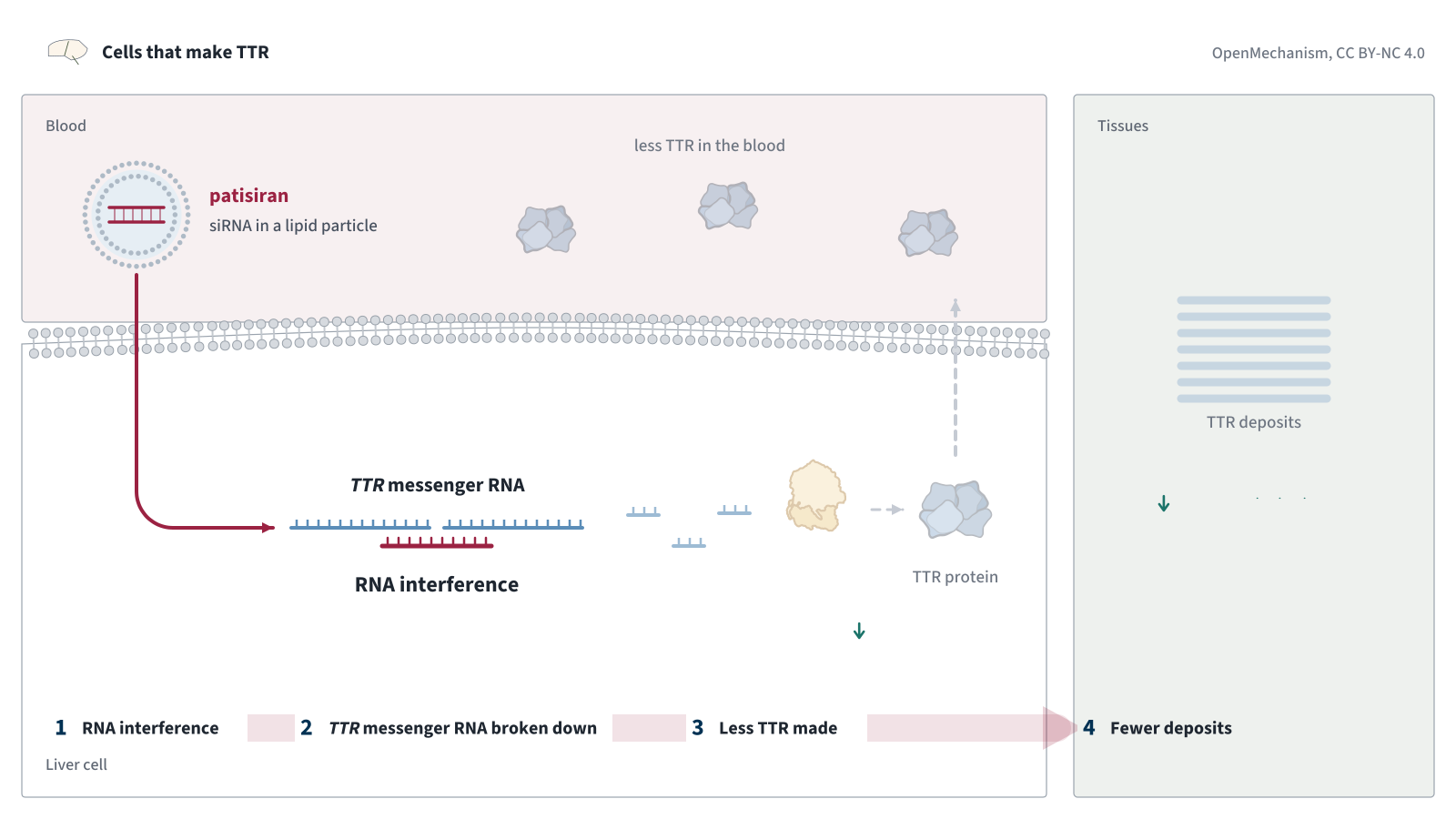
Key terms in this drawing
- mRNA
- Messenger RNA. A copy of a gene that a cell reads to make a protein.
- RNA
- Ribonucleic acid. A molecule copied from DNA; messenger RNA carries a gene's instructions.
- siRNA
- Small interfering RNA. A short double-stranded RNA that guides the cell to destroy a matching messenger RNA.
- TTR
- Transthyretin. A blood protein that can misfold and build up as amyloid.
How it works
RNA interference. Patisiran is a double-stranded siRNA acting through interference.1
TTR messenger RNA broken down. Both mutant and wild-type TTR mRNA are degraded.1
Less TTR made. Less TTR transcript availability reduces the serum TTR protein supply.1
Fewer deposits. The label links reduced TTR supply to reduced tissue TTR deposits.1
For teachers: download this drawing or build a slide deck.
Transcript
Hereditary ATTR amyloidosis is an inherited disease: a transport protein made by the liver misfolds and deposits in the nerves, the heart and other organs. This film shows how patisiran, a small interfering RNA, lowers that protein at its source.
The protein is transthyretin, TTR. Liver cells make most of it and secrete it into the blood, where four identical copies lock together into a tetramer that carries thyroxine and vitamin A. In the hereditary form, a single amino-acid change destabilizes the tetramer: the copies grip each other less tightly and the complex comes apart more often. A copy on its own cannot hold its shape; it refolds into a sticky form. Coming apart is the rate-limiting step.
Sticky copies stack into amyloid fibrils, insoluble fibers that build up outside cells, in nerves, heart muscle and elsewhere.
Damage begins in the longest nerves, so the first symptoms are in the feet: numbness, pain and weakness that climb over the years. Autonomic nerves fail too. Untreated, the disease is progressive and fatal.
Because the liver makes most of the TTR in the blood, the supply can be cut at the factory. Patisiran does this by RNA interference: it removes the instructions for making the protein.
Patisiran is a short double-stranded RNA carried inside a lipid nanoparticle, a droplet of fats built to deliver RNA into liver cells. In the bloodstream the particle picks up apolipoprotein E, a protein the body uses to send fats to the liver. Liver cells recognize it through their LDL receptors and pull the particle inside, into a pouch called an endosome. The cell acidifies that pouch. At blood pH the particle's key lipid carries no charge; in acid it becomes protonated, picking up a hydrogen ion and a positive charge. The now cationic lipid pairs with the negatively charged lipids of the pouch's membrane, the membrane loses its structure, and the siRNA slips out into the cytoplasm.
There the siRNA is loaded into RISC, the RNA-induced silencing complex: the cell's own machinery for switching genes off, which the medicine borrows. The passenger strand is cut and discarded; the guide strand stays bound to the cutting enzyme, Argonaute 2. Argonaute 2 scans messenger RNAs, the working copies of genes, for a match to its guide. Patisiran's guide matches a stretch of the TTR message that is identical in every variant and in the normal gene, so one medicine works for every family. When the match forms, Argonaute 2 cuts.
A cut message is degraded and never translated into protein. The complex lets go and finds the next copy: one guide directs many cuts.
With its message gone, each liver cell makes less transthyretin and the blood level falls. In clinical studies, serum TTR fell by about 80 percent within two weeks of a single dose and stayed about 84 percent lower at 18 months. Less TTR in the blood means less raw material reaching nerves and heart, and tissue deposits decline.
Does that change the disease? In the APOLLO trial, 225 adults with the polyneuropathy were randomized two to one to patisiran or placebo for 18 months. The primary measure was mNIS+7, a nerve-impairment score; higher means worse. On placebo the score worsened by 28 points. On patisiran it improved by 6: a difference of 34 points, with a confidence interval that excluded no effect.
Quality of life on the Norfolk questionnaire, where higher also means worse, moved the same way: a difference of 21 points in patisiran's favor.
Cutting the supply did not merely slow the nerve damage; on average the score improved.
Patisiran does not repair the gene or stabilize the protein. It works one step earlier, by removing the message: silencing TTR at its source.
Sources for the video
- 1
- 2
- 3
- 4Akinc A, et al. Nat Nanotechnol 2019;14:1084–87PMID 31802031. Saved copy
- 5Akinc A, et al. Mol Ther 2010;18:1357–64PMID 20461061. Saved copy
- 6
- 7Matranga C, et al. Cell 2005;123:607–20PMID 16271386. Saved copy
- 8Liu J, et al. Science 2004;305:1437–41PMID 15284456. Saved copy
- 9Hutvágner G, Zamore PD. Science 2002;297:2056–60PMID 12154197. Saved copy
- 10Hammarström P, et al. Science 2003;299:713–16PMID 12560553. Saved copy
- 11
- 12Ruberg FL, et al. JAMA 2024PMID 38441582. Saved copy
- 13Ando Y, et al. Orphanet J Rare Dis 2013;8:31PMID 23425518. Saved copy
- 14Johnson SM, et al. Acc Chem Res 2005;38:911–21PMID 16359163. Saved copy
- 15
- 16
- 17
- 18Wan C, et al. Drug Deliv Transl Res 2014;4:74–83PMID 25786618. Saved copy
- 19Hafez IM, et al. Gene Ther 2001;8:1188–96PMID 11509950. Saved copy
- 20Zhang X, et al. J Clin Pharmacol 2020;60:37–49PMID 31322739. Saved copy
More detail
Delivery to the liver, and silencing TTR
An siRNA in a lipid nanoparticle. Patisiran is siRNA formulated in a lipid nanoparticle, with hepatic TTR synthesis as its therapeutic target.2
Goes mainly to the liver. After intravenous delivery, patisiran distributes primarily to the liver; most circulating patisiran remains lipid-associated.1
TTR messenger RNA broken down. RNA interference mediates degradation of wild-type and mutant TTR mRNA.1
Less TTR protein in the blood. TTR mRNA degradation reduces serum TTR protein.1
What the source says
“Patisiran is an RNA interference therapeutic comprising a novel, small interfering ribonucleic acid (ALN-18328) formulated in a lipid nanoparticle targeted to inhibit hepatic transthyretin protein synthesis.”
Source 2
“ONPATTRO distributes primarily to the liver.”
Source 1
“Patisiran is a double-stranded siRNA that causes degradation of mutant and wild-type TTR mRNA through RNA interference, which results in a reduction of serum TTR protein and TTR protein deposits in tissues.”
Source 1
The APOLLO trial
Nerve scores and quality of life better than with placebo. APOLLO showed better 18-month neuropathy and quality-of-life changes with patisiran than placebo in adult hATTR polyneuropathy.3
What the source says
“In this trial, patisiran improved multiple clinical manifestations of hereditary transthyretin amyloidosis.”
Source 3
Less vitamin A in the blood
Vitamin A and its carrier protein fall. TTR carries retinol-binding protein; patisiran treatment lowers measured serum retinol-binding protein and vitamin A.1
How the body clears it
Infusion reactions
Antibodies against the medicine
Few, short-lived antibodies, with no effect seen. APOLLO analysis found low transient anti-drug antibodies (3.4%), with no observed impact on PK, PD, efficacy or safety.2
What the source says
“Incidence of antidrug antibodies was low (3.4%) and transient, with no impact on PK, PD, efficacy, or safety.”
Source 2
See also
Condition pages: hereditary transthyretin amyloidosis.
More medicines for brain & nerves: acetaminophen, alprazolam, amitriptyline, amphetamine, aripiprazole, atomoxetine, brivaracetam, buprenorphine and 67 more.
Body system: brain & nerves.
Sources
- 1Onpattro (patisiran): FDA label12.1 Mechanism of Action; §11 composition; §12.1; §12.2; §12.3 distribution/metabolism; §5.1–5.2; 5.1 Infusion-Related Reactions; 6.1 Clinical Trials Experience
- 2Patisiran Pharmacokinetics, Pharmacodynamics, and Exposure-Response Analyses in the Phase 3 APOLLO Trial in Patients With Hereditary Transthyretin-Mediated (hATTR) AmyloidosisZhang X et al., J Clin Pharmacol 2020 (abstract)
- 3Patisiran, an RNAi Therapeutic, for Hereditary Transthyretin AmyloidosisAdams D et al., N Engl J Med 2018 (abstract)
Also used on this page
The ribosome and TTR outlines are traced from the electron microscopy and crystal structures below.
- 4Human ribosome decoding an mRNAPDB 8G60; Holm, M. et al. Nature 2023; 617:200-207
- 5Human transthyretin (TTR) tetramer with tafamidis in its two thyroxine-binding sitesPDB 3TCT; Bulawa, C.E. et al. Proc.Natl.Acad.Sci.USA 2012; 109:9629-9634
Spotted a mistake? Report an error (hello@openmechanism.com). Since launch, every published error we fix is listed on the corrections page.
Notes and limits
- A schematic teaching drawing: not to scale, not exact structures, binding poses or a complete pathway, and not a guide to dosing, treatment or how a person will respond.
- The steps are in the order that explains them; one step is said to cause the next only where the source says so.
- Patisiran lipid nanoparticles are distinct from inclisiran GalNAc/ASGPR targeting.
- Exact formulation salt record is mapped to patisiran sodium; no sequence/salt equivalence is inferred for other nodes.
- No receptor-specific uptake, endosomal escape route, or molecular pose is inferred from the selected sources.
- No acquired resistance mechanism is established by these snapshots; low transient ADA showed no observed impact in APOLLO.
- Clinical outcome scope is adult hereditary ATTR amyloidosis with polyneuropathy, not all amyloidosis.
- This is not a visual claim that every existing amyloid deposit vanishes immediately.
- The chosen mechanism text does not quantify lipid-particle trafficking or intracellular escape.
All recorded limits are on the evidence page, and notes that apply to every page are on How to read a page. Version 1.1.0, not yet medically reviewed.
Cite this page
Tran D. Patisiran [Internet]. OpenMechanism; 2026 [updated 2026 Oct 16; cited 2026 Oct 16]. Available from: https://openmechanism.com/medicines/patisiran